Depreciation Recapture Calculator for Rental Property (2026)
Depreciation recapture is the part of your gain on a rental sale that comes from the depreciation you took (or could have taken). On a residential rental, that part is taxed at your regular income tax rate, but never more than 25%. The rest of the gain is taxed as a long term capital gain at 0%, 15% or 20%. Enter your numbers below to estimate both parts and your federal tax on the sale.
Depreciation Recapture Calculator
Don’t know your depreciation total? Get a rough estimate
Rough estimate:
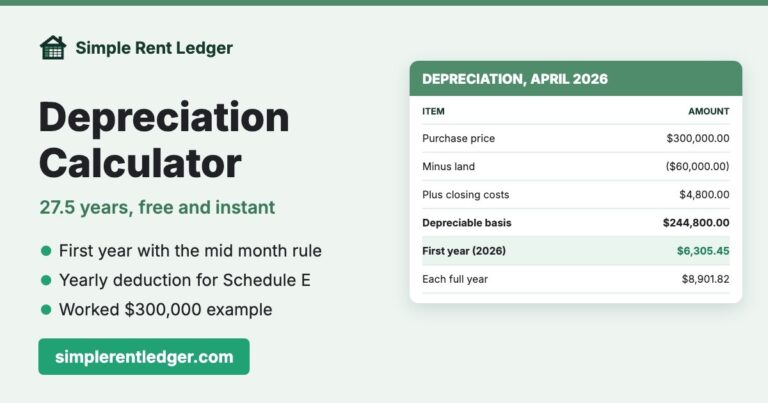
Straight line over 27.5 years, full years only. For the exact first year amount, use our rental depreciation calculator or your past Schedule E forms (line 18).
What is depreciation recapture?
Every year you own a rental, depreciation lowers your taxable rental income. It also lowers your basis in the property. When you sell, a lower basis means a bigger gain. The IRS taxes the part of that gain that came from depreciation at a special rate. That is what landlords call depreciation recapture.
For a residential rental placed in service after 1986, the IRS name for it is unrecaptured section 1250 gain. Rentals are depreciated with the straight line method, so there is no extra “section 1250 recapture” taxed as ordinary income. The whole depreciation part gets the special rate with a 25% cap.
How is depreciation recapture calculated?
- Amount realized: sale price minus selling costs such as the agent commission and closing costs.
- Adjusted basis: what you paid, plus closing costs added to basis, plus improvements, minus all depreciation taken or allowable.
- Total gain: amount realized minus adjusted basis.
- Depreciation recapture: the smaller of your total gain or your total depreciation. This part is taxed at up to 25%.
- The rest of the gain is a long term capital gain if you owned the rental more than 1 year.
Example: selling a rental after 10 years
Linda Park bought a single family rental in Fresno, California for $250,000 and added $4,000 of closing costs to her basis. Over 10 years she deducted $72,000 of depreciation on Schedule E. In 2026 she sells it for $400,000 and pays $24,000 in commission and closing costs. She is in the 24% bracket and her long term capital gains rate is 15%.
| Item | Amount |
|---|---|
| Sale price | $400,000.00 |
| Minus selling costs | ($24,000.00) |
| Amount realized | $376,000.00 |
| Purchase price plus closing costs | $254,000.00 |
| Minus depreciation taken | ($72,000.00) |
| Adjusted basis | $182,000.00 |
| Total gain ($376,000 minus $182,000) | $194,000.00 |
| Depreciation recapture at 24%: $72,000 | $17,280.00 |
| Rest of the gain at 15%: $122,000 | $18,300.00 |
| Estimated federal tax on the sale | $35,580.00 |
If Linda were in the 32% bracket, her recapture would still be taxed at only 25% ($18,000), because of the cap. State income tax would come on top. California, for example, taxes the gain as regular income.
What is the depreciation recapture tax rate?
For residential rentals, the depreciation part of the gain is taxed at your regular income tax rate, with a maximum of 25%. If you are in the 10%, 12%, 22% or 24% bracket, that rate is usually your bracket. If you are in the 32%, 35% or 37% bracket, it is capped at 25%.
The rest of the gain uses the long term capital gains rates. For 2026 sales, the IRS set these taxable income limits:
| Filing status (2026) | 0% up to | 15% up to | 20% above |
|---|---|---|---|
| Single | $49,450 | $545,500 | $545,500 |
| Married filing jointly | $98,900 | $613,700 | $613,700 |
| Head of household | $66,200 | $579,600 | $579,600 |
| Married filing separately | $49,450 | $306,850 | $306,850 |
A big gain can push you into a higher bracket in the year of the sale, so look at your total taxable income including the gain. Higher earners may also owe the 3.8% net investment income tax on the gain if their modified adjusted gross income is over $200,000 (single or head of household) or $250,000 (married filing jointly).
What if you never took depreciation?
You still have recapture. The IRS reduces your basis by the depreciation you took or could have taken, so skipping it does not avoid the tax. It only means you lost the yearly deductions. If you missed depreciation in past years, ask a tax professional about catching it up with a change in accounting method (Form 3115) before you sell. This is one more reason to track depreciation every year in your rent ledger.
Can you avoid or delay depreciation recapture?
- 1031 exchange: if you trade into another investment property under the like kind exchange rules, you can put off the tax on the gain, including the recapture, until you later sell without an exchange. The rules and deadlines are strict, so plan it before you list the property.
- Your former home: if you lived in the property as your main home for 2 of the last 5 years, you may exclude part of the gain. The exclusion does not cover depreciation claimed after May 6, 1997, so that part is still taxed.
- Installment sale: if the buyer pays you over several years, the gain is spread out, but the depreciation part is generally counted first.
- Suspended passive losses: rental losses you could not deduct in past years are usually released when you sell the whole property, which can lower the tax. See why you can’t always deduct rental losses.
Where do you report it?
You report the sale of a rental on Form 4797. The gain then flows to Schedule D, and the Unrecaptured Section 1250 Gain Worksheet in the Schedule D instructions figures the part taxed at up to 25%. Keep your purchase papers, improvement receipts and every year’s Schedule E so you can prove your basis and depreciation. Our landlord record keeping guide lists what to keep.
This calculator gives a federal estimate. It assumes a residential rental held more than 1 year and depreciated with the straight line method. It does not include state tax, a 1031 exchange, an installment sale, the home sale exclusion or suspended losses, and it applies the 3.8% tax to the whole gain as a simple estimate, which can overstate it (see the exact rule on our capital gains tax page). Ask a tax professional before you sell.
Thinking about selling instead? Our rent vs sell calculator compares selling now with keeping the rental, after recapture and capital gains tax.
Frequently asked questions
Is depreciation recapture always 25%?
No. For residential rentals, 25% is the maximum. If your regular tax bracket is lower, such as 12% or 22%, the recapture is usually taxed at that lower rate.
Do I pay depreciation recapture if I sell at a loss?
No. Recapture only applies when you have a gain. If your gain is smaller than your total depreciation, only the gain is taxed as recapture.
Does land get depreciation recapture?
No. Land is never depreciated, so there is nothing to recapture on the land. Only the building and improvements you depreciated count.
Does a 1031 exchange avoid depreciation recapture?
It delays it. In a qualifying like kind exchange, the gain, including the depreciation part, is postponed until you sell the replacement property without another exchange.
What form do I use for depreciation recapture?
Form 4797 reports the sale. The amount taxed at up to 25% is figured with the Unrecaptured Section 1250 Gain Worksheet in the Schedule D instructions.
Sources
- IRS Topic 409, Capital gains and losses (25% maximum on unrecaptured section 1250 gain)
- IRS Revenue Procedure 2025-32, 2026 capital gains rate limits (section 4.03)
- IRS: Instructions for Form 4797 (no section 1250 recapture for 27.5 year residential rental property)
- IRS: Instructions for Schedule D, Unrecaptured Section 1250 Gain Worksheet
- IRS Publication 544, Sales and Other Dispositions of Assets
- IRS Publication 527, Residential Rental Property
- IRS Publication 523, Selling Your Home (depreciation after May 6, 1997)
- IRS Topic 559, Net investment income tax