
Capital Gains Tax on Rental Property: Free Calculator for Selling a Rental (2026)
When you sell a rental property you owned more than 1 year, your federal tax on the gain has up to three parts: depreciation recapture taxed at up to 25%, the rest of the gain taxed as a long term capital gain at 0%, 15% or 20%, and a 3.8% net investment income tax if your income is high. Enter your numbers below to estimate each part with the 2026 IRS tax brackets.
Capital gains tax calculator for selling a rental (2026)
Taxable income is your income after deductions, without this sale (see last year’s Form 1040 as a guide). Adjusted gross income is used only for the 3.8% tax. Don’t know your depreciation total? Use our depreciation recapture calculator to estimate it.
Amount realized (sale price minus selling costs):
Adjusted basis (cost plus improvements minus depreciation):
Total gain:
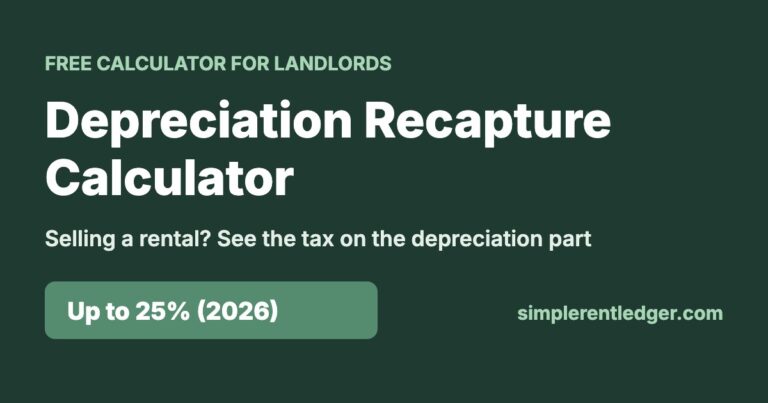
Depreciation recapture: , tax (your bracket, capped at 25%)
Long term capital gain: , tax
Short term gain taxed as regular income:
Net investment income tax (3.8%):
Estimated federal tax on the sale:
That is of your gain. You keep about after federal tax (before paying off any mortgage).
No gain on these numbers, so there is no capital gains tax on the sale. A loss on a rental sale follows different rules, so check with a tax professional.
How is the sale of a rental property taxed?
Your gain is split into layers, and each layer has its own rate:
| Part of the gain | Federal rate |
|---|---|
| Depreciation recapture (the depreciation you took or could have taken) | Your regular rate, never more than 25% |
| The rest of the gain, owned more than 1 year | 0%, 15% or 20% |
| The whole gain, owned 1 year or less | Your regular rate, 10% to 37% |
| Net investment income tax, only above the income limits | 3.8% |
The capital gains rate is not picked from one number. The gain sits on top of your other income, so part of it can fall in the 0% range and part in the 15% range. The calculator above does that stacking for you.
How do you figure your gain?
- Amount realized: sale price minus selling costs such as the agent commission, title fees and transfer taxes you paid.
- Adjusted basis: purchase price, plus closing costs added to basis, plus improvements (a new roof, an addition, new HVAC), minus all depreciation taken or allowable.
- Gain: amount realized minus adjusted basis.
Your mortgage balance does not change the gain. Paying off the loan at closing reduces the cash you take home, not the tax. For a deeper look at the depreciation part, see depreciation recapture on a rental.
Example: selling a duplex in Florida
Marcus and Dana Reed are married and file jointly. They bought a duplex in Cape Coral, Florida for $300,000, added $5,000 of closing costs to their basis and put on a $15,000 roof. Over the years they deducted $95,000 of depreciation. In 2026 they sell for $520,000 and pay $31,000 in commission and closing costs. Without the sale, their taxable income is $110,000 and their adjusted gross income is $140,000.
| Item | Amount |
|---|---|
| Sale price minus selling costs | $489,000.00 |
| Purchase price, closing costs and roof | $320,000.00 |
| Minus depreciation | ($95,000.00) |
| Adjusted basis | $225,000.00 |
| Total gain | $264,000.00 |
| Depreciation recapture: $95,000 in the 22% bracket | $20,900.00 |
| Long term capital gain: $169,000 at 15% | $25,350.00 |
| Net investment income tax: 3.8% of $154,000 (income over $250,000) | $5,852.00 |
| Estimated federal tax on the sale | $52,102.00 |
That is about 19.7% of their gain. Florida has no state income tax, so this is their whole income tax bill on the sale. If they lived in California, state tax would come on top.
2026 capital gains tax rates
These are the IRS taxable income limits for long term capital gains in 2026, including the gain itself:
| Filing status (2026) | 0% up to | 15% up to | 20% above |
|---|---|---|---|
| Single | $49,450 | $545,500 | $545,500 |
| Married filing jointly | $98,900 | $613,700 | $613,700 |
| Head of household | $66,200 | $579,600 | $579,600 |
| Married filing separately | $49,450 | $306,850 | $306,850 |
The 3.8% net investment income tax applies to the smaller of your investment income (including the gain) or the amount your modified adjusted gross income is over $200,000 (single or head of household), $250,000 (married filing jointly) or $125,000 (married filing separately).
How can you lower the tax when you sell?
- Count every improvement. A new roof, windows or a remodel raises your basis and lowers the gain. Dig out the receipts now. Repairs you already deducted don’t count twice. See repairs vs improvements.
- Include all selling costs: commission, title and escrow fees, transfer taxes and legal fees paid at closing.
- Hold more than 1 year. A gain on a rental owned 1 year or less is taxed at your regular rates.
- Use released losses. Rental losses you could not deduct in past years are usually allowed when you sell your whole interest. See why you can’t always deduct rental losses.
- Do a 1031 exchange. Trading into another investment property under the like kind exchange rules postpones the tax. The deadlines are strict, so set it up before closing.
- Spread it out with an installment sale. If the buyer pays you over several years, you report the gain as you receive payments, which can keep you in lower brackets. The depreciation part is generally counted first.
- Check the home sale exclusion. If you lived in the property as your main home for 2 of the last 5 years, you may exclude up to $250,000 of gain ($500,000 married filing jointly). Depreciation after May 6, 1997 is still taxed, and years it was a rental before you moved in can reduce the exclusion. IRS Publication 523 explains the rules.
What about state taxes?
Most states tax the gain too, and many tax it like regular income. California is one of them. Texas and Florida have no state income tax. If the rental is in a different state from where you live, the state where the property is located may also tax the gain. The calculator above shows federal tax only.
Where do you report the sale?
Report the sale of a rental on Form 4797. The gain then flows to Schedule D (Form 1040), and the net investment income tax goes on Form 8960. Keep your closing statements from the purchase and the sale, your improvement receipts and every year’s Schedule E. Our landlord record keeping guide lists what to keep and for how long.
This calculator gives a federal estimate. It uses the 2026 IRS brackets and assumes a residential rental depreciated with the straight line method. It stacks the gain on your other taxable income in a simplified way and does not include state tax, a 1031 exchange, an installment sale, the home sale exclusion, suspended losses or credits. Ask a tax professional before you sell.
Not sure whether to sell at all? Try the rent vs sell calculator to compare selling now with keeping the property.
Frequently asked questions
How much tax do you pay when you sell a rental property?
It depends on your gain, your depreciation and your other income. For a rental owned more than 1 year, the depreciation part is taxed at up to 25%, the rest at 0%, 15% or 20%, plus 3.8% for higher incomes, plus any state tax.
Is the sale of a rental property a capital gain?
Mostly, yes. The part of the gain from depreciation is taxed at up to 25%. The rest is a long term capital gain if you owned the property more than 1 year, or regular income if you owned it 1 year or less.
Does paying off the mortgage reduce capital gains tax?
No. The gain is based on your adjusted basis, not on what you still owe. Paying off the loan only reduces the cash you receive at closing.
Can I avoid capital gains tax on a rental property?
You can postpone it with a 1031 exchange, spread it with an installment sale, or exclude part of it if the property was your main home for 2 of the last 5 years. Depreciation after May 6, 1997 is still taxed under the home sale exclusion.
What form do I use to report selling a rental?
Form 4797 reports the sale. The gain flows to Schedule D, and the net investment income tax, if any, goes on Form 8960.
Sources
- IRS Revenue Procedure 2025-32, 2026 tax brackets (section 4.01) and capital gains limits (section 4.03)
- IRS Topic 409, Capital gains and losses
- IRS Topic 559, Net investment income tax
- IRS Publication 544, Sales and Other Dispositions of Assets
- IRS Publication 527, Residential Rental Property
- IRS Publication 523, Selling Your Home
- IRS: Instructions for Form 4797
- IRS: Instructions for Schedule D (Form 1040)