Why Can’t I Deduct My Rental Property Losses? Passive Loss Rules Explained
You usually can’t deduct a rental property loss because the IRS treats rental real estate as a passive activity, and passive losses can generally only offset passive income. The big exception: if you actively participate in managing the rental, you can deduct up to $25,000 of rental losses against your wages and other income. That allowance shrinks once your modified adjusted gross income (MAGI) passes $100,000 and is gone at $150,000. Losses you can’t use are not lost. They carry forward to future years and are generally released when you sell the property.
6 reasons you can’t deduct your rental loss
- Your income is too high. The $25,000 allowance phases out between $100,000 and $150,000 of MAGI. Above $150,000, most landlords can’t deduct a rental loss against other income that year (IRS Publication 925).
- You have no passive income to offset it. Passive losses can always offset passive income, such as profit from another rental. Without the allowance and without passive income, the loss waits.
- You don’t actively participate. Active participation means you own at least 10% of the property and make real management decisions, such as approving tenants, setting the rent or approving repairs. Limited partners don’t qualify.
- You used the home yourself too much. If your personal use is more than the greater of 14 days or 10% of the days you rent it at a fair price, the IRS treats it as a residence. Your rental expenses can’t be more than your rental income, so there is no loss to deduct (IRS Topic 415).
- You file married filing separately and lived with your spouse. If you lived together at any time during the year, the $25,000 allowance does not apply at all. If you lived apart all year, the limit is $12,500.
- Your rental is a short term rental. If the average guest stays 7 days or less, the IRS does not treat it as a rental activity for these rules, and the $25,000 allowance does not apply. Different rules decide whether the loss is passive.
The $25,000 allowance and the phaseout
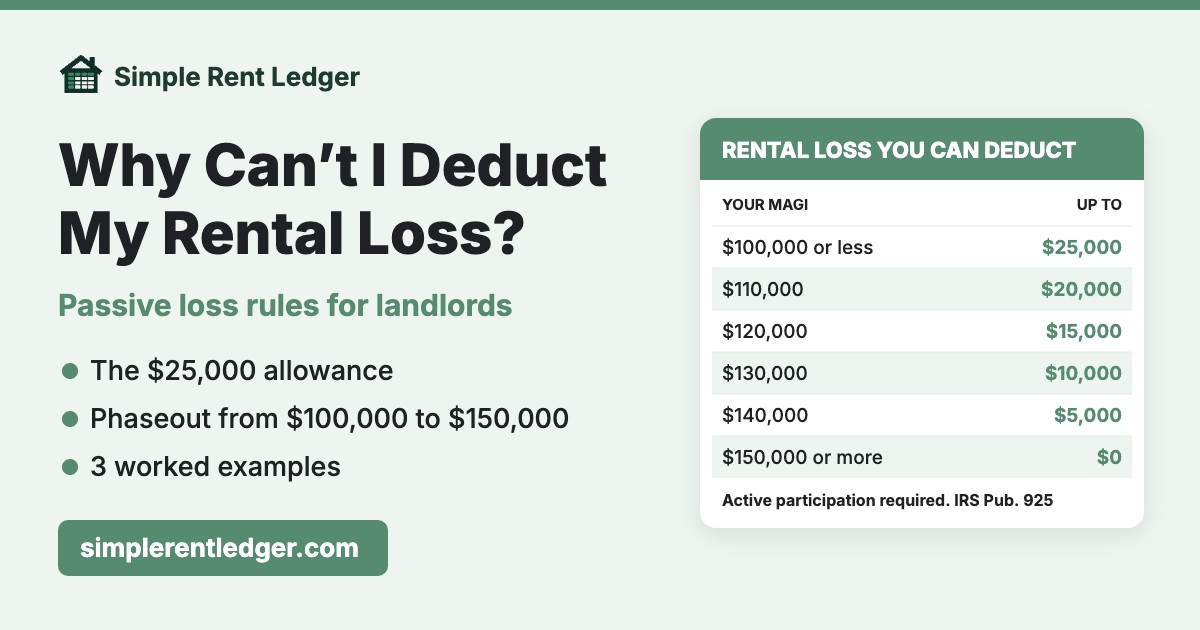
If you actively participate, you can deduct up to $25,000 of rental real estate losses against nonpassive income, such as wages. The allowance drops by 50 cents for every dollar of MAGI above $100,000 (Publication 925).
| Your MAGI | Maximum rental loss you can deduct against other income |
|---|---|
| $100,000 or less | $25,000 |
| $110,000 | $20,000 |
| $120,000 | $15,000 |
| $130,000 | $10,000 |
| $140,000 | $5,000 |
| $150,000 or more | $0 |
MAGI for this rule starts with your adjusted gross income and adds back certain items, such as IRA deductions and student loan interest. The Form 8582 instructions list them.
3 worked examples
Each example is a landlord who actively participates, owns one rental and has no other passive income.
Example 1: Income under $100,000
Rosa earns $90,000 in wages. Her duplex shows a $8,000 loss on Schedule E after mortgage interest, repairs and depreciation. Her MAGI is under $100,000 and the loss is under $25,000, so she deducts the full $8,000 against her wages.
Example 2: Income in the phaseout
Marcus has MAGI of $130,000 and a $14,000 rental loss. His allowance is $25,000 minus 50% of $30,000 (the amount over $100,000), which is $10,000. He deducts $10,000 this year and carries the other $4,000 forward.
Example 3: Income over $150,000
Dana and Lee file jointly with MAGI of $160,000 and a $12,000 rental loss. Their allowance is $0, so the full $12,000 carries forward. They can use it against future rental profit, or when they sell the property.
Planning to sell? Estimate the tax on the sale, including depreciation recapture, with our depreciation recapture calculator.
| Rosa | Marcus | Dana and Lee | |
|---|---|---|---|
| MAGI | $90,000 | $130,000 | $160,000 |
| Rental loss | $8,000 | $14,000 | $12,000 |
| Allowance | $25,000 | $10,000 | $0 |
| Deducted this year | $8,000 | $10,000 | $0 |
| Carried forward | $0 | $4,000 | $12,000 |
What happens to the losses you can’t use
They are suspended, not lost. You carry them forward to the next year, and you can use them when (IRS Topic 425):
- The rental makes a profit in a later year, or you have other passive income
- Your income drops enough for the $25,000 allowance to apply again
- You sell or otherwise dispose of your entire interest in the property, generally in a fully taxable sale to an unrelated buyer. Then the suspended losses from that property are generally deductible in full
Keep claiming depreciation. Even when your loss is suspended, you still take depreciation each year. It adds to the suspended loss, and the IRS reduces your cost basis by the depreciation you were allowed to take, whether you claimed it or not.
The real estate professional exception
If you qualify as a real estate professional, your rental losses are not passive, as long as you materially participate in the rentals. To qualify, both must be true for the year:
- More than half of the personal services you performed in all jobs and businesses were in real property trades or businesses where you materially participated
- You performed more than 750 hours of services in those real property businesses
Most landlords with a full time job outside real estate do not qualify. Keep a time log if you think you do, because the IRS often asks for proof.
Do you need Form 8582?
Form 8582 figures how much passive loss you can deduct. Per the 2025 instructions, you do not need to file it if all of these are true:
- Your only passive activities are rental real estate in which you actively participated
- You have no passive credits this year and no unallowed passive losses or credits from prior years
- Your total rental loss is $25,000 or less ($12,500 if married filing separately and you lived apart all year)
- Your MAGI is $100,000 or less ($50,000 if married filing separately)
- You don’t hold the rental as a limited partner or as the beneficiary of an estate or trust
Otherwise, Form 8582 goes with your return, and the allowed loss flows to Schedule E. Tax software fills it in from your answers.
Records to keep each year
- Your Schedule E income and expenses by line. Our Schedule E guide and rental expense spreadsheet show how to sort them
- Depreciation for each property, every year. Try our rental depreciation calculator
- The suspended loss carried forward for each property, by year, so you can claim it later or when you sell
- Proof of active participation: tenant approvals, rent decisions and repair approvals with dates
Our free rent ledger template builds a year end summary by Schedule E line, which makes this much faster.
Tax note: these rules have more exceptions than one article can cover, and your situation may differ. Use the IRS sources below and talk to a tax professional before you file.
Work in real estate most of the year? Check whether you meet the IRS real estate professional status tests.
Not sure how the rent itself is taxed, even with a mortgage? Read how rental income is taxed.
Frequently asked questions
Why can’t I deduct my rental property loss?
Rental real estate is a passive activity, so losses generally offset only passive income. The $25,000 allowance for active participants phases out between $100,000 and $150,000 of MAGI. Above that, the loss usually carries forward.
Can rental losses offset W-2 income?
Yes, up to $25,000 a year if you actively participate and your MAGI is $100,000 or less. The amount shrinks between $100,000 and $150,000 of MAGI.
Do unused rental losses expire?
No. They carry forward to future years. You can use them against future passive income, when your income qualifies for the allowance, or generally in full when you sell your entire interest in a fully taxable sale.
What counts as active participation?
Owning at least 10% of the property and making management decisions such as approving tenants, setting the rent or approving repairs. You can hire a manager and still actively participate if you make those decisions.
Do I need to file Form 8582?
Not if your only passive activities are rentals you actively participate in, your total loss is $25,000 or less, your MAGI is $100,000 or less, and you have no prior year unallowed losses. Otherwise, yes.