Schedule E for Small Landlords: Line by Line Guide (2026 Tax Year)
Schedule E (Form 1040) is the form where you report your rental income (the rent you received) and the expenses you paid for each rental property. Part I has one column per property (A, B and C). For each one you list rents on line 3, expenses on lines 5 to 19, and the profit or loss on line 21. The total then moves to Schedule 1 of your Form 1040. Below is every line a small landlord uses, with a filled in example.
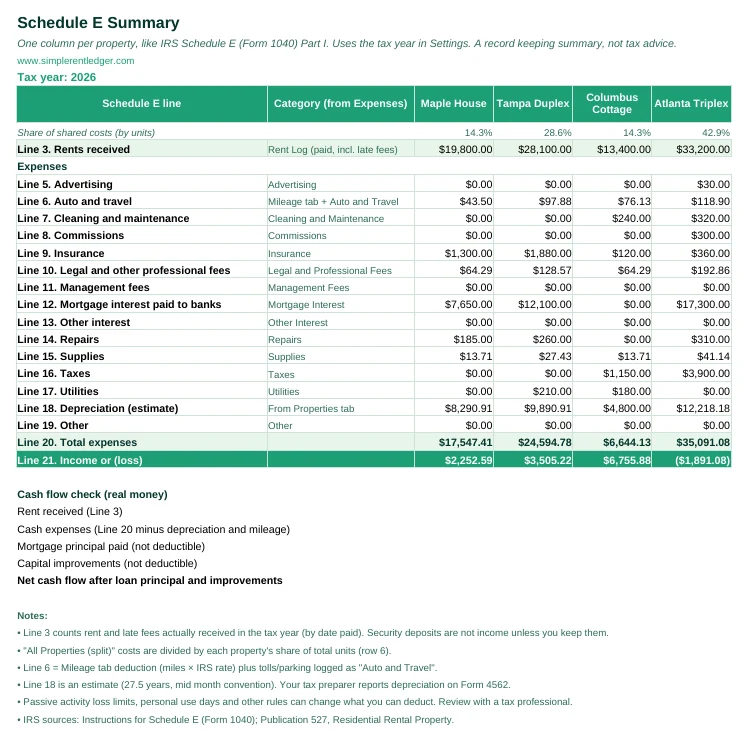
Need a Schedule E rental income worksheet? Our free rent ledger template (Excel and Google Sheets) adds up your rent and expenses for the year in a summary grouped by Schedule E line, so you can copy the totals onto the form. If you have several units, a monthly rent roll makes the year end rent totals easy to check.
Which year is this for? Your 2026 rental income is reported on the return you file in early 2027, due 04/15/2027. The line numbers below follow the current Schedule E. The IRS rarely changes them, but check the 2026 form when it is released.
Who needs to file Schedule E?
You generally file Schedule E if you own a house, condo, duplex, triplex or fourplex in your own name (or through a single member LLC that you report on your personal return) and you rent it out. If you provide hotel style services, such as daily cleaning or meals, the rules can be different. Most small long term landlords use Schedule E.
What goes at the top of Part I?
| Line | What to enter |
|---|---|
| 1a | The full street address of each property |
| 1b | Type of property code. Use 1 for a single family home and 2 for a multi family building such as a duplex |
| 2 | Fair rental days (days rented at market rent) and personal use days. For a normal year round rental, personal use days are 0 |
| QJV box | Check only if you and your spouse elect to be a qualified joint venture |
Line by line: income and expenses
| Line | Name | What goes here |
|---|---|---|
| 3 | Rents received | All rent, late fees, advance rent, lease cancellation fees, and expenses the tenant paid for you |
| 4 | Royalties | Leave blank for a normal rental |
| 5 | Advertising | Listings, signs, ads |
| 6 | Auto and travel | Mileage or car costs for rental trips (see 2026 mileage rates) |
| 7 | Cleaning and maintenance | Cleaning, lawn care, pest control |
| 8 | Commissions | Leasing fees paid to agents |
| 9 | Insurance | Landlord and flood policies |
| 10 | Legal and other professional fees | Tax prep for the rental, attorney fees |
| 11 | Management fees | Property manager fees |
| 12 | Mortgage interest paid to banks | Interest from Form 1098, not principal |
| 13 | Other interest | Other loan interest for the rental |
| 14 | Repairs | Fixes that keep the property in working order |
| 15 | Supplies | Small items for the rental |
| 16 | Taxes | Property tax |
| 17 | Utilities | Utilities you pay |
| 18 | Depreciation expense or depletion | Yearly depreciation from Form 4562 |
| 19 | Other | HOA dues, licenses, bank fees, screening fees (list them) |
| 20 | Total expenses | Lines 5 through 19 added |
| 21 | Income or loss | Line 3 minus line 20 |
| 22 | Deductible rental real estate loss | If line 21 is a loss: the loss you can deduct this year (all of it, or the part allowed on Form 8582 if the passive loss rules limit it) |
Lines 23 to 26 add up all your properties. Line 26 is the total that goes to Schedule 1 (Form 1040), line 5.
Example: a filled in Schedule E for a duplex
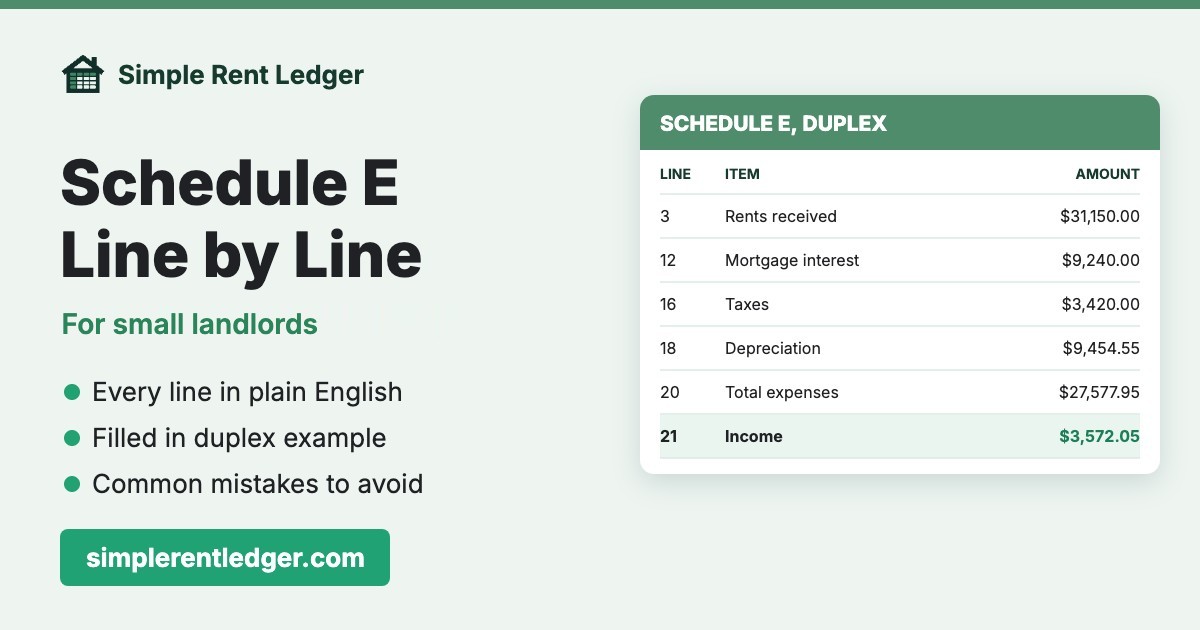
Dana Brooks owns a duplex at 1418 Elm St, Sacramento, CA 95817. Each unit rents for $1,350 a month. Unit B was vacant for one month in 2026, and one tenant paid two $50 late fees. Because both units are in one building, Dana reports the duplex in one column with property type 2.
| Line | Item | Amount |
|---|---|---|
| 3 | Rents received ($1,350 x 23 months + $100 late fees) | $31,150.00 |
| 6 | Auto and travel (mileage log) | $312.40 |
| 7 | Cleaning and maintenance | $450.00 |
| 9 | Insurance | $1,860.00 |
| 10 | Legal and other professional fees (tax prep) | $400.00 |
| 12 | Mortgage interest (Form 1098) | $9,240.00 |
| 14 | Repairs | $1,175.00 |
| 16 | Taxes | $3,420.00 |
| 17 | Utilities (water and trash) | $1,080.00 |
| 18 | Depreciation ($260,000 building / 27.5) | $9,454.55 |
| 19 | Other (rental license $150, bank fees $36) | $186.00 |
| 20 | Total expenses | $27,577.95 |
| 21 | Income (line 3 minus line 20) | $3,572.05 |
Notice how much depreciation does here. Without line 18, Dana would report $13,026.60 of income instead of $3,572.05.
How does depreciation work on line 18?
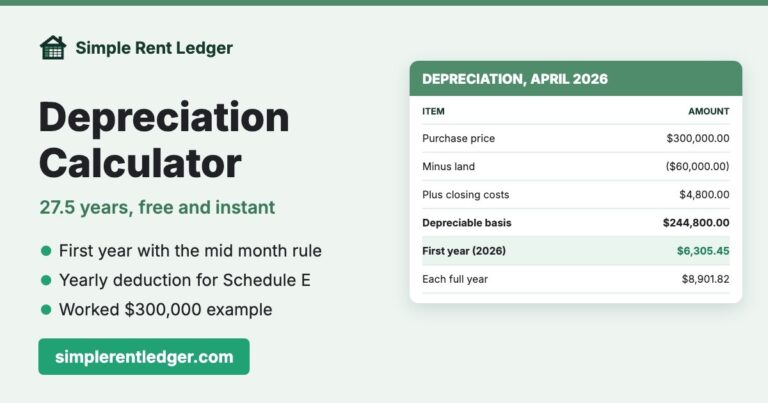
A residential rental building is depreciated over 27.5 years. Only the building counts, not the land, so split your purchase price between the two (your property tax bill often shows the split). In the first year you use the mid month rule, so you get a partial year based on the month the rental was placed in service. You figure it on Form 4562 and carry the result to line 18. Use our free rental depreciation calculator to estimate yours.
Do not skip it. When you sell, the IRS treats depreciation you were allowed to take as if you took it, so leaving it off costs you twice.
What if line 21 is a loss?
Rental losses are usually passive. If you actively take part in managing the rental (you approve tenants, set the rent and approve repairs), you may deduct up to $25,000 of rental losses against other income. That allowance shrinks when your modified adjusted gross income is over $100,000 and is gone at $150,000. Any loss you cannot use carries forward to future years. IRS Publication 925 explains the details.
Common Schedule E mistakes
- Deducting the whole mortgage payment instead of only the interest.
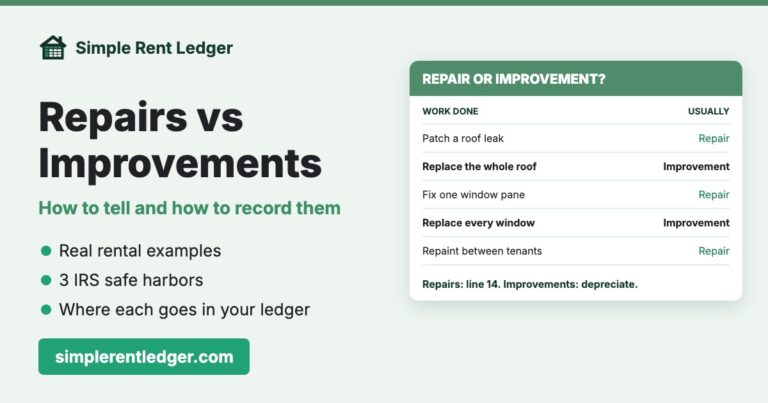
- Listing an improvement, like a new roof, as a repair. See repairs vs improvements.
- Forgetting late fees and lease cancellation fees on line 3.
- Counting a security deposit as income when you plan to return it.
- Leaving line 18 blank.
- Deducting shared costs in full when you live in one of the units. See our duplex and triplex ledger guide.
Your situation may be different. Read the official IRS instructions or ask a tax professional before you file.
Paid a contractor $2,000 or more in 2026? See 1099 for landlords for which forms to send and the February 1, 2027 deadline.
Want the big picture before you file? Our free rental property balance sheet and income statement template (Excel) uses the same Schedule E expense lines.
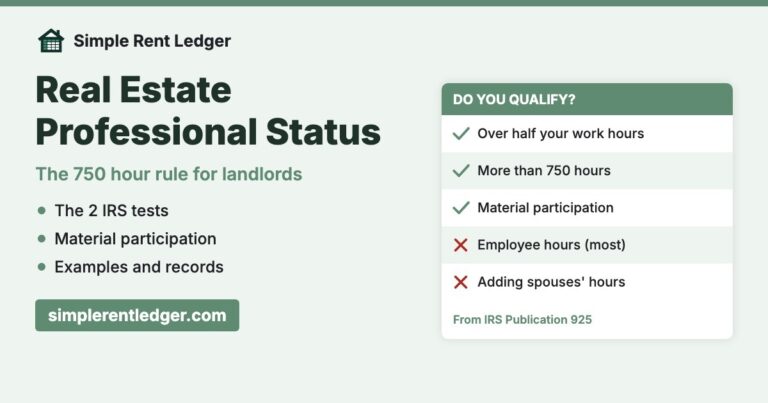
Real estate professionals report on a separate line of Schedule E. See our guide to real estate professional status.
New to rental taxes? Start with how rental income is taxed, with a worked example.
Rental loss on Schedule E? See why you can’t always deduct rental property losses.
Thinking about putting a rental in an LLC? A single member LLC is usually still reported on Schedule E. See our LLC for rental property guide.
Frequently asked questions
Do I need a separate Schedule E for each property?
No. One Schedule E page has three columns, A, B and C, one for each property. If you have more than three, use another page and add them up.
Is a duplex one property or two on Schedule E?
A duplex in one building is usually reported as one property in one column, with property type 2 for multi family.
Do I pay self employment tax on Schedule E rental income?
Usually no. Rental income on Schedule E is generally not subject to self employment tax. It can be different if you provide substantial services, like a hotel.
Where do late fees go?
Late fees are rental income. Add them to line 3 with your rent.
Can I file Schedule E myself?
Yes. Most tax software includes it. Good records make it simple: a total for each line and a depreciation amount.