Real Estate Professional Status for Landlords: The 750 Hour Rule (2026)
Real estate professional status is an IRS test for landlords. You qualify for a year if more than half of the hours you work are in real estate businesses where you materially participate, and those hours add up to more than 750. If you qualify and also materially participate in your rentals, your rental losses are no longer automatically passive, so they can offset other income such as wages. Most landlords with a full time job outside real estate cannot meet the first test. Here is how the rules work, with examples, from IRS Publication 925.
The two tests
You are a real estate professional for a tax year only if you meet both tests:
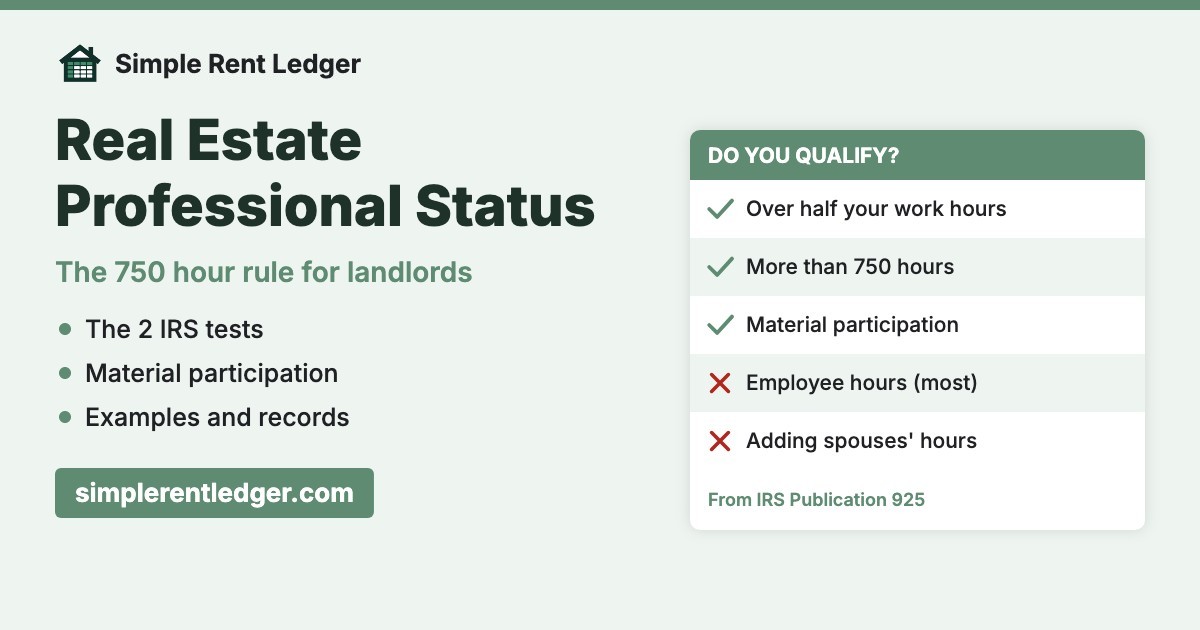
- More than half: more than half of the personal services you performed in all trades or businesses during the year were in real property trades or businesses in which you materially participated.
- More than 750 hours: you performed more than 750 hours of services during the year in real property trades or businesses in which you materially participated.
- Work as an employee does not count toward these tests, unless you own more than 5% of your employer.
- Married filing jointly: either you or your spouse must meet both tests alone. You cannot add your hours together for these two tests.
- You test every year. Qualifying one year does not carry over to the next.
What counts as a real estate business
Publication 925 lists real property trades or businesses as those in which you develop or redevelop, construct or reconstruct, acquire, convert, rent or lease, operate or manage, or broker real property.
Material participation in your rentals
Qualifying as a real estate professional is only half of it. Your rental activities are still passive unless you also materially participate in them. The Instructions for Form 8582 list seven tests. You need to meet only one. The most common for small landlords:
- You worked more than 500 hours in the activity during the year.
- Your work was substantially all of the work done in the activity by anyone, including people who were not owners.
- You worked more than 100 hours and at least as much as anyone else, including a property manager or contractor.
Your spouse’s work in the activity counts toward your material participation, even though it does not count toward the two real estate professional tests.
The election to group your rentals
Each rental property is normally a separate activity, so you would have to show material participation in each one. A real estate professional can elect to treat all interests in rental real estate as one activity. You make the election by attaching a statement to your original tax return saying you are a qualifying taxpayer for the year and are making the election under section 469(c)(7)(A). It applies to that year and later years when you qualify, and you can change it only if your facts and circumstances materially change. Rev. Proc. 2011-34 can allow a late election in some cases.
On the 2025 Schedule E, a real estate professional completes line 43. Check the current year’s instructions, because line numbers can change.
Examples
| Dana | Lena | |
|---|---|---|
| Main work | Nurse, about 1,900 hours a year as an employee | No other job |
| Hours on her rentals | About 400 hours managing a duplex | About 1,100 hours managing and repairing 4 units |
| More than half of her work hours in real estate? | No (400 of about 2,300) | Yes (all of her work) |
| More than 750 hours? | No | Yes |
| Real estate professional? | No | Likely yes. With the election to treat her 4 units as one activity, her more than 500 hours meet the material participation test. She keeps a log of her hours. |
The people and hours in this example are made up.
If you do not qualify
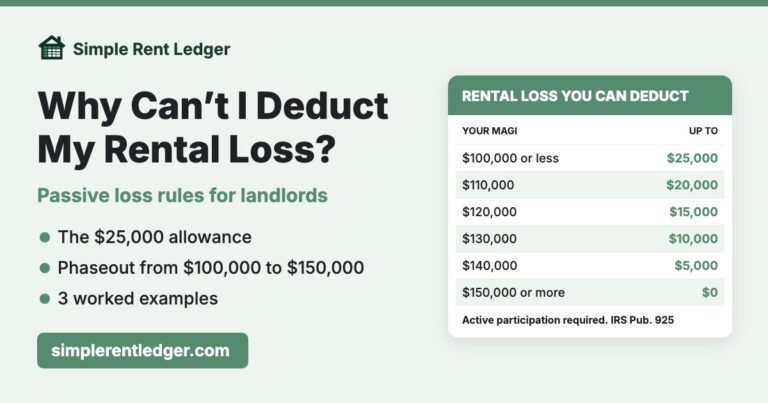
Most small landlords do not qualify. You may still deduct up to $25,000 of rental losses against other income if you actively participate in the rental (for example, you approve tenants and set the rent). The $25,000 is reduced by half of your modified adjusted gross income over $100,000 and is gone at $150,000 (lower limits apply if married filing separately). Losses you cannot use carry forward. See our guide to why you may not be able to deduct a rental loss.
Keep a record of your hours
The IRS lets you prove participation by any reasonable means. Daily time logs are not required if you can show your work another way, for example the services you did and the approximate hours, based on appointment books, calendars or narrative summaries. A simple log kept during the year is the easiest proof. Keep it with your landlord records.
These rules are strict and the IRS can ask for proof of your hours. Talk to a tax professional before you claim real estate professional status.
Thinking about an LLC for your rental? See our LLC for rental property guide.
Frequently asked questions
What is real estate professional status?
An IRS status for a tax year in which more than half of your work hours were in real estate businesses where you materially participate, and those hours were more than 750. With material participation in your rentals, your rental losses are not automatically passive.
Can I be a real estate professional with a full time job?
Usually not. More than half of all your work hours must be in real estate businesses, so a full time job outside real estate makes the first test very hard to meet. Work as an employee counts only if you own more than 5% of the employer.
Can my spouse and I combine hours?
Not for the two real estate professional tests. On a joint return, one spouse must meet both tests alone. Your spouse’s work does count toward material participation in an activity.
What is the 750 hour rule?
To qualify, you must perform more than 750 hours of services during the year in real property trades or businesses in which you materially participate, and that must be more than half of all your work hours.
Do I need a time log?
The IRS lets you prove participation by any reasonable means, such as appointment books, calendars or narrative summaries. A log kept during the year is the easiest proof.
Tracking your rental income and costs? Use our free rent ledger and expense spreadsheet so your Schedule E numbers are ready.