LLC for Rental Property: A Plain-English Guide for Small Landlords
An LLC (limited liability company) for rental property is a separate legal entity that owns the rental instead of you owning it personally. Its main purpose is to help keep claims connected to the rental away from your personal savings and home. It does not change much on your tax return by default, it does not replace insurance, and moving a property with a mortgage into an LLC can create problems with your lender. This guide covers how an LLC works for a small landlord, what it costs, and the questions to ask before you form one.
The short version
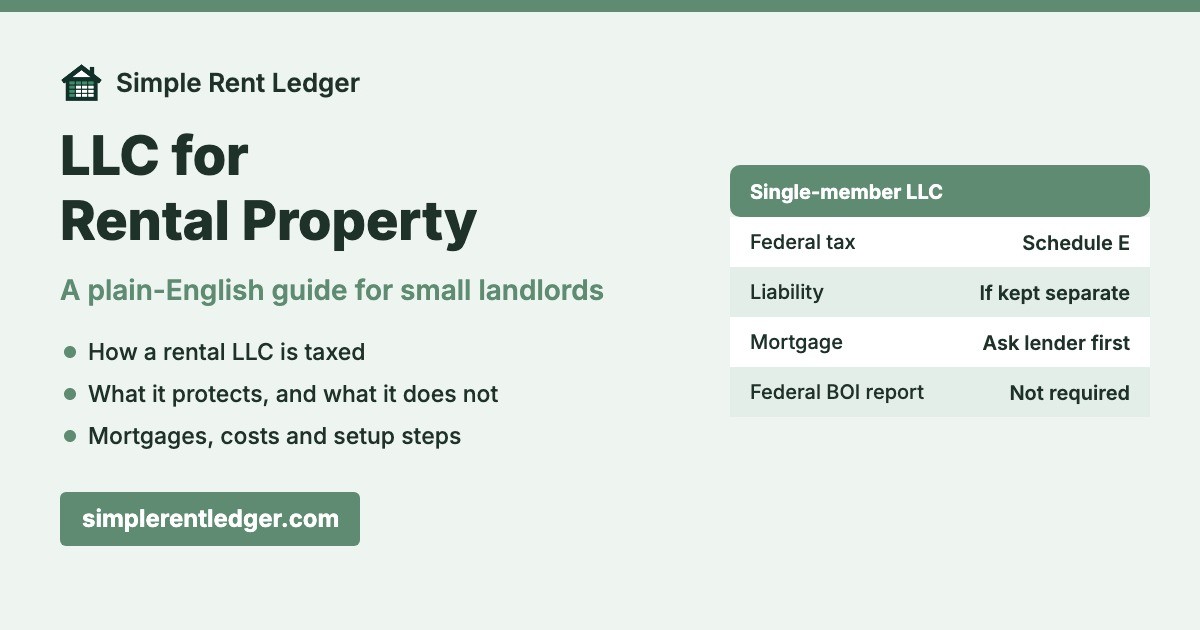
- Taxes: a single-member LLC is ignored for federal income tax by default, so your rental still goes on Schedule E. A two-owner LLC files a partnership return by default.
- Liability: an LLC can help protect personal assets, but only if you keep it truly separate. It generally does not protect you from your own negligence.
- Mortgage: federal law protects some transfers from a lender’s due-on-sale clause, but a transfer to an LLC is not on that list. Talk to your lender first.
- Insurance still matters. Many small landlords rely on landlord insurance plus an umbrella policy, with or without an LLC.
What an LLC does for a landlord
When you own a rental in your own name, a lawsuit about that property can reach everything you own. When an LLC owns the rental and you run it properly, a claim against the property is generally limited to the LLC’s assets: the property, its bank account and its insurance. That is the “limited liability” in the name.
| Own in your name | Own through an LLC | |
|---|---|---|
| Who holds title | You | The LLC |
| Federal income tax (one owner) | Schedule E | Schedule E by default (disregarded entity) |
| Liability for property claims | Personal assets exposed | Generally limited to LLC assets, if kept separate |
| Setup and yearly cost | None | State filing fees, yearly reports or taxes |
| Bank account | Can be personal (separate is better) | Must be in the LLC’s name |
| Financing | Standard residential mortgages | Lender may treat transfer as a sale; LLC loans can cost more |
How a rental LLC is taxed
By default, the IRS treats an LLC with one owner as a “disregarded entity”: it is ignored for federal income tax, and its activity goes on the owner’s own return. For an individual landlord, the rental income and expenses still go on Schedule E, the same as before. An LLC with two or more owners is treated as a partnership by default and files its own partnership return, giving each owner a share of the income. Either type can elect to be taxed as a corporation instead, which is a bigger decision to make with a tax professional.
- Your deductions, depreciation and loss rules generally work the same way for a single-member LLC.
- An LLC with no employees can usually use the owner’s Social Security number for federal income tax, but many banks ask for an EIN to open the LLC’s account. An EIN is free from the IRS.
- Some states charge their own LLC taxes or fees. California, for example, charges every LLC doing business or organized there an $800 annual tax.
Liability protection and its limits
An LLC is not a force field. Keep these limits in mind:
- Your own actions. If you personally cause an injury, for example by doing a repair badly, you can generally still be sued personally.
- Personal guarantees. If you sign a loan personally, the lender can still come after you.
- Mixing money. If rent goes into your personal account and you pay personal bills from the LLC, a court may ignore the LLC (“pierce the veil”).
- One LLC, many properties. A claim against one property can reach every property the same LLC owns. Some owners use more than one LLC; that adds cost and paperwork.
Insurance is still your first line of defense. Make sure the landlord policy names the LLC as the insured once the property is in the LLC.
Mortgages and the due-on-sale clause
Most residential mortgages have a due-on-sale clause: if the property is transferred, the lender can demand the full loan balance. The federal Garn-St Germain Act blocks lenders from using that clause for certain transfers of homes with fewer than five units, such as a transfer into a living trust where the borrower stays a beneficiary. A transfer to an LLC is not on that list. Many lenders never act on it, but the right exists, so ask your lender in writing before you deed a mortgaged property to an LLC.
Deeding a property to an LLC can also affect your title insurance, trigger a transfer tax or a property tax reassessment in some states, and change your insurance. Check each one before you sign a deed.
Disadvantages of an LLC for rental property
An LLC is not free protection. These are the main downsides small landlords run into:
| Disadvantage | What it means for you |
|---|---|
| Ongoing cost | A state filing fee to form it and, in many states, a yearly report fee or LLC tax. California charges every LLC doing business or organized there an $800 annual tax, even in a year with no profit. |
| Mortgage risk | Moving a mortgaged home into an LLC is not one of the transfers federal law protects from the due-on-sale clause, so the lender may be able to demand the full balance. |
| Harder or costlier financing | Fannie Mae’s general rule is that borrowers must be natural persons (with limited exceptions such as revocable living trusts), so many standard home loans are not made to an LLC. LLC owners often use commercial or portfolio loans, which can have higher rates, bigger down payments and a personal guarantee anyway. |
| More paperwork | A separate bank account, separate books, an operating agreement, yearly state filings and, for an LLC with two or more owners, a federal partnership return. |
| No federal tax savings by default | A single-member LLC is ignored for federal income tax, so the rental is reported on Schedule E just as before. |
| Transfer side effects | A new deed can affect title insurance and, in some states, trigger a transfer tax or a property tax reassessment. |
Costs and paperwork
| Item | What to expect |
|---|---|
| Formation | A filing fee to your state, usually to the Secretary of State. Amounts vary by state. |
| Yearly upkeep | Many states require an annual or biennial report and fee; some charge an annual LLC tax. |
| Registered agent | Every LLC needs one in its state. You can often be your own if you have an address there. |
| Operating agreement | The rules for the LLC: who owns it, who manages it, what happens if an owner dies. |
| Deed | A new deed transferring the property to the LLC, recorded with the county. |
| Bank account and EIN | A separate business account; the EIN is free from the IRS. |
| Federal BOI report | Not required for U.S. companies. FinCEN made this exemption final in August 2026. |
How landlords set up a rental LLC
- Talk to a local attorney and a tax professional about your state, your loan and your goals.
- Ask your lender how it treats a transfer to an LLC if the property has a mortgage.
- Form the LLC with your state and name a registered agent.
- Sign an operating agreement, even if you are the only owner.
- Get an EIN and open a bank account in the LLC’s name.
- Transfer the property with a new deed, if you are moving an existing rental in.
- Update the insurance, the leases and the rent payment details so tenants pay the LLC.
- Keep separate books from day one.
Keeping the LLC separate
The protection depends on treating the LLC as a real business. Rent goes into the LLC’s account; repairs, taxes and insurance are paid from it; and any money you take out is recorded as a draw. A simple rental income and expense spreadsheet and a tenant ledger in the LLC’s name make that easy, and they are the records a court or the IRS would look at. The landlord record keeping guide covers what to keep and for how long.
Do you need an LLC?
There is no single right answer. An LLC tends to make more sense when you own the property outright or are buying new, have significant personal assets to protect, or own with a partner. It may be less useful when the property has a mortgage you cannot move, your personal assets are modest, or your state’s yearly LLC costs are high. Many small landlords start with good landlord insurance plus an umbrella policy and revisit the question as they grow.
LLC rules, fees and taxes differ by state, and the right structure depends on your situation. Talk to a licensed attorney and a tax professional before forming an LLC or transferring property.
Keep the LLC’s rent separate from your personal money: log every payment in a rent ledger (free template).
Frequently asked questions
Should I put my rental property in an LLC?
It depends on your state, your mortgage, your other assets and whether you own with partners. An LLC can help limit liability, but it adds cost and paperwork and does not replace insurance. Talk to a local attorney and tax professional.
How is a single-member rental LLC taxed?
By default the IRS treats it as a disregarded entity, so an individual owner reports the rental on Schedule E of their own return, the same as owning it personally.
Can I transfer a mortgaged property to an LLC?
You can, but the lender may have the right to call the loan under its due-on-sale clause. Federal law exempts some transfers, such as into a living trust, but not transfers to an LLC. Ask your lender first.
Does an LLC protect me from all lawsuits?
No. It generally does not protect you from your own negligence or from debts you personally guarantee, and a court can disregard it if you mix personal and LLC money.
Do rental LLCs have to file a beneficial ownership (BOI) report?
Not if they are U.S. companies. FinCEN’s final rule, effective August 14, 2026, exempts U.S. companies from BOI reporting.
What are the disadvantages of an LLC for rental property?
Ongoing state fees or taxes, the risk of triggering the mortgage due-on-sale clause, harder or more expensive financing, more paperwork, and no federal tax savings by default for a single-member LLC.
How much does a rental LLC cost?
A state filing fee to form it plus any yearly report fees or taxes, which vary by state. California, for example, charges an $800 annual LLC tax.
Sources
- IRS: Single member limited liability companies
- IRS: Limited liability company (LLC)
- 12 U.S.C. 1701j-3 (Garn-St Germain Act, due-on-sale exemptions)
- FinCEN: Beneficial ownership information reporting
- Fannie Mae Selling Guide B2-2-01: General borrower eligibility requirements
- California Franchise Tax Board: Limited liability company