Pet Addendum to Lease: Free Fillable Template, Sample and State Rules
A pet addendum is a short add-on to your lease that names the pets a tenant may keep, sets any pet deposit, fee or rent your state allows, and lists the rules the tenant agrees to follow. Below is a free fillable pet addendum (PDF), a sample to copy, what pet charges are allowed in a few states (from the state laws themselves), and why an assistance animal is not a pet.
Free fillable pet addendum (PDF). One page: lease and tenant details, up to two approved pets, pet deposit, fee and rent lines, tenant rules, an optional renters insurance requirement, a box for your own rules, an assistance animal note, and signature lines.
Fill it in on your computer, then print it and sign it with your tenant.
Want more forms? Join our email list and get the free Landlord Starter Kit: the filled in example ledger, the Quick Start guide and 5 printable forms.
What is a pet addendum?
A pet addendum (also called a pet agreement or pet lease addendum) is a separate page that both you and the tenant sign and attach to the lease. It changes the lease only for pets. You can use it when a new tenant moves in with a pet, or when a current tenant asks to get one in the middle of the lease.
Why bother? If something goes wrong (damage, noise, an extra dog nobody mentioned), a signed page that names the pet and the rules is much easier to point to than a conversation you both remember differently.
What to include
- The lease it belongs to: lease date, landlord, all tenants and the property address.
- Each approved pet: name, type and breed, color, weight, age and license or tag number, and whether vaccines are current. Say that no other animal may live there without your written approval.
- Pet charges: any pet deposit, one time pet fee or monthly pet rent, but only what your state and city allow (see the table below).
- Rules: leash and control in shared areas, waste cleanup, noise, local licensing, no breeding or selling animals at the property.
- Responsibility: the tenant pays for damage the pet causes and is responsible for injuries it causes to others. You can also require renters insurance with liability coverage.
- What happens if the rules are broken: written notice to fix the problem or remove the pet, as the lease and state law allow.
- Signatures and dates from you and every adult tenant.
Pet deposit, pet fee and pet rent: what your state allows
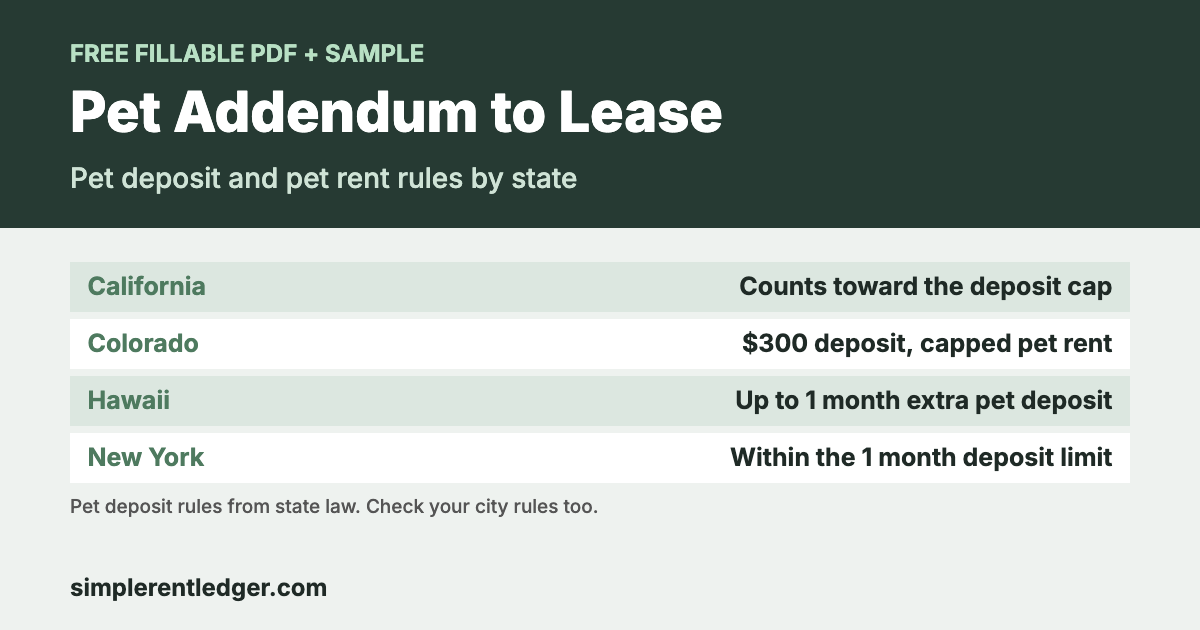
Many states have no rule just for pets, but their general security deposit limit still counts a pet deposit. A few have specific pet rules. Four examples, taken from the laws:
| State | What the law says | Law |
|---|---|---|
| California | Security, “however denominated,” is capped at 1 month’s rent (2 months for some small landlords who are individuals or LLCs owned by individuals and own no more than 2 properties with no more than 4 units). “Security” includes any payment, fee, deposit or charge, so a pet deposit counts toward the cap. | Civil Code 1950.5 (AB 12, for deposits collected from July 1, 2024) |
| Colorado | A pet security deposit can be no more than $300 and must be refundable. Monthly pet rent can be no more than $35 or 1.5% of the monthly rent, whichever is greater. | HB23-1068 (from January 1, 2024) |
| Hawaii | The deposit can include a pet amount of up to 1 month’s rent, on top of the regular limit of 1 month’s rent. No pet deposit may be charged for an assistance animal that is a reasonable accommodation for a tenant with a disability. | HRS 521-44 |
| New York | “No deposit or advance shall exceed the amount of one month’s rent.” There is no exception for pets, so do not add a pet deposit on top of a full month’s deposit. | General Obligations Law 7-108 |
Some cities add their own limits. Whatever you charge, write it on the addendum, record it in your rent ledger, and track any refundable pet deposit with the rest of the deposit in your security deposit record.
Assistance animals are not pets
The federal Fair Housing Act makes it discrimination to refuse “reasonable accommodations in rules, policies, practices, or services” that a person with a disability needs to use and enjoy a home (42 U.S.C. 3604(f)(3)(B)). HUD’s own rule gives the example of allowing a blind tenant’s guide dog in a building with a no pets policy (24 CFR 100.204). So a request to keep an animal because of a disability is an accommodation request, not a pet request, and this addendum is not the right form for it.
What changed in 2025 and 2026. HUD withdrew its 2020 assistance animal guidance (FHEO 2020-01), effective September 17, 2025, in a notice published April 6, 2026. On May 22, 2026 it issued enforcement guidance to its staff: HUD will find reasonable cause in animal complaints only when the animal is individually trained to do work or perform tasks for a person with a disability, and requests for untrained emotional support animals are not presumed reasonable. That guidance also says it does not affect anyone’s right to sue in court, and it does not change state laws, some of which go further (Hawaii’s ban on pet deposits for assistance animals is one example).
For a small landlord, the practical steps stay the same: answer an animal request in writing and promptly, decide it on its own facts instead of under your pet policy, keep records of what was asked and why you decided, and talk to a local fair housing attorney before you refuse a request or charge pet fees for an animal requested because of a disability.
Sample pet addendum
Here is how a filled in addendum reads. The names and amounts are made up.
Pet Addendum to Lease
This addendum is part of the lease dated 08/01/2026 between Dana Brooks (landlord) and Maria Ortiz and Sam Ortiz (tenants) for 418 Maple Street, Unit 2.
Approved pet: Biscuit, dog, beagle mix, tan, 24 lb, 3 years old, license FC-20931, vaccines current. No other animal may live at or regularly stay at the property without the landlord’s written approval.
Pet charges: refundable pet deposit $300.00. Pet rent $25.00 per month, due with the rent.
Tenants agree to keep Biscuit under control and on a leash in shared areas, clean up waste right away, not let him disturb neighbors, follow local licensing and vaccination laws, and pay for any damage he causes. Tenants will keep renters insurance with at least $100,000 of liability coverage.
Other rules: no pets on the shared balcony. The dog is crated when no one is home.
Before you copy the amounts, check them against your own state’s rules. In New York, for example, the $300 pet deposit could not be added on top of a full month’s security deposit.
How to use it
- Ask about pets on the application. Our rental application form has a line for pets, so you know before the lease is signed.
- Fill in the addendum with the pet details and only the charges your state allows.
- Sign it with the lease (or on the day you approve a new pet) and give every tenant a copy.
- Record the money in your rent ledger, and keep the signed page with the lease.
- At move out, note any pet damage on your inspection and handle the pet deposit with the rest of the deposit, as your state requires.
Pet and deposit rules differ by state and city and change over time, and fair housing rules for assistance animals are changing. Check your state and local law and your lease, or ask a local attorney, before you use this addendum.
Changing something else in the lease, like parking, utilities or the rent? Use our free lease addendum template.
Frequently asked questions
Can a landlord charge a pet deposit and pet rent?
In many states, yes, if the lease or pet addendum says so and the total stays within state and local limits. Some states cap them. Colorado, for example, limits a pet deposit to $300 and pet rent to $35 or 1.5% of the rent, whichever is greater.
Does a pet deposit count toward the security deposit limit?
Often, yes. California counts any payment, fee, deposit or charge as security, and New York caps any deposit or advance at one month’s rent. Hawaii instead allows a separate pet amount of up to one month’s rent.
Can I charge a pet fee for a service or emotional support animal?
Treat an animal requested because of a disability as a reasonable accommodation request under the Fair Housing Act, not as a pet. Some state laws, such as Hawaii’s, ban pet deposits for assistance animals. Federal guidance changed in 2025 and 2026, so ask a local fair housing attorney before charging any pet fee for such an animal.
Can a tenant get a pet in the middle of a lease?
Only if the lease allows it or you approve it. If you say yes, have the tenant sign a pet addendum that day, so the new pet and any charges are in writing.
Sources
- 42 U.S.C. 3604 (Fair Housing Act) and 24 CFR 100.204
- HUD, Notification of Withdrawal of FHEO Guidance Documents (Federal Register, April 6, 2026)
- HUD enforcement guidance on animal accommodation requests (May 22, 2026)
- California AB 12 (Civil Code 1950.5)
- Colorado Division of Real Estate, 2023 legislative summaries (HB23-1068)
- Hawaii Revised Statutes 521-44
- New York General Obligations Law 7-108