Security Deposit Tracker + Which States Require Interest (2026)
A security deposit tracker records how much each tenant paid, when, where you hold it, any interest you owe, and every deduction at move out. Most states do not require landlords to pay interest on deposits, but several do, including Massachusetts, New Jersey, Connecticut, Minnesota and Ohio. California, Texas and Florida have no general statewide interest rule, though some California cities do.
What should a security deposit tracker include?
| Field | Example |
|---|---|
| Tenant and unit | Maria Lopez, 418 Oak St Unit 2 |
| Amount received | $1,350.00 |
| Date received | 08/01/2026 |
| Where it is held | Separate savings account at a local bank |
| Interest rate owed (if your state requires it) | Example: 1% in Minnesota |
| Move out date | 07/31/2027 |
| Deductions with reason and receipt | $120.00 carpet cleaning beyond normal wear |
| Amount returned and date | $1,230.00 on 08/12/2027 |
| How it was returned | Check #1107, mailed to forwarding address |
Keep the deposit out of your rent income. A deposit you plan to return is not income for taxes. It becomes income only if you keep part of it, for example for damage or unpaid rent.
Which states require interest on security deposits?
These state rules are the ones small landlords most often run into. Rules change, have exceptions and can be stricter in some cities, so always open the statute for your state.
| State | Interest rule (summary) | Law |
|---|---|---|
| Connecticut | Yes. Rate set each year by the Banking Commissioner (0.49% for 2026) | Conn. Gen. Stat. 47a-21 |
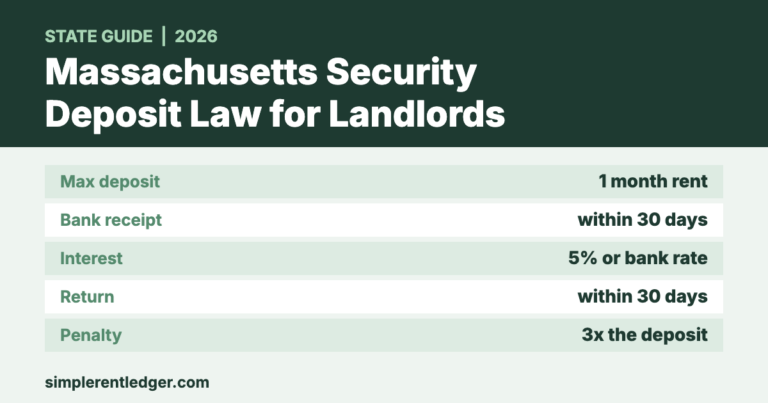
| Massachusetts | Yes. 5% a year, or the rate the bank pays if lower, for deposits held a year or more | M.G.L. c. 186, 15B |
| Minnesota | Yes. 1% simple interest a year | Minn. Stat. 504B.178 |
| New Jersey | Yes. Interest earned on the deposit, paid yearly or credited to rent | N.J.S.A. 46:8-19 |
| Ohio | Yes. 5% a year on the part above $50 or one month’s rent (whichever is greater), if the tenant stays 6 months or more | Ohio Rev. Code 5321.16 |
| Pennsylvania | Yes, starting in the third year, for deposits over $100 (bank interest minus a 1% fee) | 68 P.S. 250.511b |
| Maryland | Yes, for deposits of $50 or more, at a rate set by state law | Md. Real Prop. 8-203 |
| New Hampshire | Yes, for deposits held a year or more | RSA 540-A:6 |
| Iowa | Interest earned in the first 5 years belongs to the landlord | Iowa Code 562A.12 |
| New York | Yes in buildings with 6 or more units. Under 6 units, only if you put it in an interest bearing account | N.Y. Gen. Oblig. Law 7-103 |
| Florida | Only if you hold it in an interest bearing account (75% of the interest or 5% a year), or post a surety bond (5% a year) | Fla. Stat. 83.49 |
| California | No statewide rule. Some cities, such as San Francisco and Los Angeles for covered units, require it | Check your city |
| Texas | No | Tex. Prop. Code 92 |
How do you track security deposit interest?
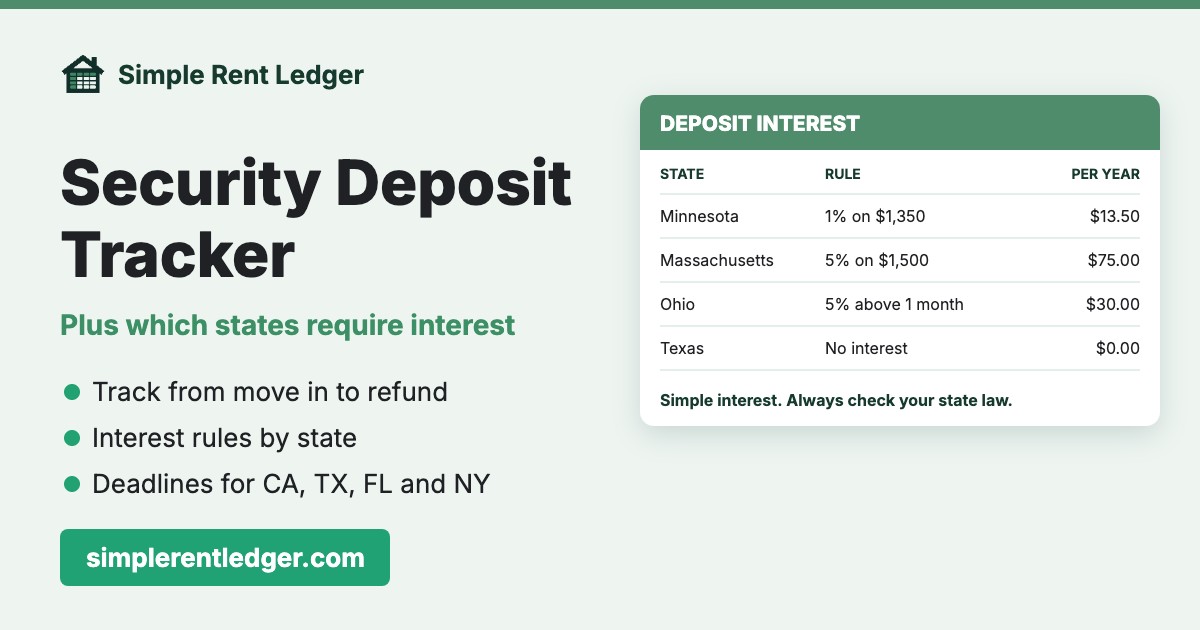
Most states use simple interest: deposit x rate x years held. Three examples:
| State | Deposit | Calculation | Interest per year |
|---|---|---|---|
| Minnesota | $1,350 | $1,350 x 1% | $13.50 |
| Massachusetts | $1,500 | $1,500 x 5% | $75.00 |
| Ohio (rent $1,400) | $2,000 | ($2,000 minus $1,400) x 5% | $30.00 |
Record the interest in your tracker each year so the final refund is easy to figure. For your exact dates and the 2026 rates, use our security deposit interest calculator.
Deposit limits and return deadlines in CA, TX, FL and NY
| State | Maximum deposit | Deadline to return or send deductions | Law |
|---|---|---|---|
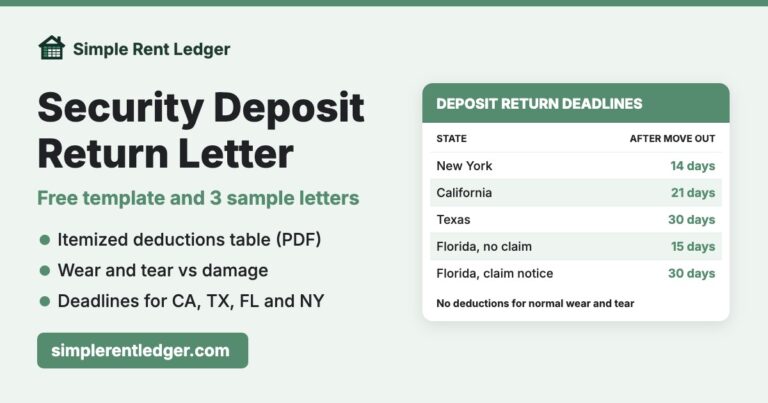
| California | 1 month’s rent for most landlords (2 months for some small landlords) | 21 days after move out, with an itemized statement | Civil Code 1950.5 |
| Texas | No limit | 30 days after the tenant moves out | Property Code 92.103 |
| Florida | No limit | 15 days if no deductions; 30 days to send written notice of a claim | Fla. Stat. 83.49 |
| New York | 1 month’s rent | 14 days, with an itemized statement | Gen. Oblig. Law 7-108 |
New York security deposit law: the 14 day rule
In New York, the landlord has 14 days after the tenant moves out to return the deposit and send an itemized statement of any deductions. Miss the 14 days and the landlord loses the right to keep any part of the deposit, even for real damage (General Obligations Law 7-108).
What New York requires:
- Deposit limit: no more than 1 month’s rent.
- Move out inspection: tell the tenant in writing that they can ask for an inspection before they leave. If they ask, it takes place 1 to 2 weeks before the lease ends, with at least 48 hours’ written notice.
- Return: within 14 days after move out, send the itemized statement and any money left.
- Holding the deposit: keep it in trust, separate from your own money. In buildings with 6 or more units, it must go into an interest bearing account at a New York bank, and each tenant gets written notice of the bank’s name and address and the amount (General Obligations Law 7-103).
See our full New York landlord guide.
Put the deadline in your tracker on move out day. Example: a tenant moves out on 07/31/2027, so the statement and refund are due by 08/14/2027. Rent stabilized and rent controlled units have extra rules, so check those separately.
Move out: how to record deductions
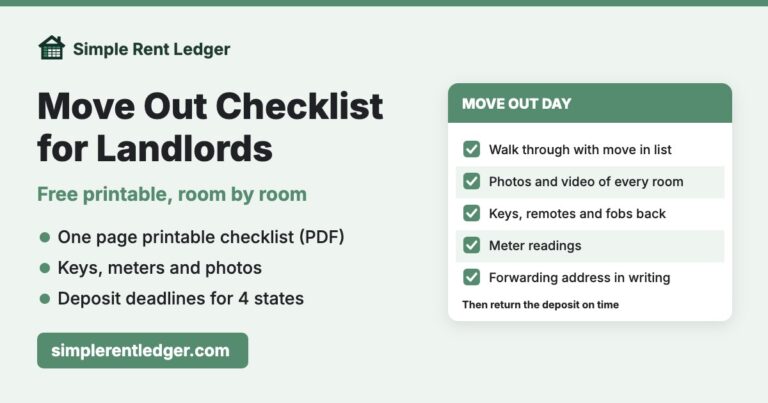
- Take dated photos at move in and move out.
- List each deduction with the reason and the cost, such as a receipt or invoice.
- Do not deduct normal wear and tear, like faded paint or light carpet wear after years of use.
- Subtract deductions and add any interest owed.
- Send the refund and the itemized list before your state deadline, and record both in your tracker and the tenant ledger.
Security deposit laws change often and many cities add their own rules. Read the current law for your state and city, or ask a local attorney.
California landlords: the deposit limit, photo rules and 21 day deadline are all in our California landlord guide.
Texas landlords: the 30 day deposit deadline and forwarding address rule are in our Texas landlord guide.
Florida landlords: the 15 and 30 day deposit deadlines are explained in our Florida landlord guide.
Taking a new deposit? Give the tenant a signed receipt with our free security deposit receipt template (fillable PDF).
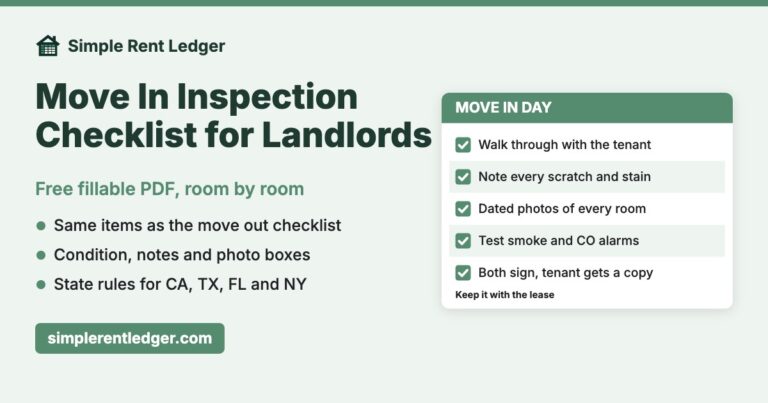
Doing the move in walkthrough? Note the condition of each room with our free rental property inspection checklist (fillable PDF), so deposit deductions are easy to support later.
Before you deduct from a deposit, check our normal wear and tear vs damage guide: normal wear and tear cannot be charged to the tenant.
Track rent payments the same way: our free rent ledger template records every charge, payment and balance.
Frequently asked questions
Do landlords have to pay interest on security deposits?
Only in some states and cities. Connecticut, Massachusetts, Minnesota, New Jersey, Ohio, Pennsylvania, Maryland and New Hampshire have statewide rules. California, Texas and Florida generally do not, with exceptions.
Is a security deposit taxable income?
Not if you plan to return it. It becomes income in the year you keep part of it. If the deposit is meant to be the last month’s rent, it is advance rent and counts as income when you receive it.
Can I mix the deposit with my own money?
Some states require a separate account. Even where it is not required, a separate account makes the deposit easy to prove and return.
How do I calculate interest on a deposit?
Usually deposit x interest rate x years held, as simple interest. Check whether your state uses a fixed rate or a rate published each year.
What happens if I miss the return deadline?
In many states you can lose the right to keep any deductions and may owe penalties, sometimes two or three times the deposit. Track the move out date and the deadline together.