Repairs vs Improvements on a Rental Property: How to Tell and How to Record Them
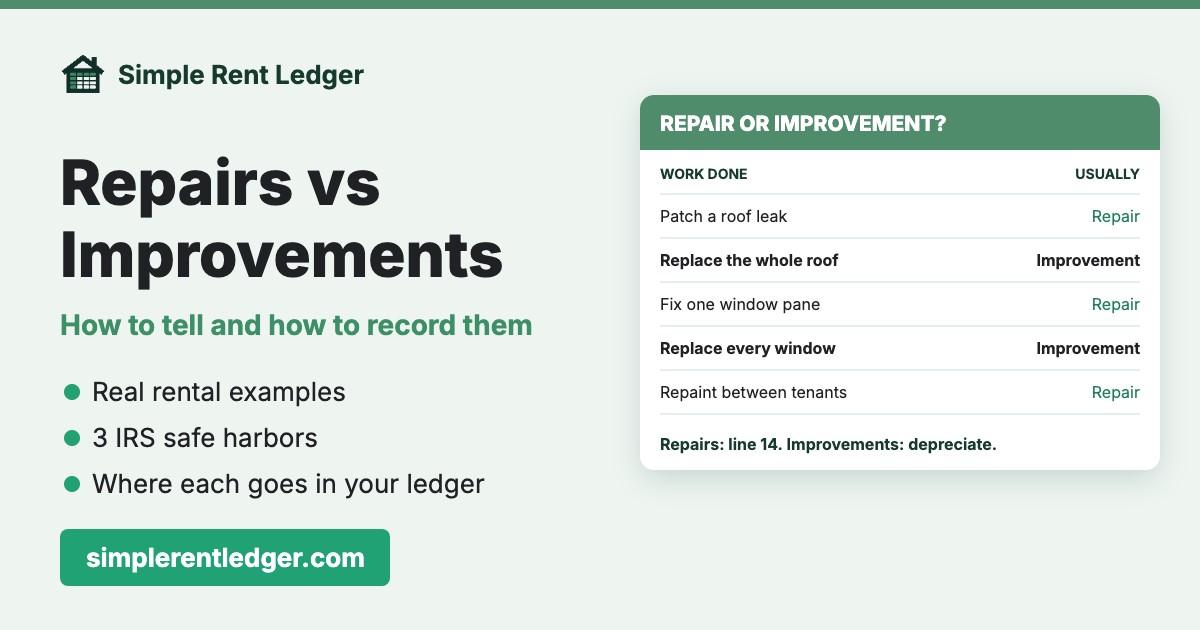
A repair keeps your rental in normal working condition and is deducted in the year you pay it. An improvement makes the property better, restores a major part, or adapts it to a new use, and is depreciated over several years. Patching a roof leak is a repair. Replacing the whole roof is an improvement. Three IRS safe harbors let small landlords deduct some improvements right away, so it pays to know them.
What is the difference between a repair and an improvement?
The IRS tangible property regulations use three tests. If the work does any of these, it is usually an improvement:
| Test | Meaning | Example |
|---|---|---|
| Betterment | Makes it bigger, stronger or better than before | Adding a bedroom, upgrading to a much better HVAC system |
| Restoration | Replaces a major part or brings back a property that fell into disrepair | Replacing the whole roof, rebuilding after a fire |
| Adaptation | Changes it to a new or different use | Turning a garage into a rental unit |
If none of the three apply and the work just keeps things working, it is a repair.
Real examples for a small rental
| Work done | Usually | Where it goes |
|---|---|---|
| Patching a roof leak | Repair | Schedule E line 14 |
| Replacing the entire roof | Improvement | Depreciate over 27.5 years |
| Replacing one broken window pane | Repair | Line 14 |
| Replacing every window in the house | Improvement | Depreciate over 27.5 years |
| Repainting a unit between tenants | Repair | Line 14 |
| Full kitchen remodel | Improvement | Depreciate over 27.5 years |
| Fixing a running toilet | Repair | Line 14 |
| New refrigerator for the unit ($1,100) | Improvement, unless de minimis applies | 5 years, or deduct under de minimis |
| New fence ($4,800) | Improvement | Depreciate over 15 years |
The 3 safe harbors that let you deduct more
1. De minimis safe harbor ($2,500 per item or invoice)
If you make this election each year, you can deduct items that cost $2,500 or less per item or per invoice instead of depreciating them. A $1,100 refrigerator for your rental can be deducted in full. You make the election with a statement attached to your tax return. Your tax software or preparer can add it.
2. Routine maintenance safe harbor
Work you expect to do more than once in 10 years to keep a building system working, such as servicing the HVAC or replacing worn parts, can be deducted even if it looks large.
3. Small taxpayer safe harbor
If your building’s unadjusted basis is $1,000,000 or less and your average yearly gross receipts are $10 million or less, you can deduct all repairs, maintenance and improvements on that building for the year, as long as the total is not more than the smaller of $10,000 or 2% of the building’s unadjusted basis. It is an election made each year, building by building.
Example. Your duplex building has an unadjusted basis of $300,000. 2% is $6,000, which is less than $10,000, so your limit is $6,000. If all repairs, maintenance and improvements on it in 2026 total $5,400 (including a $3,000 water line replacement), you can elect to deduct all $5,400. If the total were $6,500, you could not use this safe harbor for that building in 2026 at all, and the normal rules would apply.
How do you record each one in your ledger?
- Repairs: enter them on the Expenses tab with category Repairs (line 14).
- Items under the de minimis safe harbor: enter them as Repairs or Supplies and write de minimis in the notes.
- Improvements: list them with the date placed in service and the cost, so they can be depreciated. In our template, add them to the Properties tab.
- Keep the invoice with a short description of what was done. The description is what proves whether it was a repair or an improvement.
Why does this matter so much?
Say you spend $9,000 on a new roof. As a repair it would cut this year’s taxable rent by $9,000. As an improvement it cuts it by only about $327 a year ($9,000 / 27.5) for 27.5 years. Calling an improvement a repair is one of the most common landlord tax mistakes, and the IRS knows it. When in doubt, ask a tax professional before you file.
These rules are detailed and depend on your facts. Read the IRS guidance or ask a tax professional before you decide how to treat a large expense.
Track the rent side too: our free rent ledger template builds a year-end summary by Schedule E line.
Improvements also raise your basis, which lowers your gain when you sell. See what that means for your tax with our capital gains tax calculator for rental property.
Frequently asked questions
Is replacing a water heater a repair or an improvement?
Replacing a whole water heater is often treated as an improvement because it is a major part of the plumbing system. Depending on the cost and your elections, a safe harbor may let you deduct it. Ask your tax preparer.
Is painting a rental a repair?
Painting to keep the unit in good condition, such as between tenants, is usually a repair. Painting as part of a larger remodel is usually part of the improvement.
Can I deduct an improvement all at once?
Not under the normal rules, but the de minimis or small taxpayer safe harbor may let you deduct it if it fits the limits and you make the election.
How long do I depreciate a new roof?
A new roof on a residential rental is generally depreciated over 27.5 years, the same as the building.
Where do improvements go on Schedule E?
Not on line 14. Their yearly depreciation is figured on Form 4562 and goes on line 18. Try our depreciation calculator.