Rental Property Mileage Deduction: 2026 Rates and a Free Mileage Log
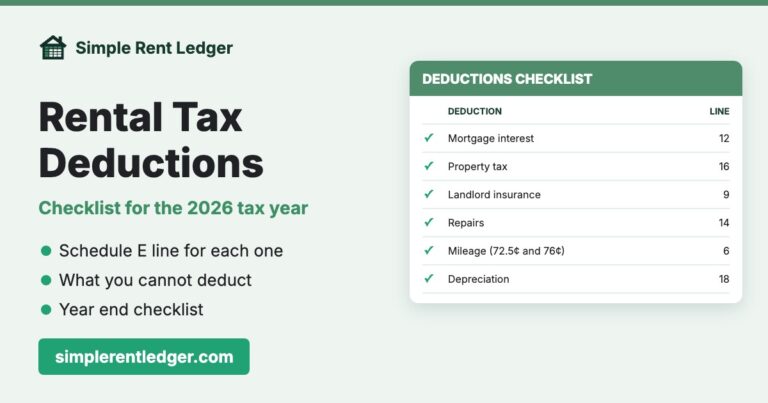
You can deduct the miles you drive to manage, repair or collect rent for your rental property on Schedule E, line 6. For 2026 the IRS standard mileage rate is 72.5 cents per mile for drives from 01/01 to 06/30 and 76 cents per mile for drives from 07/01 to 12/31, after a rare midyear increase. Keep a simple log with the date, where you went, why and the miles, and the deduction adds up fast.
What is the mileage rate for 2026?
| Drives between | Business rate per mile | IRS source |
|---|---|---|
| 01/01/2026 and 06/30/2026 | 72.5 cents | Notice 2026-10 |
| 07/01/2026 and 12/31/2026 | 76 cents | Announcement 2026-11 |
| All of 2025 (for the return you file in early 2026) | 70 cents | Notice 2025-5 |
The midyear change matters. If you drive 1,000 miles for your rentals in the second half of 2026, the higher rate is worth an extra $35. Use the rate for the date of each trip, not one rate for the whole year.
Which rental trips can you deduct?
IRS Publication 527 allows local transportation costs when the main purpose of the trip is to collect rent or to manage, conserve or maintain your rental property. For a small landlord that usually includes:
- Showing a vacant unit to applicants
- Inspecting the property or doing a move in or move out walkthrough
- Fixing something yourself or meeting a plumber or contractor
- Buying supplies for the rental at a hardware store
- Picking up a rent check or depositing rent at the bank
- Posting a notice the law requires you to deliver in person
These usually do not count:
- Your commute to a regular job
- Personal errands, even if you drive past the rental
- The personal part of a mixed trip (only the rental miles count)
- Trips to look at a house you are thinking about buying, which relate to buying property rather than running a rental
Standard mileage rate or actual car expenses?
| Standard mileage rate | Actual expenses | |
|---|---|---|
| What you deduct | Business miles x the IRS rate | The business share of gas, repairs, insurance, depreciation and more |
| Records needed | A mileage log | A mileage log plus every car receipt |
| Best for | Most small landlords | Expensive vehicles driven mostly for the rentals |
If you want to use the standard rate for a car, choose it in the first year you use that car for your rentals. Parking fees and tolls for rental trips are deductible on top of the standard rate. You cannot use the standard rate if you use five or more cars at the same time for business.
Example: a year of mileage for a duplex
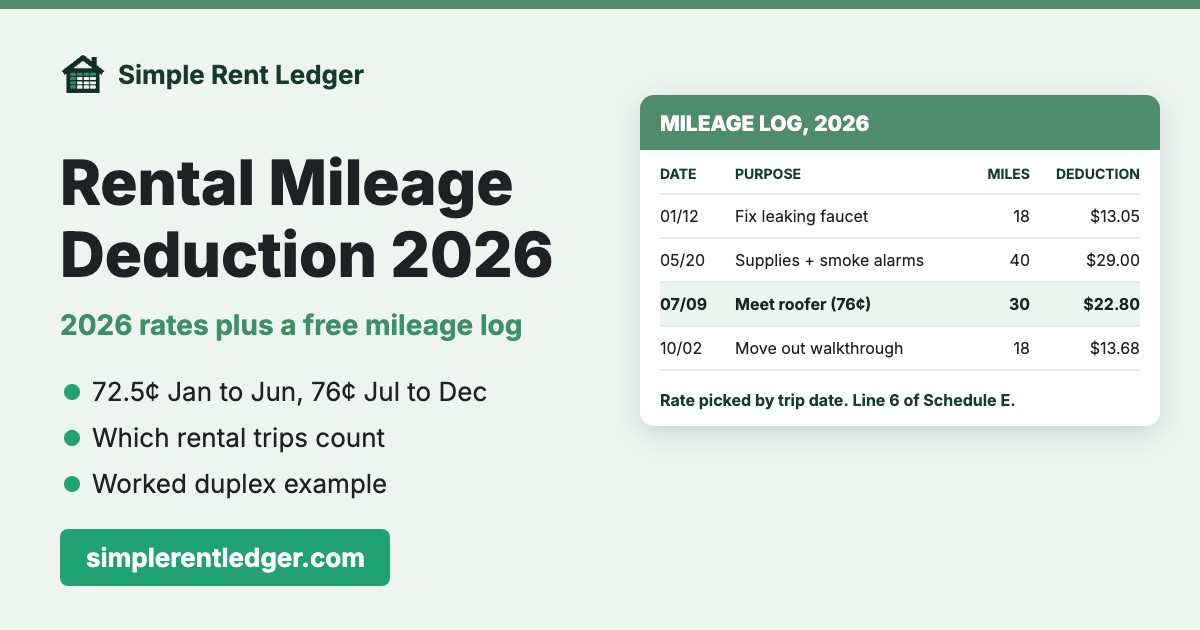
Maria Lopez owns a duplex at 418 Oak St, Tampa, FL 33604, about 9 miles from her home. Here is part of her 2026 log:
| Date | Purpose | Miles | Rate | Deduction |
|---|---|---|---|---|
| 01/12/2026 | Fix leaking faucet in Unit 2 | 18 | $0.725 | $13.05 |
| 03/03/2026 | Show Unit 1 to applicants | 24 | $0.725 | $17.40 |
| 05/20/2026 | Home Depot, then install smoke detectors | 40 | $0.725 | $29.00 |
| 07/09/2026 | Meet roofer for estimate | 30 | $0.76 | $22.80 |
| 10/02/2026 | Move out walkthrough, Unit 1 | 18 | $0.76 | $13.68 |
| Total | 130 | $95.93 |
She also paid $12 for parking during a repair, so her Schedule E line 6 total is $107.93. Notice that the July and October trips use the higher 76 cent rate.
What should a mileage log include?
The IRS expects records made at or near the time of each trip, not rebuilt from memory in April. Each line needs:
- The date of the trip
- Where you started and where you went
- The rental property the trip was for
- The business purpose, in a few words
- The miles driven
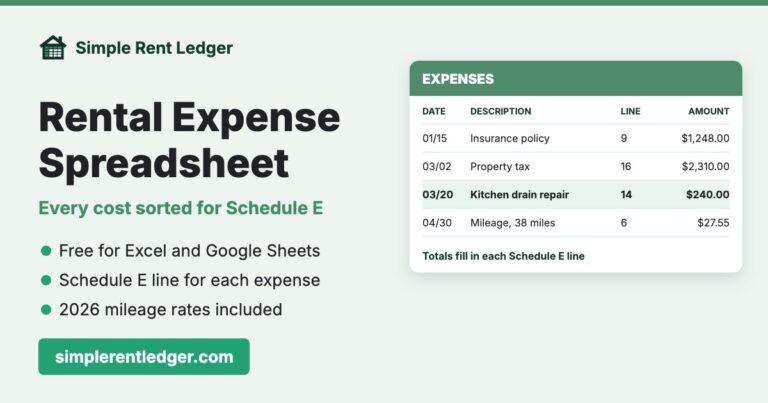
Our free rent ledger template has a Mileage tab that does the math for you. Type the date and miles, and it applies 72.5 cents or 76 cents based on the date, then carries the total to the Schedule E tab, line 6. The rates live on the Settings tab, so you can update them each January.
Where does the deduction go on your tax return?
The total goes on Schedule E (Form 1040), line 6, Auto and travel, for the property the trips were for. If one trip covers two rentals, split the miles between them. See our line by line Schedule E guide and the full rental tax deductions checklist.
Mileage rules have details and exceptions. Check the IRS guidance or ask a tax professional about your situation.
Frequently asked questions
What is the IRS mileage rate for rental property in 2026?
72.5 cents per mile for drives from 01/01/2026 to 06/30/2026 and 76 cents per mile for drives from 07/01/2026 to 12/31/2026.
Can I deduct driving to my rental property?
Yes, when the main purpose of the trip is to collect rent or to manage, maintain or repair the rental. Keep a log of each trip.
Do I need a mileage log?
Yes. The IRS expects a record of the date, destination, purpose and miles, made at or near the time of the trip.
Can I deduct parking and tolls?
Yes. Parking and tolls for rental trips are deductible in addition to the standard mileage rate.
Where do I report rental mileage?
On Schedule E (Form 1040), line 6, Auto and travel, for the property the trips were for.