Rental Application Form (Free Fillable PDF) for Landlords
A rental application form (also called a rent application or tenant application) is the document a landlord asks each adult applicant to fill out before signing a lease: identity, current and past addresses, landlord references, income, and written permission to run a credit and background check. Below is a free fillable rental application form (PDF) you can send to applicants for an apartment, a duplex unit or a whole house, plus what to ask, what not to ask, and how to handle screening and fees the right way.
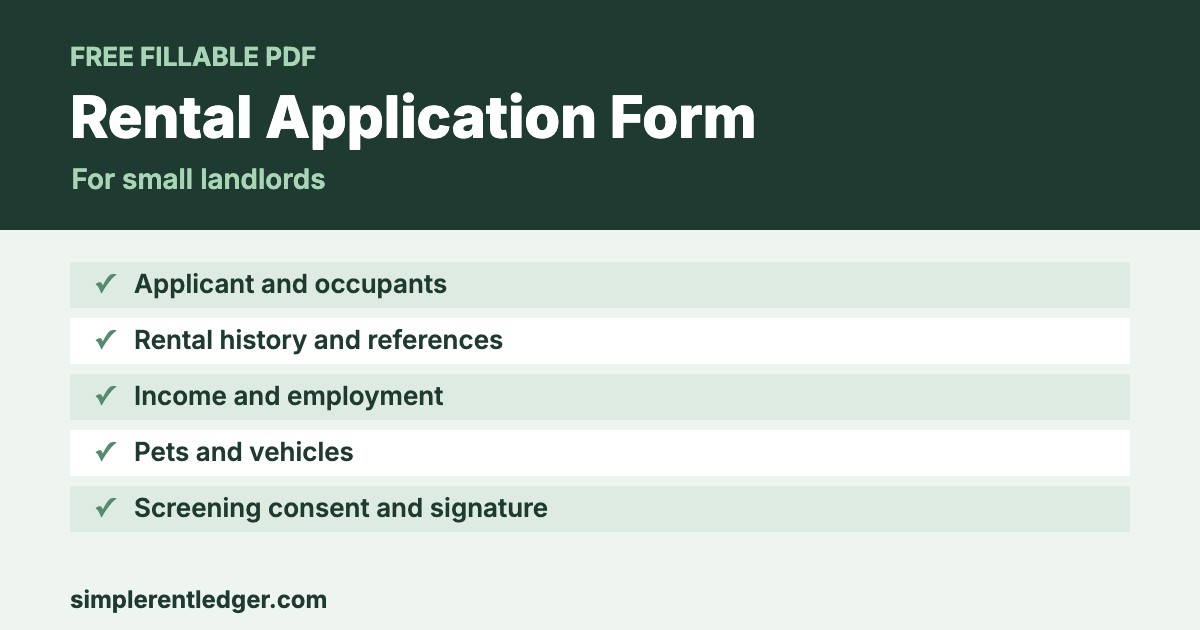
Free fillable rental application form (PDF). Two pages with 10 sections: the rental, the applicant, current and previous address, employment and income, emergency contact, pets and vehicles, rental history questions, application fee, authorization and signature, and a “for landlord use only” box to record your decision.
Applicants can type in it on a computer or print it.
Want more forms? Join our email list and get the free Landlord Starter Kit: the filled in example ledger, the Quick Start guide and 5 printable forms.
What should a rental application form include?
Most rental application forms ask for the same core information. Ours covers:
- The rental: address and unit, move in date, monthly rent and lease term.
- The applicant: full legal name, date of birth, phone, email, SSN or ITIN for the credit check, and ID.
- Who will live there: names of the other occupants and the total number of people.
- Rental history: current and previous addresses, landlord names and phone numbers, and the reason for moving.
- Income: employer, start date, gross monthly income, other income and the proof the applicant can provide.
- Pets, vehicles and an emergency contact. If you approve a pet, put the details and any charges in a pet addendum signed with the lease.
- A signed authorization to check credit, rental history and background, and to contact references.
Ask every adult who will live in the unit to complete their own application. That way each person signs their own screening consent.
What should you not ask on a rental application?
The federal Fair Housing Act makes it illegal to refuse to rent, or to set different terms, because of race, color, religion, sex, national origin, familial status or disability. It also bans any notice or statement about a rental that shows a preference or limitation based on those groups, and HUD’s rules say that includes applications.
- Do not ask about race, religion, national origin, pregnancy or plans to have children, or whether an applicant or occupant has a disability.
- Disability questions are limited. HUD’s rule allows only a few questions, asked of every applicant, such as whether the applicant can meet the requirements of the tenancy. That is why our form does not ask about health or disability.
- Assistance animals are not pets. A request for an assistance animal is a request for a reasonable accommodation, so the form asks applicants not to list them under pets.
- Check state and local law. Many states and cities protect more groups, such as source of income, and some limit questions about evictions or criminal records.
Screening consent and what to do if you say no
According to the FTC, a landlord needs a permissible purpose to get a consumer report, and written permission from the applicant is one way to have it. The signed authorization in section 10 of the form gives you that permission. The FTC also says:
- If a report played any part in a “no”, or in asking for a cosigner or a higher deposit, you must give the applicant an adverse action notice. It names the screening company, with its address and phone number, and explains the applicant’s right to a free copy of the report if they ask within 60 days.
- Use the report only for the rental decision.
- Dispose of reports securely when you are done, for example by shredding paper and deleting files so they cannot be recovered.
The “for landlord use only” box on page 2 lets you record the date you received the application, the reports you ordered, your decision and the date you sent any adverse action notice.
Can you charge an application fee?
It depends on your state and city. Some states cap or ban these fees. Two examples:
- New York: a landlord may not charge a fee to process an application. The only allowed charge is for background and credit checks, capped at the actual cost or $20, whichever is less. The fee must be waived if the applicant gives you a background or credit check from the past 30 days, and you must give the applicant a copy of the check and the receipt.
- Massachusetts: before a tenancy starts, a landlord may collect only first month’s rent, last month’s rent, a security deposit and the cost of a new lock and key, so an application fee is not on the list.
If you do charge a fee, record it in section 9 of the form and keep the receipt. Treat every applicant the same way.
Rental applications in California, Texas and Florida
California
From Civil Code 1950.6 (current version effective January 1, 2026):
- Fee limit: the screening fee can only cover your actual costs (screening service, credit report and your reasonable time), and never more than $30 per applicant, adjusted each year for inflation since 1998.
- No unit, no fee: do not charge a fee if you know no unit is available now or soon.
- When you collect a fee, you must offer one of two processes:
- Consider complete applications in the order you receive them, give your written screening criteria with the application, approve the first applicant who meets them, and do not charge anyone until their application is actually considered.
- Or return the whole fee to everyone not selected, within 7 days of choosing a tenant or 30 days after they applied, whichever comes first.
- Receipt: give an itemized receipt in person, by mail, or by email if the applicant agrees.
- Unused fee: return any part of the fee you did not use.
- Credit report copy: give the applicant a copy of their credit report within 7 days of receiving it.
- Reusable reports: you may accept a reusable screening report.
Texas
From Property Code 92.3515:
- Criteria notice: when you give out an application, you must make available a printed notice of your tenant selection criteria and the reasons you may deny an application: criminal history, rental history, current income, credit history, or inaccurate or incomplete information.
- Signed acknowledgment: the applicant signs that the notice was made available. It can be part of the application if the notice is underlined or in bold. Without a signature, the law presumes you did not give the notice.
- Refund rule: if you reject an applicant without having made the notice available, you must return the application fee and any application deposit.
- No fee amount: this section does not set one.
Florida
From the Florida Residential Landlord and Tenant Act (chapter 83, part II):
- No fee limit: state law does not cap rental application or screening fees, and has no general rule on refunds or on giving out your screening criteria. Florida Senate staff confirmed this in a 2025 bill analysis. Keep your fee close to your real screening cost and put your criteria in writing anyway.
- One state rule for everyone: since 2023, cities and counties cannot add their own rules on screening, rental applications or application fees. The state law covers it all (section 83.425).
- Servicemember applicants: you must process the application within 7 days and tell the applicant in writing whether it is approved or denied. If you deny it, give the reason. If you do not deny it in time, you must rent to them as long as they meet the other terms (section 83.683). This rule cannot be waived.
In California and Texas, cities can add stricter rules (Florida does not allow local rules on this).
How to use the form, step by step
- Write your rental criteria first, such as minimum income and rental history, and apply them to everyone.
- Send the same form to every applicant. One form per adult.
- Check that every section is complete and signed, including the authorization.
- Verify: call past landlords and the employer, and order screening reports. Past landlords can answer with a landlord reference letter.
- Decide, record it in the landlord box, and send an adverse action notice if a report affected a “no” or a condition.
- Once approved, sign the lease, collect the deposit within your state’s limit and start a rent ledger and a security deposit record for the new tenant.
Own more than one unit? Add the new tenant to your rent roll so you see all units on one page.
Screening, fee and fair housing rules differ by state and city. Check your local rules or ask a local attorney before you use any rental application form.
Screening the applications you get? Use our free tenant screening checklist (fillable PDF) to apply the same written criteria to every applicant and record your decision.
Checking the rental history on an application? Send our free rental verification form (fillable PDF) to the applicant’s current and previous landlords.
Watch: how to use a rental application form

 Simple Rent LedgerFree landlord tutorials on YouTube
Frequently asked questions
Is there a free rental application form PDF?
Yes. Our two page rental application form is a free fillable PDF. Applicants can type in it on a computer or print it.
Does every adult need to fill out a rental application?
It is a good practice. Each adult who will live in the unit fills out and signs their own application, so each one gives their own permission for screening.
Can I use this form for a house rental?
Yes. The form works for a house, an apartment, a condo or one unit of a duplex. Enter the address and unit at the top.
What happens if a landlord denies an application because of a credit report?
The FTC says the landlord must give the applicant an adverse action notice that names the screening company and explains the right to a free copy of the report within 60 days and to dispute errors.
Are there special rental application rules in California and Texas?
Yes. California limits the screening fee to your actual costs, including your time, up to $30 per applicant adjusted for inflation, and requires a receipt, a copy of the credit report and one of two fair processes when you collect a fee. Texas requires you to make your written tenant selection criteria available with the application, or return the fee if you reject the applicant.
What is a credit reference on a rental application?
A credit reference is a lender or creditor, such as a bank, card issuer or car lender, that can confirm the applicant pays on time. Many small landlords rely on a credit report instead. Contact references only with the applicant’s written permission, which the form’s authorization section covers.
What should an applicant who lives with their parents put for rental history?
They can list the parents’ address as the current address, the parent as the contact, and note “living with family.” The landlord can then look more at income, credit and personal references. Use the same screening criteria for every applicant.
Sources
- California Civil Code 1950.6 (application screening fees)
- Texas Property Code 92.3515 (notice of eligibility requirements)
- FTC: Using consumer reports, what landlords need to know
- Fair Housing Act, 42 U.S.C. 3604
- HUD rule on disability inquiries, 24 CFR 100.202
- HUD rule on discriminatory statements, including applications, 24 CFR 100.75
- New York Real Property Law 238-a (application and screening fees)
- Massachusetts General Laws chapter 186, section 15B