Rental Property Balance Sheet and Income Statement Template (Free Excel)
A rental property balance sheet shows what your rental owns (cash and the property at cost, minus depreciation) and what it owes (the mortgage and the security deposits you must return) on one date. The difference is your equity. An income statement shows one year of rental income minus expenses, which gives your net income. Below is a free Excel template with both, a filled in duplex example, and how each line connects to your tax records.
Free rental property balance sheet and income statement template (Excel). Two blank tabs you fill in, two example tabs filled in for a duplex, and a How to use tab. Totals, net income and owner’s equity are figured for you.
Works in Excel, Google Sheets and Numbers.
Want more forms? Join our email list and get the free Landlord Starter Kit: the filled in example ledger, the Quick Start guide and 5 printable forms.
Balance sheet vs income statement
| Balance sheet | Income statement | |
|---|---|---|
| Question it answers | What does the rental own and owe? | Did the rental make money this year? |
| Time | One date, usually December 31 | A period, usually January to December |
| Main lines | Assets, liabilities, owner’s equity | Income, expenses, net income |
| Formula | Assets = Liabilities + Equity | Income minus expenses = Net income |
| Where the numbers come from | Bank and loan statements, your purchase records, depreciation records | Your rent ledger and expense spreadsheet |
The U.S. Securities and Exchange Commission describes a balance sheet as a snapshot of assets, liabilities and equity at the end of a period, and an income statement as revenue and expenses over a period, ending in net earnings or a net loss. The same idea works for a single rental.
How to fill in the balance sheet
| Line | What to enter | Where to find it |
|---|---|---|
| Cash | Money in the rental bank account | Bank statement on that date |
| Security deposits held | Deposit money you are holding for tenants | Deposit account statement or your deposit tracker |
| Land | The part of the purchase price for the land | Purchase records; your property tax bill often shows the split |
| Building | Purchase price minus land, plus settlement costs such as title and recording fees | Closing statement |
| Improvements | What you spent on improvements such as a new roof | Receipts |
| Accumulated depreciation | All depreciation through that date, as a negative number | Form 4562 and past returns, or our depreciation calculator |
| Mortgage balance | What you still owe | Lender’s year end statement |
| Deposits you must return | The same deposit amount, as a liability | Your deposit records |
Two rules from IRS Publication 527 shape this sheet. Land is never depreciated, so it stays at cost. And a security deposit you plan to return is not income when you receive it, so it sits on the balance sheet as money you owe the tenant.
Owner’s equity is figured for you as total assets minus total liabilities. Because the template uses cost (book value), this is not what you would get if you sold today. A lender may ask for current market value on its own form instead.
How to fill in the income statement
The template uses the same expense categories as Schedule E, lines 5 to 19, so the totals carry straight into your tax return. See our Schedule E guide for each line.
- Income: rent received, late fees and any part of a security deposit you kept. Most individual landlords use the cash method: count income when you receive it.
- Mortgage interest only. Enter the interest from Form 1098. The principal part of your payment is not an expense.
- Depreciation: a residential rental building is depreciated over 27.5 years. Enter the amount for this year from your depreciation records.
- Car use: business miles times the IRS standard mileage rate for that year. See our mileage deduction guide.
If net income is negative, you have a rental loss. How much of it you can deduct depends on the passive loss rules; see why you can’t always deduct a rental loss.
Example: a duplex at the end of 2026
An owner bought a duplex in January 2024: $60,000 for the land and $244,500 for the building including settlement costs, with a $240,000 loan at 6.5% for 30 years. Each unit rents for $1,650, and one unit was empty for one month in 2026.
Income statement for 2026
| Line | Amount |
|---|---|
| Rents received ($1,650 x 23 months) | $37,950.00 |
| Late fees (2 x $50) | $100.00 |
| Total income | $38,050.00 |
| Mortgage interest (Form 1098) | $15,166.14 |
| Depreciation ($244,500 / 27.5) | $8,890.91 |
| Taxes | $3,960.00 |
| Insurance | $1,740.00 |
| Repairs | $1,310.00 |
| Utilities | $1,140.00 |
| Other expenses (cleaning, tax prep, car, advertising, supplies, license and bank fees) | $1,600.40 |
| Total expenses | $33,807.45 |
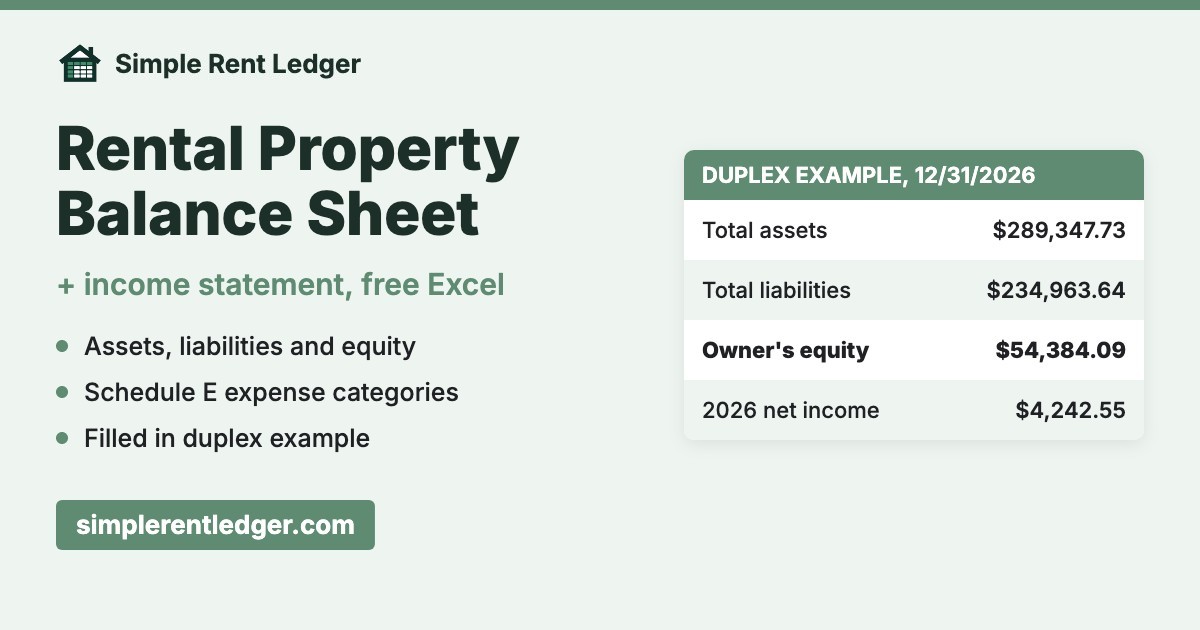
| Net income | $4,242.55 |
Balance sheet on 12/31/2026
| Line | Amount |
|---|---|
| Cash in the rental account | $7,850.00 |
| Security deposits held | $3,300.00 |
| Land | $60,000.00 |
| Building | $244,500.00 |
| Less accumulated depreciation (2024 to 2026) | ($26,302.27) |
| Total assets | $289,347.73 |
| Mortgage balance | $231,663.64 |
| Deposits owed to tenants | $3,300.00 |
| Total liabilities | $234,963.64 |
| Owner’s equity | $54,384.09 |
Notice that the deposits appear twice: as cash the owner holds and as a debt to the tenants. They add nothing to equity. Accumulated depreciation is $8,520.45 for 2024 (placed in service in January, so 11.5 months under the mid month rule) plus $8,890.91 for each of 2025 and 2026. The example tabs in the Excel file show every line.
Names, addresses and numbers in this example are made up. Figures were calculated without the IRS percentage tables, which can differ by a few dollars.
5 common mistakes
- Counting deposits as income when you plan to return them.
- Listing the whole mortgage payment as an expense. Only the interest is an expense; the principal lowers the mortgage balance.
- Depreciating the land. Only the building and improvements are depreciated.
- Mixing personal and rental money. A separate bank account makes the cash line easy. See landlord record keeping.
- Mixing cost and market value on one sheet. Pick one and label it.
When you need them
- At year end, before you prepare Schedule E.
- When you apply for a loan or refinance, if the lender asks for them.
- When you have a partner or co-owner who wants to see the numbers.
- When you compare properties. Pair them with a rent roll to see rents unit by unit.
Ask a tax professional about your situation, especially for depreciation and the first year you rent a property.
Comparing rentals before you buy? Try our free cap rate calculator.
Frequently asked questions
What goes on a rental property balance sheet?
Assets (cash, deposits held, land, the building and improvements at cost minus accumulated depreciation), liabilities (the mortgage balance, security deposits you must return and other debts) and owner’s equity, which is assets minus liabilities.
What is the difference between a balance sheet and an income statement for a rental?
A balance sheet shows what the rental owns and owes on one date. An income statement shows the income and expenses for a period, usually one year, and the net income or loss.
Are security deposits income on a rental income statement?
Not if you plan to return them. IRS Publication 527 says not to include a deposit in income when you receive it if you plan to return it. Any part you keep is income in the year you keep it.
Is the mortgage payment an expense on a rental income statement?
Only the interest is. The principal part of the payment is not deductible; it lowers the mortgage balance on the balance sheet.
Should a rental balance sheet use market value or cost?
This template uses cost minus depreciation, which matches your tax records. A lender may ask for current market value on its own form. Whichever you use, label it.
The numbers come from your rent ledger. Track every payment with our free rent ledger template.