How to Become a Section 8 Landlord: Requirements and Steps (2026)
To become a Section 8 landlord, you rent your unit to a family with a Housing Choice Voucher, your local public housing agency (PHA) inspects the unit and approves the rent, and you sign a lease with the tenant plus a contract with the PHA. The PHA then pays part of the rent to you each month and the tenant pays the rest. Below are the steps, the requirements your unit must meet, how the rent is split, and what changes after move in, all taken from HUD’s voucher rules.
How does Section 8 work for landlords?
“Section 8” is the common name for HUD’s Housing Choice Voucher program. HUD funds it, but it is run by local public housing agencies (PHAs), often called housing authorities. A family with a voucher looks for a home on the private market, and if you agree to rent to them, three agreements are involved:
- Your lease with the tenant, which must include HUD’s tenancy addendum.
- A housing assistance payments (HAP) contract between you and the PHA. Under it, the PHA pays its share of the rent directly to you.
- The family’s obligations to the PHA, which are between them and the housing authority, not you.
You stay the landlord. You choose your tenant, collect the tenant’s part of the rent, handle repairs and enforce the lease.
How to become a Section 8 landlord in 7 steps
- Find your local PHA. HUD keeps a contact list of housing agencies by state. Many PHAs run landlord briefings, list available units for voucher holders and publish their payment standards (the maximum subsidy by unit size).
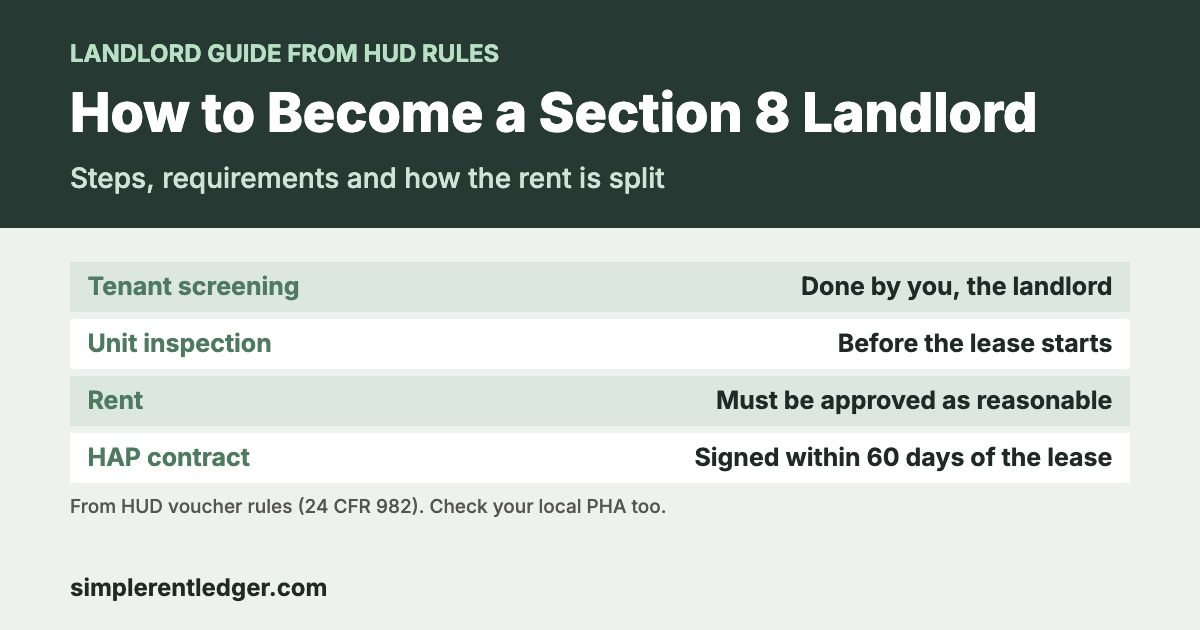
- Advertise the unit and screen applicants as usual. HUD’s rule is clear: “The owner is responsible for screening and selection of the family to occupy the owner’s unit.” Use the same written criteria for every applicant, for example with our rental application form.
- Fill in the Request for Tenancy Approval. The family gives you the PHA’s request packet. You fill in the unit details and the rent you are asking, and the family turns it in to the PHA.
- Pass the inspection. The PHA inspects the unit before the lease starts. It must pass HUD’s housing quality standards (see below).
- Agree on a reasonable rent. The PHA may not approve a tenancy unless the rent is reasonable compared with similar unassisted units nearby. At the start, the family’s share also cannot be more than 40% of its monthly adjusted income when the gross rent is above the payment standard, so a rent that is too high can block the move.
- Sign the lease and the HAP contract. Your lease must include HUD’s tenancy addendum. The PHA must sign the HAP contract no later than 60 calendar days after the lease starts, and it cannot pay you until the contract is signed.
- Set up payments. Give the PHA your payment details (many use direct deposit). From then on, you get the HAP from the PHA and the tenant’s share from the tenant each month.
Section 8 landlord requirements
Before approving a tenancy, the PHA must confirm that:
- The unit is an eligible type of housing.
- The unit was inspected and passes the inspection standard.
- The lease includes the HUD tenancy addendum.
- The rent to owner is reasonable.
- The family’s share passes the 40% test at move in, when it applies.
Which inspection standard? HUD is moving voucher inspections from the older housing quality standards (HQS) to its newer NSPIRE standards. Under HUD Notice PIH 2026-18 (July 15, 2026), the compliance date for voucher programs is February 1, 2027. Until then, PHAs may keep using HQS, but either way they must check the smoke alarm and carbon monoxide alarm requirements. Ask your PHA which checklist it uses and walk the unit with it before the inspection. Our free Section 8 inspection checklist follows the NSPIRE items so you can find problems first.
Can you say no to Section 8? Under federal law, taking part is voluntary, but many states and cities ban refusing a tenant because their rent is paid partly by a voucher. In California, for example, “source of income” in the fair housing law includes federal housing assistance vouchers, so a “No Section 8” policy or ad is not allowed there. Check your state and city rules before you advertise.
How much does Section 8 pay landlords?
It depends on the rent, the family’s income and the PHA’s payment standard. Each PHA sets payment standards, normally between 90% and 110% of HUD’s fair market rent for the unit size. When the rent is below the payment standard, the family generally pays 30% of its adjusted monthly income toward rent and the PHA pays the rest to you.
| Example (made up numbers) | Amount |
|---|---|
| Rent to owner (approved as reasonable) | $1,400 |
| Tenant’s share (set by the PHA from the family’s income) | $420 |
| Housing assistance payment from the PHA | $980 |
Your PHA tells you the exact split in writing, and it changes when the family’s income changes. You may not ask the tenant for more than their share. HUD’s rule says the owner “may not demand or accept any rent payment from the tenant in excess of this maximum,” and any extra must be returned.
After move in: inspections, rent and records
- Inspections: the PHA must inspect the unit at least every two years during the tenancy (every three years for some small rural PHAs), and may also inspect after a complaint. Fix failed items by the deadline, or the payments can be stopped.
- Payments: the PHA must pay the HAP promptly when due under the HAP contract, and the contract provides for late payment penalties, except when HUD finds the delay was beyond the PHA’s control.
- Rent changes: any increase must follow your lease, the HAP contract and the PHA’s process, and the new rent must still be reasonable.
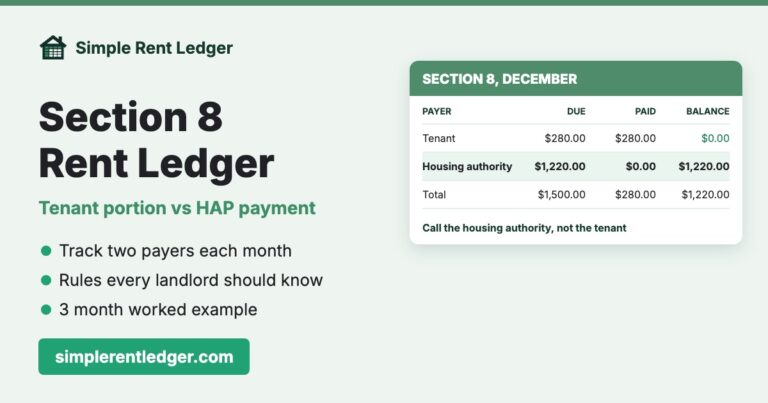
- Records: track the tenant’s share and the HAP as two separate charges, so you always know who is behind. Our Section 8 rent ledger guide shows how, with a 3 month example, and the free rent ledger template works for it.
Pros and cons
| Pros | Cons |
|---|---|
| Part of the rent comes from a government agency, paid directly to you | An inspection must pass before the lease starts, and again at least every two years |
| A larger pool of applicants | Paperwork and waiting time before the first payment |
| You still screen and choose your tenant | The rent must be approved as reasonable, and rent changes go through the PHA |
Each PHA has its own forms, payment standards and timelines, and state and city laws add their own rules. Check with your local housing authority, or ask a local attorney, before you sign a HAP contract.
Frequently asked questions
Who screens Section 8 tenants, the landlord or the housing authority?
The landlord. HUD’s rules say the owner is responsible for screening and selecting the family. The PHA checks the family’s eligibility for the voucher, not whether they will be a good tenant.
How long does it take to get the first Section 8 payment?
The PHA cannot pay until the HAP contract is signed, and it must sign it no later than 60 calendar days after the lease starts. If it is signed within that window, the PHA pays for the earlier part of the lease too.
Can a Section 8 landlord charge more than the tenant’s share?
No. The owner may not demand or accept more than the tenant’s share set by the PHA, and must return any extra payment.
How often are Section 8 units inspected?
Before the lease starts, then at least every two years during the tenancy (every three years for some small rural PHAs), plus any inspection after a complaint.
Sources
- 24 CFR 982.305 (PHA approval of tenancy, HAP contract timing)
- 24 CFR 982.307 (tenant screening)
- 24 CFR 982.405 (inspections)
- 24 CFR 982.451 (housing assistance payments)
- 24 CFR 982.503 (payment standards)
- HUD Notice PIH 2026-18, NSPIRE for voucher programs (July 15, 2026)
- California SB 329 (source of income, Government Code 12955)