Security Deposit Interest Calculator (2026 Rates by State and City)
Security deposit interest is the interest some states and cities require landlords to pay tenants on the deposit they hold. Most rules use simple interest: deposit x rate x time held. Pick your state or city below, enter the deposit and the dates, and the calculator shows what you owe. Rates and rules are taken from the laws and official agency pages, current for 2026.
Security Deposit Interest Calculator
How to calculate security deposit interest
Most laws use simple interest, which means interest is not added to the deposit before the next year’s interest is figured:
Interest = deposit x annual rate x (days held / 365)
- Connecticut example: a $2,400 deposit held for one year in 2026 at 0.49% earns $2,400 x 0.0049 = $11.76.
- San Francisco example: a $1,800 deposit held from March 1, 2026 to March 1, 2027 at 4.2% earns $1,800 x 0.042 = $75.60.
- Ohio example: rent is $1,200 and the deposit is $1,600. Only the $400 above one month’s rent earns interest, so one year at 5% is $400 x 0.05 = $20.00.
Maryland counts whole months instead of days, so choose “Full months held” there. For Minnesota, the calculator counts the months for you, from the month after you received the deposit through the month you return it. Where the law ties the rate to your bank account (New York, New Jersey, Pennsylvania, New Hampshire, Washington DC), use the rate on your bank statement.
Which states and cities require interest?
These are the rules we checked against the laws and official pages in October 2026. This list is not complete: other states and cities have their own rules, so check yours.
| Place | Rate and who it covers | When to pay | Law |
|---|---|---|---|
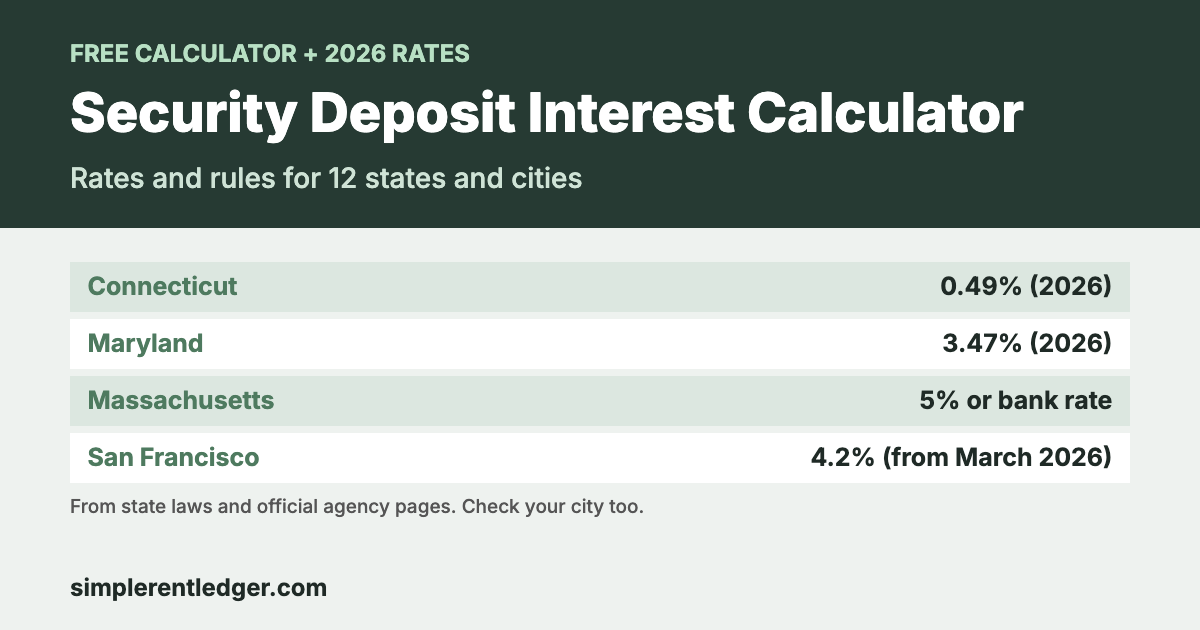
| Connecticut | 0.49% for 2026, set each year by the Banking Commissioner | Each year on the tenancy anniversary (cash or rent credit); within 21 days if the tenancy ends sooner | Gen. Stat. 47a-21 |
| Massachusetts | 5% a year, or the lower rate the bank actually paid | End of each year of the tenancy; within 30 days if the tenancy ends sooner | Ch. 186, Sec. 15B |
| Maryland | Greater of 1.5% or the 1 year Treasury rate on the first business day of the year (3.47% for 2026); simple, full months; deposits of $50 or more held at least 6 months | With the deposit, within 45 days after the tenancy ends | Real Prop. 8-203 |
| Minnesota | 1% simple interest, from the first day of the month after the deposit is paid in full to the last day of the month you return it; amounts under $1 are not owed | With the deposit at the end of the tenancy | Stat. 504B.178 |
| New Jersey | What the account earns; owner occupied two or three family homes are exempt, unless the tenant asks in writing (the law then applies 30 days later) | Each year, in cash or as a rent credit | N.J.S.A. 46:8-19 |
| New York | The rate the bank pays, in buildings with 6 or more units (or if the deposit is in an interest bearing account); landlord may keep 1% a year | Each year, as a rent credit, or at the end of the lease | Gen. Oblig. Law 7-103 |
| Ohio | 5% a year on the part of the deposit above $50 or one month’s rent, whichever is greater, if the tenant stays 6 months or more | Each year | Rev. Code 5321.16 |
| Pennsylvania | The rate the bank pays, for deposits over $100, starting after the deposit has been held 2 years; landlord may keep 1% a year | Each year on the lease anniversary | 68 P.S. 250.511b |
| New Hampshire | The bank’s regular savings rate, for deposits held one year or longer; some small and owner occupied rentals are exempt | With the deposit, within 30 days after the tenancy ends | RSA 540-A:6 |
| Washington DC | All interest earned in the escrow account, at least the statement savings rate on January 1 and July 1 | With the deposit, within 45 days after the tenancy ends | D.C. Code 42-3502.17 |
| Chicago | Rate set by the City each year (0.01% for 2026), for deposits held more than 6 months; owner occupied buildings with 6 or fewer units are exempt | Within 30 days after each 12 month rental period | Mun. Code 5-12-080 |
| San Francisco | 4.2% for March 1, 2026 to February 28, 2027, set each year by the Rent Board; none if the tenant leaves before one full year | Each year on the annual due date | Admin. Code ch. 49 |
How to pay it and keep records
- Put the deposit where the law says. Several of these states require a separate or interest bearing bank account and a written notice to the tenant with the bank’s name.
- Pay on time. Some places want interest every year, others only when the tenancy ends. Set a yearly reminder on the date you received the deposit.
- Write it down. Record the deposit, the bank, the rate and each interest payment or rent credit in a security deposit record, and show rent credits in your rent ledger.
Rates change every year in some places, and many cities add their own rules. Check your state and local law, or ask a local attorney, before you pay or withhold interest.
Frequently asked questions
How do you calculate interest on a security deposit?
Multiply the deposit by the annual rate and by the share of the year you held it. For example, a $2,400 deposit held one year at 0.49% earns $11.76. Some places use whole months, and some only count part of the deposit.
What is the security deposit interest rate in Connecticut for 2026?
0.49%, set by the Connecticut Banking Commissioner. It was 0.52% for 2025.
Do all states require interest on security deposits?
No. Only some states and cities do, including Connecticut, Massachusetts, Maryland, Minnesota, New Jersey, Ohio and San Francisco, and some apply only to certain buildings or after the deposit has been held for a while.
Sources
- Connecticut Department of Banking: 2026 deposit index and Gen. Stat. 47a-21
- Massachusetts General Laws ch. 186, sec. 15B
- Maryland Real Property 8-203 and U.S. Treasury yield curve rates, January 2026
- Minnesota Statutes 504B.178
- N.J.S.A. 46:8-19 and 46:8-26
- New York General Obligations Law 7-103 and New York Attorney General
- Ohio Revised Code 5321.16
- Pennsylvania 68 P.S. 250.511b
- New Hampshire RSA 540-A:6
- D.C. Code 42-3502.17
- Chicago Residential Landlord and Tenant Ordinance and Chicagoland Apartment Association: 2026 Chicago rate
- San Francisco Rent Board: rate effective March 1, 2026