Prorated Rent Calculator (Free): Move In and Move Out
Prorated rent (also called pro rata rent) is the partial rent a tenant pays for only the days they live in the unit during a month. To prorate rent, work out a daily rate and multiply it by the number of days the tenant has the unit. Enter the monthly rent and the move in or move out date below, and the calculator does it instantly with any of the 3 common methods.
Prorated rent formula: prorated rent = (monthly rent ÷ days in the month) × days the tenant has the unit.
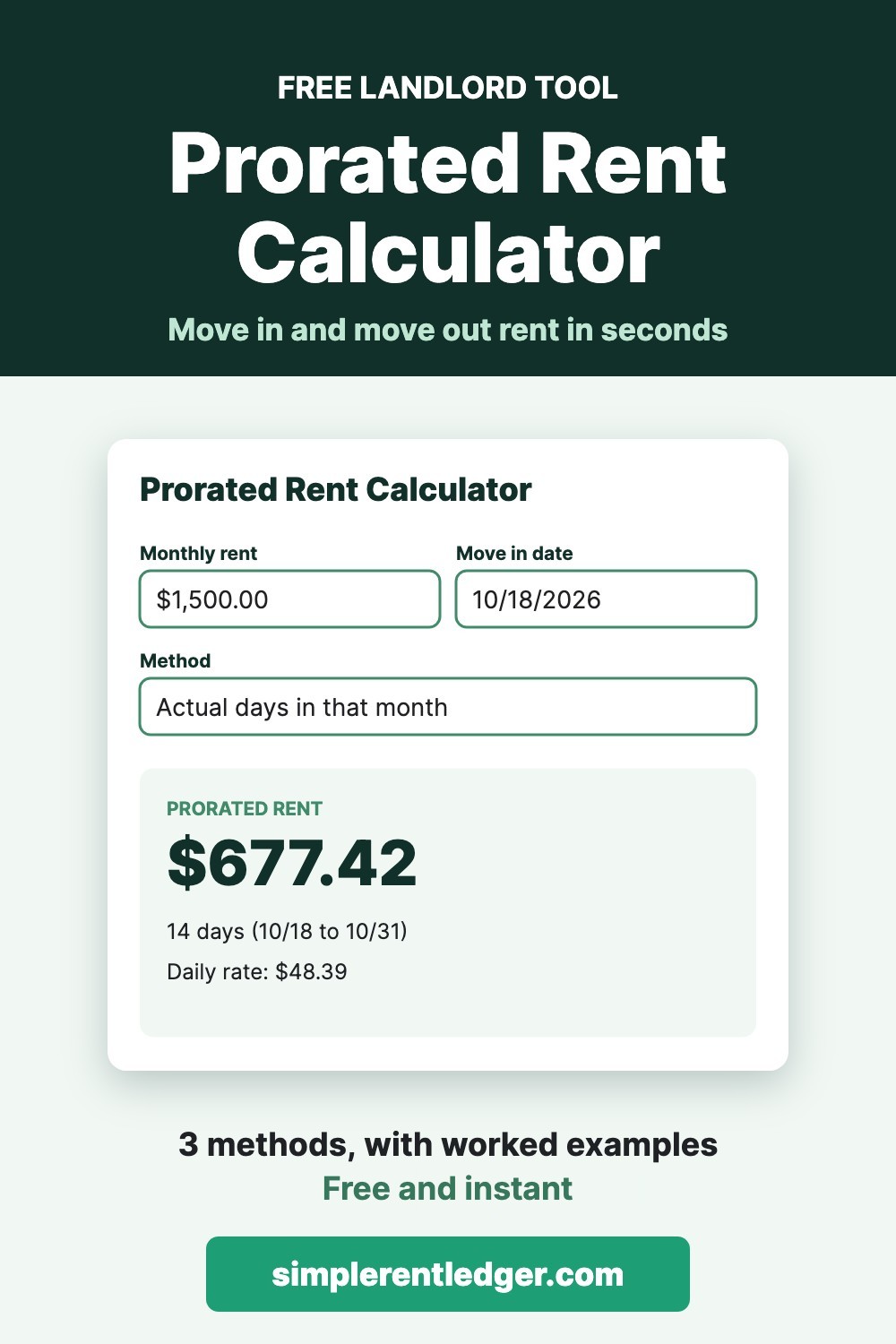
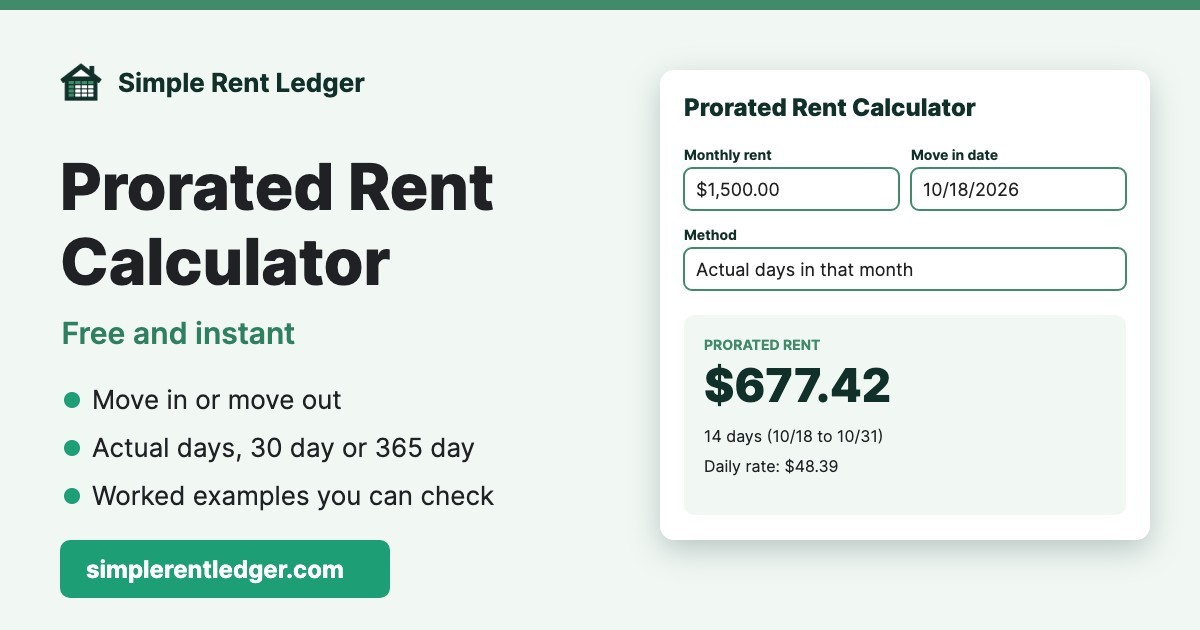
Example: rent is $1,500 and the tenant moves in on October 18. October has 31 days, so the tenant has the unit for 14 days: $1,500 ÷ 31 × 14 = $677.42.
Prorated Rent Calculator
Free, nothing to buy. Use Move in or Move out for one partial month, or Start and end date when the rent period runs across several months (for example a mid-month move in with a lease that ends mid-month). Then click Print or save as PDF to get a prorated rent statement with the dates, days, amounts and signature lines. Nothing you type is saved or sent.
Watch: how to prorate rent, step by step

 Simple Rent LedgerFree landlord tutorials on YouTube
What is prorated rent?
When a lease starts or ends in the middle of a month, charging a full month would not be fair to the tenant. Prorating means charging only for the days the tenant actually has the unit. It is most common in the first month of a new lease and the last month of a tenancy. In short, the prorated rent meaning is rent for part of a month: the tenant pays only for the days they have the unit.
How to calculate prorated rent (formula and steps)
Here is how to prorate rent by hand. Every method uses the same 2 steps:
- Find the daily rate. Divide the rent by the number of days, using one of the methods below.
- Multiply by the days charged. Count the days the tenant has the unit, including the move in day.
Prorated rent for a move in: example
Here is a move in example. Rent is $1,500 a month and the tenant moves in on October 18, 2026. October has 31 days, so the tenant has the unit for 14 days (October 18 through 31).
| Method | Daily rate | Prorated rent for 14 days |
|---|---|---|
| Actual days in the month | $1,500 / 31 = $48.39 | $677.42 |
| 30 day month | $1,500 / 30 = $50.00 | $700.00 |
| 365 day year | $1,500 x 12 / 365 = $49.32 | $690.41 |
Tip: round only the final answer. Rounding the daily rate first can change the total by a few cents.
Which proration method should you use?
- Actual days in the month is the most common. The daily rate changes with the month (28, 29, 30 or 31 days), but the result always matches the real calendar.
- 30 day month (a banker’s month) is the simplest. It gives a slightly higher amount in 31 day months and a lower one in February.
- 365 day year uses the yearly rent divided by 365, so the daily rate is the same in every month.
There is no single right answer. What matters is that your lease says which method you use and that you apply it the same way to every tenant. If your lease is silent, the actual days method is the safest choice because it is the easiest to explain.
How do you prorate rent when a tenant moves out?
For a move out, count from the 1st of the month through the last day the tenant has the unit. Using the same $1,500 rent, a tenant who moves out on November 12, 2026 has 12 days. November has 30 days, so the actual days method gives $1,500 / 30 x 12 = $600.00. Switch the calculator above to Move out to check any date.
Remember that the security deposit is separate. Prorated rent is a rent charge, and any deposit deductions follow your state’s deposit rules.
Common proration mistakes
- Forgetting to count the move in day. October 18 through 31 is 14 days, not 13.
- Using the wrong month length. Use the days in the month the tenant moves, not the month after.
- Switching methods between tenants. Pick one method, put it in your lease and stick with it.
- Not writing it down. Record prorated rent as its own line in your rent ledger and give a rent receipt when it is paid.
Note: Lease terms and local rules on rent and move dates vary by state and city. Check your lease and local rules, or ask a local attorney.
Related free forms for move in and move out
- Move in inspection checklist: record the unit condition on day one
- Move out checklist: inspect the unit when the tenant leaves
- Security deposit receipt: give the tenant proof of the deposit
Frequently asked questions
Can I print the prorated rent calculation for my tenant?
Yes. Fill in the calculator, add the tenant name and property address if you want, and click Print or save as PDF. You get a one page statement with each month, the dates and days charged, the total due and lines for both signatures. Keep a copy with your rent ledger.
How do you prorate rent?
Divide the monthly rent by the number of days in that month to get a daily rate, then multiply it by the days the tenant has the unit, counting the move in day. For $1,500 rent and a move in on October 18, that is $1,500 ÷ 31 × 14 = $677.42.
Is the move in day counted in prorated rent?
Usually yes. Most landlords charge rent starting on the day the tenant gets the keys, so the move in day counts as a rent day. Write your rule in the lease so there is no debate.
Do landlords have to prorate rent?
In most states there is no general law that requires it. It is usually a business choice or a lease term. Some leases and local rules do address it, so check your lease and your state rules.
Can I charge a full month and prorate the second month instead?
Yes, many landlords do this when a tenant moves in late in the month. For example, a tenant who moves in on the 25th pays the prorated days plus the next full month at signing, so rent is due on the 1st from then on.
Which proration method is fairest?
The actual days method is the most common because it matches the real length of the month. The 365 day method gives the same daily rate all year, which some landlords find easier to explain. Pick one and use it every time.
Where do I record prorated rent?
Log it as its own charge in your rent ledger, with a note such as Prorated rent, Oct 18 to Oct 31. You can log it as a charge in our free rent ledger template, so your running balance stays correct.
What does prorated rent mean?
It means rent charged only for the part of the month the tenant has the unit, not the full month. Example: rent is $1,500 and the tenant moves in on June 21. June has 30 days, so the tenant has 10 days, counting the move in day: $1,500 ÷ 30 × 10 = $500 (actual days method).