Cash on Cash Return Calculator for Rental Property
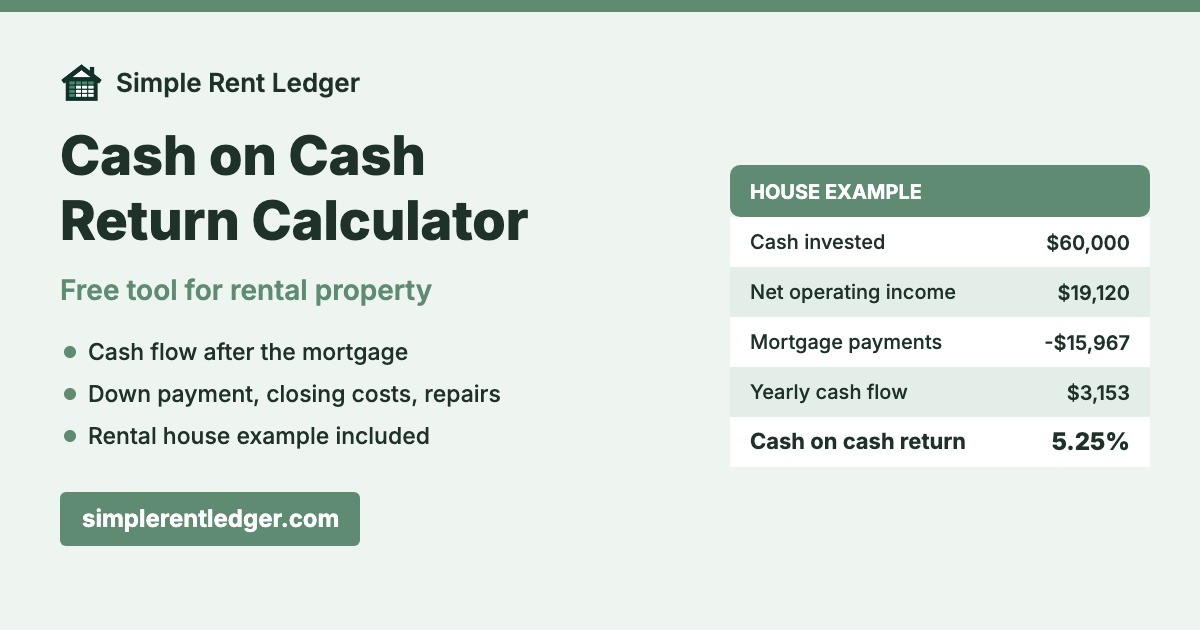
Cash on cash return is the yearly cash flow from a rental, after the mortgage payment, divided by the cash you put in to buy it. A house bought with $60,000 of your own cash that leaves $3,153 a year after all costs and the mortgage has a cash on cash return of 5.25%. Enter your numbers in this cash on cash calculator to see the cash on cash return of a rental you own or want to buy.
Cash on Cash Return Calculator
Free to use. Your numbers stay in your browser.
What is cash on cash return?
Cash on cash return (also called cash on cash ROI) shows how hard the cash you invested is working. It compares the money a rental puts in your pocket each year, after every cost and the mortgage, with the money you took out of your own pocket to buy it.
Because it includes the loan, two people who buy the same property can get very different cash on cash returns. That makes it the number to check when you are deciding how much to put down and which loan to use.
Cash on cash return formula
Cash on cash return = yearly cash flow before taxes ÷ total cash invested × 100
- Yearly cash flow = rent and other income, minus vacancy, minus operating costs (taxes, insurance, repairs, management, utilities, HOA), minus the mortgage payments for the year.
- Total cash invested = down payment + closing costs + repairs or upgrades you paid before renting it out. Closing costs can include charges like appraisal fees, title insurance and prepaid taxes (CFPB).
How to calculate cash on cash return
- Add up a year of rent from all units, plus any other income such as parking or laundry.
- Subtract an allowance for vacancy and unpaid rent. Use your own history if you have it; if not, choose a cautious estimate, such as 5% of the rent.
- Subtract the yearly operating costs. The result is net operating income (NOI).
- Subtract 12 months of mortgage payments (principal and interest). The result is your yearly cash flow.
- Divide the cash flow by the total cash you invested and multiply by 100.
The calculator above does each step for you and shows the cap rate next to it, so you can see the property with and without the loan.
Example: a $250,000 rental house
A landlord buys a single family house for $250,000 with 20% down and a 30 year loan at 7%. The house rents for $2,300 a month. These are the numbers already filled in the calculator:
| Line | Amount |
|---|---|
| Down payment | $50,000 |
| Closing costs | $6,000 |
| Repairs before the first tenant | $4,000 |
| Total cash invested | $60,000 |
| Rent: $2,300 × 12 | $27,600 |
| Vacancy allowance (5%) | −$1,380 |
| Taxes, insurance, repairs and water ($3,000 + $1,500 + $2,000 + $600) | −$7,100 |
| Net operating income | $19,120 |
| Mortgage: $200,000 at 7% for 30 years ($1,330.60 × 12) | −$15,967.26 |
| Yearly cash flow | $3,152.74 ($262.73 a month) |
| Cash on cash return: $3,152.74 ÷ $60,000 | 5.25% |
Two quick tests show how much the result depends on your choices:
- Paying all cash: no mortgage, so the cash flow is the full $19,120, but the cash invested is $260,000. The cash on cash return is $19,120 ÷ $260,000 = 7.35%.
- Hiring a manager at 8% of the rent collected ($2,097.60 a year): the cash flow drops to $1,055.14 and the cash on cash return to 1.76%.
The numbers in this example are made up. Run your own, and try a few versions.
What is a good cash on cash return?
There is no official or standard number. A return that one investor is happy with, another would turn down. Three practical checks:
- Is it positive with honest numbers? Include vacancy, repairs and a reserve for big items. A deal that only works with perfect numbers is risky.
- How does it compare with what the same cash could earn elsewhere? If a low risk option pays more, the rental has to make up for it in other ways, like future value or loan paydown.
- Does it still work if something changes? Test a higher interest rate, a month of vacancy or a manager. The example above drops from 5.25% to 1.76% with a manager.
Set your own target before you look at deals, and compare similar properties with the same assumptions.
Cash on cash return vs cap rate vs ROI
| Cash on cash return | Cap rate | Total ROI | |
|---|---|---|---|
| Formula | Cash flow after mortgage ÷ cash invested | NOI ÷ price | All gains ÷ cash invested |
| Includes the mortgage? | Yes | No | Yes |
| Includes loan paydown and value change? | No | No | Yes |
| Best for | Judging your own deal and loan | Comparing properties | Looking back once you sell |
To compare properties before financing, use our cap rate calculator. To see how much you really make once you own the rental, track every payment and cost in the rent ledger and the rental expense spreadsheet.
What cash on cash return does not show
- Loan paydown: each payment also lowers the loan balance, which builds equity but is not cash in hand.
- Change in value: the property can rise or fall in value.
- Taxes: it is a before tax number. Depreciation and other deductions can lower the tax on rental income; see how rental income is taxed.
- Big repairs ahead: one year of numbers can hide a roof or furnace that needs replacing soon.
- Later years: rent, taxes and insurance change, so recheck it each year with real numbers.
Check the numbers with your own records and, before you buy, with a qualified professional.
Related free tools
- Cap rate calculator: compare properties before the loan
- Rental property expense spreadsheet: track the real costs
- Rental property balance sheet: what the rental owns and owes
- Rental depreciation calculator: the yearly tax deduction for the building
Frequently asked questions
What is cash on cash return in real estate?
It is the yearly cash flow from a rental after all costs and the mortgage payment, divided by the cash you invested (down payment, closing costs and early repairs). It shows the return on your own cash before income taxes.
How do you calculate cash on cash return?
Take a year of rent and other income, subtract vacancy, operating costs and 12 months of mortgage payments, then divide the result by your total cash invested and multiply by 100.
What is the cash on cash return formula?
Cash on cash return = yearly pre-tax cash flow ÷ total cash invested × 100.
Is cash on cash return the same as ROI?
No. Cash on cash return counts only the yearly cash flow. A total ROI also counts loan paydown, a change in value and, when you sell, the sale proceeds.
What is a good cash on cash return?
There is no official number. Make sure it is positive with honest numbers, compare it with what the same cash could earn elsewhere, and test it with a higher rate, a vacancy or a manager.
Does cash on cash return include the mortgage?
Yes. The mortgage payment is subtracted to get the cash flow, and only your own cash counts as the investment. The cap rate is the measure that leaves the loan out.