Move In Inspection Checklist for Landlords: Free Fillable PDF and State Rules
A move in inspection checklist is a room by room record of the rental’s condition on the day the tenant moves in, signed by you and the tenant. It lists every existing scratch, stain and chip, with dated photos, so at move out you can tell new damage from old and keep only what the law allows from the security deposit. Below is a free move in checklist you can fill in on screen or print, how to do the walk through step by step, and which states require one.
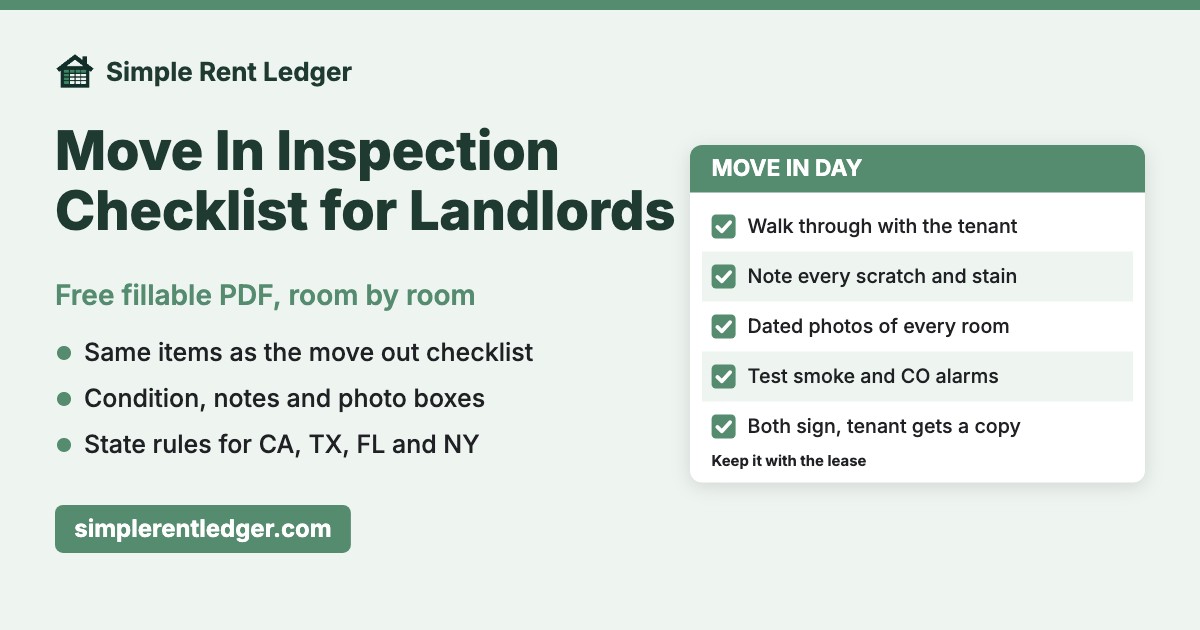
Free fillable move in checklist (PDF). One page, room by room, with boxes for condition, existing damage and photos, plus keys, meter readings, alarms and both signatures. It uses the same items as our move out checklist, so you can compare the two side by side.
Why does a move in checklist matter?
Most security deposit fights come down to one question: was that damage there before the tenant moved in? Without a signed record, it is your word against theirs, and in many states the landlord has to prove the deduction. A good move in checklist settles it.
- It protects the deposit. You can charge for damage beyond normal wear and tear, but only if you can show the unit was in better shape at move in.
- It protects the tenant too, so they do not pay for the last tenant’s damage. That fairness usually means fewer disputes.
- Some states require it. In a few states you cannot keep any of the deposit for damage unless you gave the tenant a written move in checklist (see the state table).
- It makes move out fast. Walk the same list on move out day with our move out checklist and the differences jump out.
The move in checklist, room by room
For each item, write the condition (New, Good, Fair or Poor) and describe anything that is not perfect: what it is, where it is and how big. “Scratch on floor” is weak. “4 inch scratch on hardwood floor, 2 feet left of the bedroom door” is strong.
Living areas and bedrooms
- Walls and ceilings: paint color and finish, nail holes, marks, cracks, water stains
- Floors and carpet: stains, burns, scratches, loose tiles, carpet age if you know it
- Windows, screens and blinds: cracks, tears, broken slats, locks that work
- Doors, locks and light fixtures: dents, sticking doors, missing bulbs or covers
- Closets: rods, shelves, sliding doors on their tracks
Kitchen
- Stove, oven and hood: every burner works, oven clean, filter in place
- Refrigerator: cold, shelves and drawers all there, ice maker working or not
- Dishwasher and microwave: run each one for a minute
- Cabinets, counters and sink: chips, burns, stains, drips under the sink, garbage disposal
Bathrooms
- Toilet, tub and shower: flushes, drains, no leaks, condition of the tub surface
- Sink, vanity and mirror: chips, cracks, water damage inside the cabinet
- Exhaust fan, tile and caulk: fan runs, grout and caulk clean, no mold
Whole home and outside
- Smoke and carbon monoxide alarms: press test on each one and write down that it worked
- HVAC filter and water heater: filter date, thermostat works, no leaks
- Yard, garage, patio and outside: lawn, fences, garage door opener
- Keys and access: how many keys, remotes, fobs and mailbox keys you hand over
- Meter readings: electric, water and gas, if the tenant takes over those utilities
How do you do a move in inspection?
- Schedule it before you hand over the keys, ideally the same day, after cleaning and repairs are done.
- Invite the tenant to walk through with you. Two sets of eyes catch more, and a tenant who helped fill it in rarely disputes it later.
- Go room by room in the same order as the checklist, and test things: run water, flush toilets, open windows, press alarm buttons.
- Write specific notes with location and size, and mark the photo box when you take a picture of an item.
- Record keys, remotes and meter readings at the bottom of the form.
- Both sign and date it. If the tenant finds something later, let them add it in writing within a few days and attach it to the checklist.
- Give the tenant a copy and keep yours with the lease and your security deposit records.
How do you take move in photos that hold up?
- Shoot every room from each corner, then close ups of every flaw you wrote down. Put a coin or tape measure next to a stain or scratch to show size.
- Keep the date. Phone photos store the date in the file. Do not edit or crop the originals; save copies if you need to.
- Add a slow video walk through, talking through each room. It takes five minutes and fills gaps in the photos.
- Store them in one folder per unit and tenant (for example “Unit B, Maria Lopez, move in 12/01/2026”), backed up in the cloud, and share a link with the tenant.
Example: Maria Lopez moves into Unit B at 418 Elm Street, Sacramento, on 12/01/2026. The landlord, David Chen, notes “Good” for the kitchen counters but writes “1 inch chip on counter edge right of sink, photo 14.” At move out a year later the chip is still 1 inch, so it is not Maria’s damage. A new burn mark next to it is.
Which states require a move in checklist?
A move in checklist is a smart habit everywhere, and in some states the law requires one. Here are the rules in the four biggest rental states, plus other states with a written move in requirement.
| State | Move in rule | Law |
|---|---|---|
| California | For tenancies that began on or after 07/01/2025, the landlord must take photos of the unit right before or at the start of the tenancy. Move out and after repair photos are required for all tenancies since 04/01/2025, and must go with any deduction for repairs or cleaning. | Civ. Code 1950.5(g) |
| New York | After the lease is signed and before move in, the landlord must offer the tenant an inspection. If the tenant asks for it, both sign a written agreement listing existing defects, and the landlord cannot keep deposit money for anything listed. Rent controlled units and some senior housing are excluded. | Gen. Oblig. Law 7-108(1-a)(c) |
| Texas | No state law requires a move in checklist. Use one anyway; it is your best proof at move out. | Prop. Code ch. 92 |
| Florida | No state law requires a move in checklist. The deposit law covers how you hold and return the deposit. | Fla. Stat. 83.49 |
| Washington | You must give the tenant a written checklist or statement of condition at the start of the tenancy, signed and dated by both. Without it, you cannot keep any of the deposit. | RCW 59.18.260 |
| Virginia | Within 5 days after the tenant moves in, give a written report of existing damage. It counts as accurate unless the tenant objects in writing within 5 days. | Va. Code 55.1-1214 |
| Massachusetts | If you take a deposit, give a signed statement of the unit’s condition when you receive the deposit or within 10 days after the tenancy starts, whichever is later. | M.G.L. c. 186, s. 15B |
| Michigan | If you take a deposit, give the tenant two blank inventory checklists. The tenant returns one within 7 days after moving in. | MCL 554.608 |
| Arizona | Give the tenant a move in form for listing existing damage. | A.R.S. 33-1321 |
| Georgia | Before you accept a deposit, give the tenant a list of existing damage to inspect and sign. Small landlords who own 10 or fewer units and do not use a paid manager may be exempt. | O.C.G.A. 44-7-33 (Georgia handbook) |
| Kentucky | In cities and counties that adopted the state’s landlord tenant act, give a list of existing damage before taking a deposit, or you cannot keep any of it. | KRS 383.580 |
| Maryland | The deposit receipt must tell tenants they can ask, by certified mail within 15 days of moving in, for an inspection to list existing damage. | Real Prop. 8-203.1 |
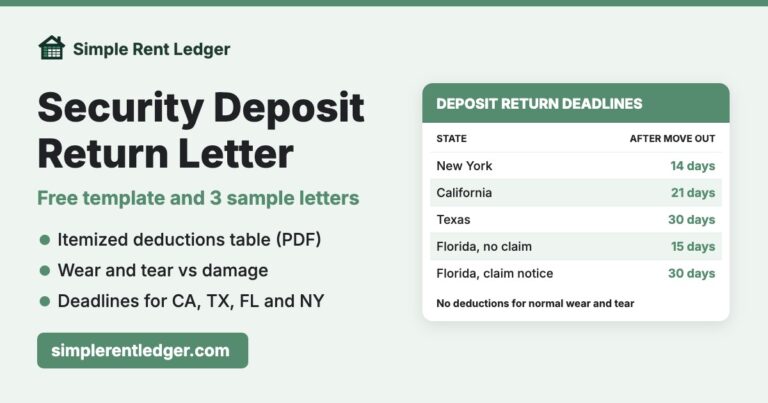
For every deposit rule in one place, see our California, Texas, Florida and New York landlord guides. When the tenant leaves, use our move out checklist and security deposit return letter.
Note: Deposit and inspection rules change and vary by city, so check your local rules before you rely on them.
Not at move in yet? Before you sign the lease, use our free tenant screening checklist (fillable PDF) to screen every applicant the same way.
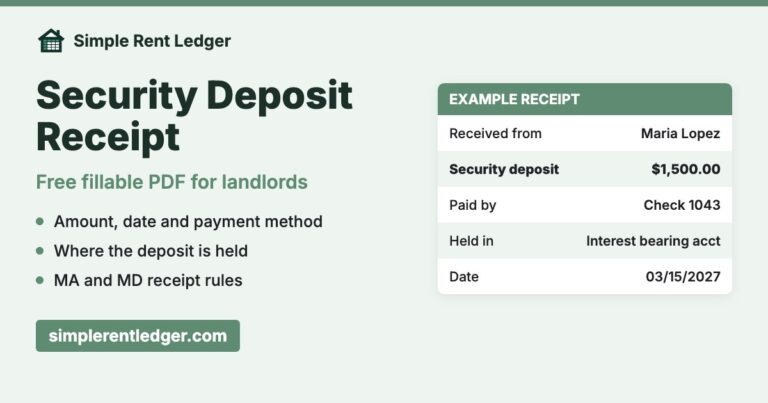
Collecting the deposit at move in? Give the tenant a signed security deposit receipt template too.
Mail still arriving for the last tenant? See what to do with mail for a previous tenant.
Renting to a Housing Choice Voucher tenant? See our Section 8 inspection checklist.
Record the first month’s rent and the deposit on move-in day in our free rent ledger template.
New to renting out a property? Our guide on how to be a landlord walks through each step, with a free first time landlord checklist.
During the lease, use our rental property inspection checklist for routine visits, so you have a dated record of each one.
Frequently asked questions
What should be on a move in checklist for landlords?
Every room and item: walls, floors, windows, doors, kitchen appliances, cabinets, bathroom fixtures, smoke and CO alarms, HVAC and the outside. For each, write the condition and any existing damage with its location and size. Add keys given, meter readings, the photo date and both signatures.
Who fills out the move in inspection checklist?
Usually the landlord fills it out during a walk through with the tenant, and both sign. In Michigan the tenant fills in and returns one copy within 7 days. Either way, the tenant should get a signed copy.
What if the tenant refuses to sign the checklist?
Write “tenant declined to sign” with the date, give them a copy anyway, and rely on your dated photos and video. Invite them in writing to add anything they think you missed within a few days.
Are photos enough without a checklist?
Photos are strong proof, and California requires them for tenancies starting on or after 07/01/2025. But a signed checklist is better, because the tenant agreed to it in writing, and some states like Washington require the written checklist itself.
How long should I keep the move in checklist?
Keep it, with the photos, for the whole tenancy and until the deposit is settled after move out. Many landlords keep it a few years longer with their tax and lease records. See our landlord record keeping guide.
Sources
- California Civil Code 1950.5
- New York General Obligations Law 7-108
- Texas Property Code Chapter 92
- Florida Statutes 83.49
- Washington RCW 59.18.260
- Virginia Code 55.1-1214
- Massachusetts General Laws c. 186, s. 15B
- Michigan Compiled Laws 554.608
- Arizona Revised Statutes 33-1321
- Georgia Landlord Tenant Handbook (DCA)
- Kentucky Revised Statutes 383.580
- Maryland Real Property 8-203.1