Late Rent Fee: How Much Can You Charge and How to Record It
A late rent fee is a charge in the lease that a tenant pays when rent arrives after the due date and any grace period. Most small landlords use either a flat amount, such as $50, or a percentage of the monthly rent, such as 5%. Some states set limits, so the right fee depends on where your rental is. Below are the rules for California, Texas, Florida and New York, plus how to record a late fee in your ledger.
Free bonus: the Landlord Starter Kit. Get the filled in example ledger, the Quick Start guide and 5 printable forms (late rent notice, partial payment agreement, move in and out checklist, security deposit record and year end tax checklist) when you join our email list. Get the kit
What is a late rent fee?
A late fee covers the extra work and cost a landlord has when rent is late: follow up calls, notices and the delay in paying the mortgage or bills. It is not a penalty to punish the tenant. Courts in many states look at whether the fee is reasonable, so keep it fair and clearly written in the lease.
Should you charge a flat fee or a percentage?
Here is how the two common options compare on a $1,400 monthly rent:
| Type | Example | Good to know |
|---|---|---|
| Flat fee | $50 once rent is late | Easy to explain and the same every month. |
| Percentage | 5% of rent = $70 | Grows with the rent, so it stays fair if you raise rent later. |
Whichever you pick, write the exact amount or percentage in the lease, the day it applies, and how it is paid. Then charge it the same way to every tenant.
What is a grace period?
A grace period is the number of days after the due date when rent is still accepted without a late fee. For example, rent is due on the 1st with a 5 day grace period, so the late fee applies if rent is still unpaid at the end of the 5th. Some states require a minimum grace period, so check the 50-state table below before you set yours.
How much can you charge? Rules in CA, TX, FL and NY
| State | Late fee rule | Source |
|---|---|---|
| California | No fixed dollar or percentage cap in state law. A late fee in a residential lease is treated as liquidated damages and must be a reasonable estimate of the landlord’s actual loss. Some cities have their own rules. | California Civil Code 1671 |
| Texas | The fee must be in a written lease, it can only be charged after rent is unpaid for two full days after the due date, and it must be reasonable. It is considered reasonable at up to 12% of monthly rent for a building with 4 or fewer units (10% for larger buildings). | Texas Property Code 92.019 |
| Florida | No statewide cap or required grace period for homes and apartments. The fee comes from the lease, and a court can refuse to enforce a term it finds unconscionable. | Florida Statutes 83.45 |
| New York | The fee can be no more than $50 or 5% of monthly rent, whichever is less, and only if rent is more than 5 days late. | NY Real Property Law 238-a |
Example: with $1,400 rent, the most a New York landlord can charge is $50 (5% would be $70, and the law uses whichever is less). A Texas landlord with a duplex can charge up to $168 (12%), which the law considers reasonable. Always check your city as well, since some local rules are stricter than state law. To work out the exact fee for your dates, use our free late rent fee calculator.
Late fee laws in all 50 states and DC
This table shows the statewide rules for homes and apartments: the grace period the law requires before a late fee, and the most you can charge. “None in state law” means the state sets no number. Your lease still has to state the fee, and courts in every state can refuse a fee that is unfair. City and county rules can be stricter, for example in Chicago, Cook County and some Ohio cities such as Cleveland.
Last checked: November 2026, against the state law linked in each row. Laws change, often on January 1 and July 1.
| State | Grace period in state law | Late fee limit | Law |
|---|---|---|---|
| Alabama | None in state law | No set limit in state law. The fee must be in the lease and reasonable. | Ala. Code 35-9A |
| Alaska | None in state law | No set limit in state law. The fee must be in the lease and reasonable. | AS 34.03 |
| Arizona | None in state law | No set dollar limit. Must be reasonable and written in the lease. (Mobile home parks have separate rules.) | A.R.S. 33-1368(B) |
| Arkansas | None in state law | No set limit in state law. The fee must be in the lease and reasonable. | Ark. Code 18-17 |
| California | None in state law | No set limit. Must be a reasonable estimate of the landlord’s actual loss. Some cities add rules. | Civ. Code 1671(d) |
| Colorado | 7 days | The greater of $50 or 5% of the past-due rent. Must be in the lease. | C.R.S. 38-12-105 |
| Connecticut | 9 days (4 days for week-to-week) | The lesser of $5 a day up to $50, or 5% of the late payment. One fee per late payment. | C.G.S. 47a-15a |
| Delaware | 5 days | 5% of the monthly rent. | 25 Del. C. 5501(d) |
| District of Columbia | 5 days | 5% of the rent due. Must be in a written lease. One fee per late payment. | D.C. Code 42-3505.31 |
| Florida | None in state law | No set limit in state law. The fee must be in the lease and reasonable. | Fla. Stat. ch. 83, Part II |
| Georgia | None in state law | No set limit in state law. Georgia courts have allowed a late fee that is a fair estimate of the landlord’s loss, written in the lease. | O.C.G.A. 44-7 |
| Hawaii | None in state law | 8% of the rent due. Must be in the rental agreement. | HRS 521-21(f) |
| Idaho | None in state law | No set number. Fees, including late fees, must be reasonable. | Idaho Code 55-305(1) |
| Illinois | None in state law | No statewide limit. Chicago: $10 plus 5% of rent over $500. Cook County (outside Chicago, Evanston, Mount Prospect): $10 plus 5% of rent over $1,000. | Chicago RLTO 5-12-140(h); Cook County RTLO |
| Indiana | None in state law | No set limit in state law. The fee must be in the lease and reasonable. | IC 32-31 |
| Iowa | None in state law | Rent $700 or less: $12 a day, up to $60 a month. Rent over $700: $20 a day, up to $100 a month. | Iowa Code 562A.9(4) |
| Kansas | None in state law | No set limit in state law. The fee must be in the lease and reasonable. | K.S.A. 58-2540 to 58-2573 |
| Kentucky | None in state law | No set limit in state law. The fee must be in the lease and reasonable. | KRS 383.500 to 383.705 |
| Louisiana | None in state law | No set limit. A court can reduce a fee that is clearly unreasonable. | La. Civ. Code arts. 2005, 2012 |
| Maine | 15 days | 4% of one month’s rent. The tenant must be told in writing when the lease is made. | 14 M.R.S. 6028 |
| Maryland | None in state law | 5% of the unpaid rent due for the period, since Oct 1, 2025 (weekly rent: $3 a week, up to $12 a month). | Real Prop. 8-208(d)(3) |
| Massachusetts | 30 days | No set amount, but no late fee or interest until rent is 30 days late. | M.G.L. c.186 §15B(1)(c) |
| Michigan | None in state law | No set limit in state law. The fee must be in the lease and reasonable. | MCL 554.601 to 554.641 |
| Minnesota | None in state law | 8% of the overdue rent. Must be agreed in writing, including when the fee starts. | Minn. Stat. 504B.177 |
| Mississippi | None in state law | No set limit in state law. The fee must be in the lease and reasonable. | Miss. Code 89-8 |
| Missouri | None in state law | No set limit in state law. The fee must be in the lease and reasonable. | RSMo ch. 441 and 535 |
| Montana | None in state law | No set limit in state law. The fee must be in the lease and reasonable. | Mont. Code 70-24 |
| Nebraska | None in state law | No set limit in state law. The fee must be in the lease and reasonable. | Neb. Rev. Stat. 76-1401 to 76-1449 |
| Nevada | 3 days | 5% of the periodic rent. Must be reasonable and in the rental agreement. | NRS 118A.210(4) |
| New Hampshire | None in state law | No set limit in state law. The fee must be in the lease and reasonable. | RSA 540, 540-A |
| New Jersey | 5 business days, only for some seniors and benefit recipients | No set limit in state law. | N.J.S.A. 2A:42-6.1 |
| New Mexico | None in state law | 5% of the rent for each period it is late (cut from 10% in June 2025). | NMSA 47-8-15(D) |
| New York | 5 days | The lesser of $50 or 5% of the monthly rent. | RPL 238-a(2) |
| North Carolina | 5 days | The greater of $15 or 5% of monthly rent (weekly rent: $4 or 5%). One fee per late payment. | G.S. 42-46(a) |
| North Dakota | None in state law | No set limit in state law. The fee must be in the lease and reasonable. | N.D.C.C. 47-16 |
| Ohio | None in state law | No set limit in state law. The fee must be in the written lease, and a court can refuse an unfair (unconscionable) term. Some cities, such as Cleveland, set their own limits. | Ohio R.C. 5321 |
| Oklahoma | None in state law | No set limit in state law. The fee must be in the lease and reasonable. | 15 O.S. 213-215; 41 O.S. 101 and after |
| Oregon | 4 days (fee if rent is not received by the 4th day) | One of 3 methods: a reasonable flat fee once a period; a daily fee up to 6% of that flat fee; or 5% of rent for each 5 days late. Must be in the written agreement. | ORS 90.260 |
| Pennsylvania | None in state law | No set limit in state law. The fee must be in the lease. The state Attorney General has gone to court over late fees it called unfair. | Landlord and Tenant Act of 1951 |
| Rhode Island | None in state law | No set limit. The fee must be disclosed in the lease. | R.I. Gen. Laws 34-18 |
| South Carolina | None in state law | No set limit in state law. Late charges count as part of the rent. | S.C. Code 27-40 |
| South Dakota | None in state law | No set limit in state law. The fee must be in the lease and reasonable. | SDCL 43-32 |
| Tennessee | 5 days (counties under the URLTA) | 10% of the past-due rent (counties under the URLTA, population over 75,000). | T.C.A. 66-28-201(d) |
| Texas | Fee only after rent is unpaid two full days after the due date | Must be reasonable. Up to 12% of monthly rent is considered reasonable for buildings with 4 or fewer units (10% for more). Must be in a written lease. | Prop. Code 92.019 |
| Utah | None in state law | The greater of 10% of the rent or $75. Must be in the rental agreement. | Utah Code 57-22-4(5)(a) |
| Vermont | None in state law | No set limit. Must reflect the landlord’s real loss. | 9 V.S.A. ch. 137 |
| Virginia | None in state law | The lesser of 10% of the periodic rent or 10% of the balance owed. Must be in the written lease. | Va. Code 55.1-1204(E) |
| Washington | 5 days | No statewide dollar limit. Check your city too. | RCW 59.18.170(2) |
| West Virginia | None in state law | No set limit in state law. The fee must be in the lease and reasonable. | W. Va. Code 37-6A |
| Wisconsin | None in state law | No set number. Must be in the rental agreement; no fee on a fee. | Wis. Admin. Code ATCP 134.09(8) |
| Wyoming | None in state law | No set limit in state law. The fee must be in the lease and reasonable. | Wyo. Stat. 1-21-1201 to 1-21-1211 |
Watch out for two common mix-ups. A notice period before eviction (for example 3 days in Florida, 5 days in South Carolina or 7 business days in Alabama) is not a late-fee grace period. And late-fee limits written for self-storage units or mobile home parks (for example Florida’s $20 or 20% rule for storage units) do not apply to apartments and houses.
Once you know your state’s rule, put it in your lease, record each fee on its own line in your rent ledger, and use the late fee calculator to check the amount.
How do you record a late fee in a rent ledger?
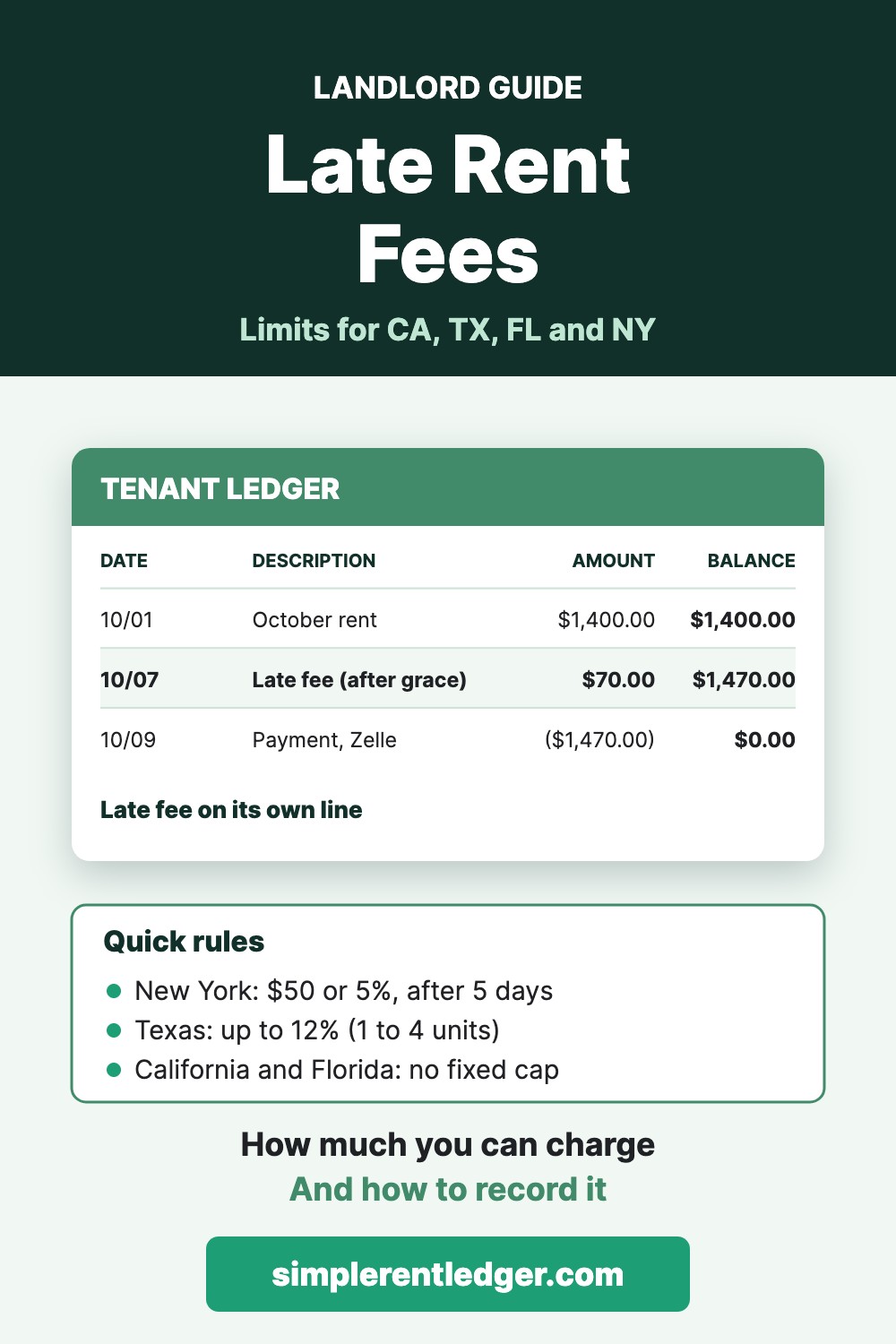
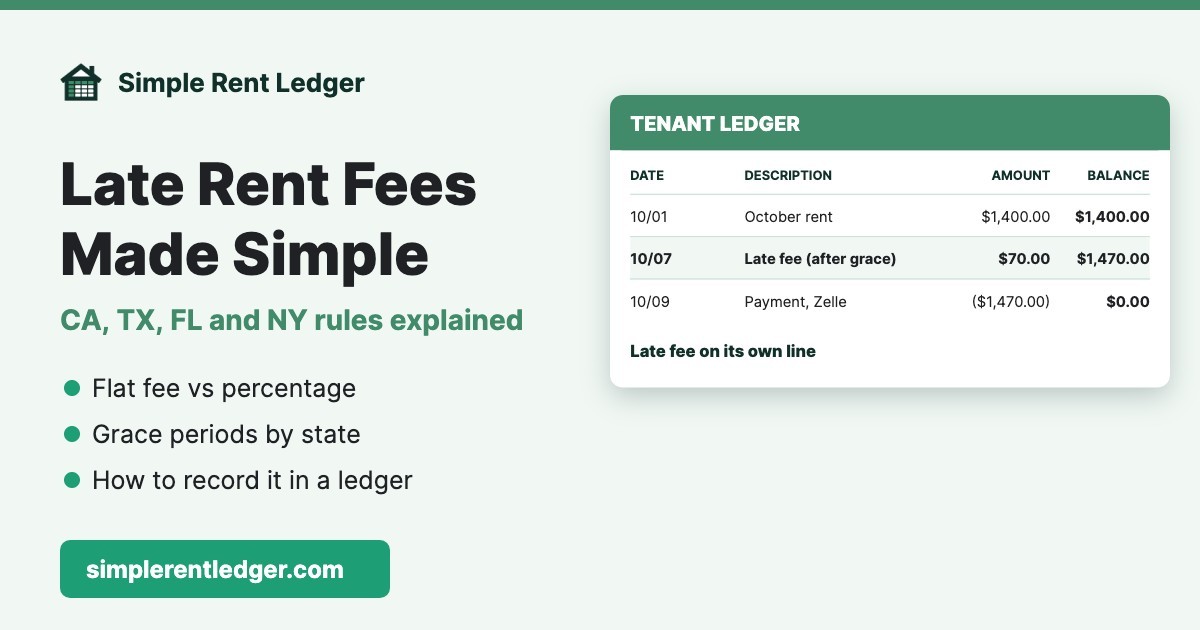
Record the late fee as its own charge line, never by changing the rent amount. That way anyone reading the ledger can see the rent, the fee and the payment separately. Here is October for a tenant with $1,400 rent, a 5 day grace period and a $70 late fee:
| Date | Description | Charge | Payment | Balance |
|---|---|---|---|---|
| 10/01/2026 | October rent | $1,400.00 | $1,400.00 | |
| 10/07/2026 | Late fee (rent unpaid after 5 day grace period) | $70.00 | $1,470.00 | |
| 10/09/2026 | Payment, Zelle | $1,470.00 | $0.00 |
When the tenant pays, give a rent receipt that splits the payment into rent and late fee. If you need a full history for one tenant, see our tenant ledger template and example. For a mid month move in, the prorated rent calculator works out the first month’s rent.
Late fee mistakes to avoid
- Charging a fee the lease does not mention. If it is not in the lease, do not charge it.
- Charging before the grace period ends. Count the days carefully, especially in New York and Texas.
- Setting the fee too high. A fee that looks like a penalty may not hold up if you ever go to court.
- Waiving it for one tenant but not another. Treat all tenants the same way to stay fair.
- Mixing it into the rent line. Keep the late fee on its own line in your rent ledger.
Note: Late fee rules change and vary by state and city. Check your current state and local rules, or ask a local attorney, before you set or charge a late fee.
Need to tell a tenant the rent is late? Use our free late rent notice template and sample letter.
Renting in California? See all the state rules in our California landlord guide.
Renting in Texas? See every state rule in our Texas landlord guide.
Renting in Florida? See every state rule in our Florida landlord guide.
Renting in New York? See every state rule in our New York landlord guide.
Frequently asked questions
Can a landlord charge a late fee that is not in the lease?
Usually no. A late fee generally has to come from the lease. Texas law, for example, requires notice of the fee in a written lease. Add a clear late fee clause before you ever charge one.
Is a grace period required?
It depends on the state. New York does not allow a late fee until rent is more than 5 days late, and Texas requires rent to be unpaid for two full days after the due date. California and Florida have no statewide grace period, but your lease can give one.
Can I charge a daily late fee?
Some leases use an initial fee plus a small daily fee. The total still has to follow your state rules. In Texas, the initial and daily fees are added together and treated as one late fee for the limit.
What if the tenant never pays the late fee?
Leave it on the ledger as an open charge so the balance stays accurate. If you decide to forgive it, add a separate line such as Late fee waived with a credit, instead of deleting the original line.
Does a rent receipt need to show the late fee?
It should. Our free rent receipt template has separate lines for rent, late fee and other charges, so the tenant can see exactly what the payment covered.