New York Landlord Guide: Deposits, Late Fees, Notices and Rent Rules (2026)
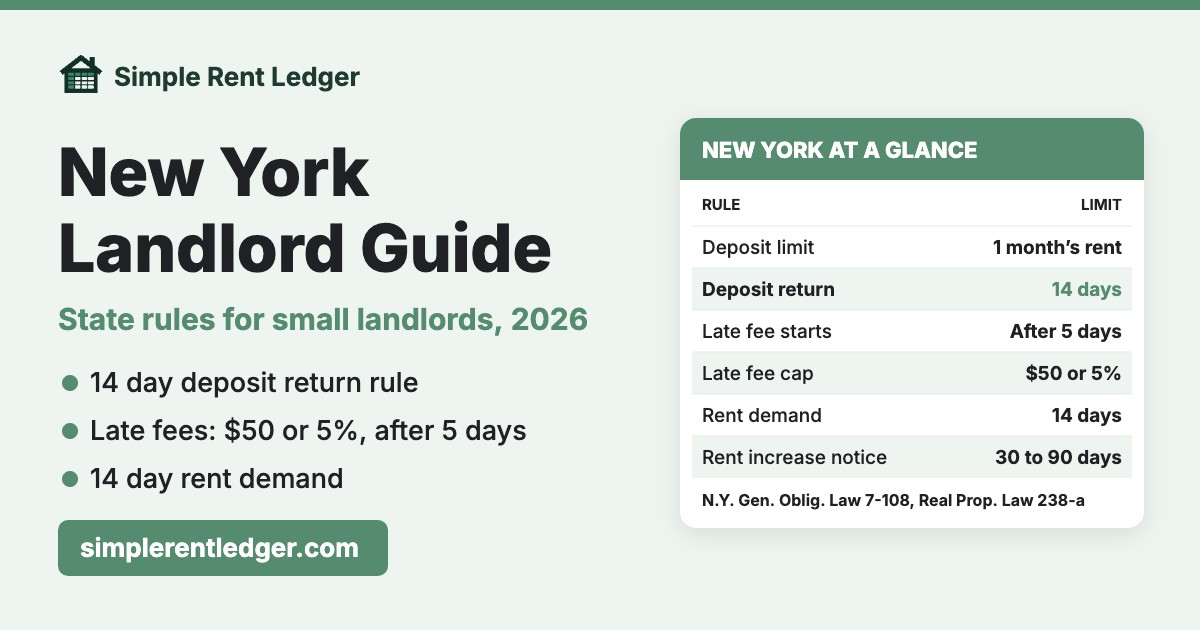
New York landlords must return the security deposit within 14 days after the tenant moves out, with an itemized statement, or they lose the right to keep any of it. Deposits are capped at one month’s rent, late fees can’t start until rent is more than 5 days late and can’t exceed $50 or 5% of the rent, whichever is less, and a nonpayment case starts with a 14 day written rent demand. Here is each rule for a small landlord, with the New York law behind it.
Check your city. New York City and other places add their own rules, such as rent stabilization and the Good Cause Eviction law. This guide covers statewide rules, plus a short section on Good Cause Eviction.
New York rules at a glance
| Topic | New York rule | Law |
|---|---|---|
| Security deposit limit | 1 month’s rent | Gen. Oblig. Law 7-108 |
| Move in inspection | Offer the tenant a chance to inspect before move in; if they ask, sign a written condition report | Gen. Oblig. Law 7-108 |
| Deposit return | Within 14 days after move out, with an itemized statement | Gen. Oblig. Law 7-108 |
| Holding the deposit | In trust, not mixed with your money; interest bearing account in buildings with 6 or more units | Gen. Oblig. Law 7-103 |
| Application fee | Background and credit check fee of $20 or the actual cost, whichever is less | Real Prop. Law 238-a |
| Late fees | Only after rent is more than 5 days late; up to $50 or 5% of monthly rent, whichever is less | Real Prop. Law 238-a |
| Late rent notice | Certified mail notice if rent is not received within 5 days of the due date | Real Prop. Law 235-e |
| Rent demand | 14 day written demand before a nonpayment case | RPAPL 711 |
| Rent increase of 5% or more | 30, 60 or 90 days written notice, based on how long the tenant has lived there | Real Prop. Law 226-c |
| Receipts | Written receipt for rent paid any way other than the tenant’s personal check | Real Prop. Law 235-e |
Security deposits and the 14 day rule
How much can you charge?
No more than one month’s rent as a security deposit or advance (General Obligations Law 7-108).
Move in inspection
After the lease is signed and before the tenant moves in, you must offer the tenant the chance to inspect the unit with you. If they ask for the inspection, you both sign a written report of the unit’s condition. You can’t later keep deposit money for any condition listed in that report.
Holding the deposit
The deposit stays the tenant’s money. Hold it in trust and keep it separate from your own funds. In buildings with 6 or more units, it must go into an interest bearing account at a New York bank, and you tell each tenant in writing the bank’s name and address and the amount (General Obligations Law 7-103). For most 1 to 4 unit landlords, the interest bearing account rule does not apply, but the trust rule does.
Before move out
Tell the tenant in writing that they can ask for an inspection before they leave. If they ask, it takes place no earlier than 2 weeks and no later than 1 week before the tenancy ends, with at least 48 hours written notice. That gives them a chance to fix problems.
Returning the deposit: the 14 day rule
Within 14 days after the tenant moves out, send an itemized statement of anything you keep and return the rest. If you miss the 14 days, you lose the right to keep any part of the deposit. You can only keep money for:
- Unpaid rent
- Damage caused by the tenant beyond normal wear and tear
- Unpaid utility charges payable directly to you
- Moving and storing the tenant’s belongings
Use our free security deposit return letter template and move out checklist, and put the 14 day deadline in your security deposit tracker on move out day.
Application fees and late fees
Application and background check fees
You can charge for a background and credit check, but no more than $20 or the actual cost, whichever is less. You must give the applicant a copy of the check and the receipt or invoice from the company that ran it, and you must waive the fee if the applicant gives you a check done within the past 30 days (Real Property Law 238-a).
Late fees
New York sets a firm limit. A late fee is allowed only when rent is unpaid more than 5 days after the due date, and it can’t be more than $50 or 5% of the monthly rent, whichever is less.
| Monthly rent | 5% of rent | Maximum late fee |
|---|---|---|
| $800 | $40 | $40 |
| $1,000 | $50 | $50 |
| $1,500 | $75 | $50 |
| $2,500 | $125 | $50 |
Show the fee on its own line in your ledger. Our late rent fee guide covers how to record it.
Notices for unpaid rent
- Day 5: if you have not received the rent within 5 days of the due date, send the tenant a written notice by certified mail. If you skip this notice, the tenant can raise it as a defense in a nonpayment case (Real Property Law 235-e).
- Rent demand: before you can file a nonpayment case, you must give a written demand for the rent with at least 14 days to pay (RPAPL 711).
Our late rent notice guide has a sample friendly reminder and the formal notice rules. Eviction cases have strict rules, so talk to a New York attorney before you file.
Rent increases and renewals
If you plan to raise the rent by 5% or more, or not renew the lease, you must give written notice (Real Property Law 226-c):
| How long the tenant has lived there (or lease length) | Notice required |
|---|---|
| Less than 1 year | At least 30 days |
| 1 to 2 years | At least 60 days |
| More than 2 years, or a lease of 2 years or more | At least 90 days |
If you give notice late, the tenancy continues on the existing terms until the full notice period has run from the day you gave written notice. New York has no statewide rent cap for most 1 to 4 unit rentals, but rent stabilized units and Good Cause Eviction areas have limits. Use our free rent increase letter template.
Good Cause Eviction
The Good Cause Eviction law took effect in New York City on 04/20/2024, and other cities and towns can opt in. For covered market rate homes, a landlord generally needs a “good cause” reason to end a tenancy, and a rent increase above the local rent standard can be found unreasonable. In New York City, that standard is 5% plus inflation, never more than 10% (NYC HPD).
Many small landlords are exempt:
- Owners who own 10 or fewer units in New York State in total
- Buildings with 10 or fewer units where the owner lives in the building
Even if you are exempt, New York City landlords must tell tenants whether the law applies when they offer or renew a lease, end a tenancy, raise the rent by more than 5% or send a rent demand. HPD has template notices. Outside New York City, check whether your city or town has opted in.
Rent receipts and records
Give the tenant a written receipt whenever rent is paid in cash, by money order or cashier’s check, or any way other than the tenant’s personal check. The receipt shows the date, the amount, the unit and rent period, and the name and title of the person who received it. A tenant who pays by personal check can ask for receipts too. Keep records of cash payments for at least 3 years (Real Property Law 235-e).
Our free rent receipt template includes every required field, and the rent ledger template keeps payments, late fees and the deposit on separate lines.
Compare with our California, Texas and Florida landlord guides.
Ending a month to month tenancy? Use our free 30 day notice to vacate.
Need to figure the interest owed? Try our security deposit interest calculator.
Frequently asked questions
How long does a landlord have to return a security deposit in New York?
14 days after the tenant moves out, with an itemized statement of any deductions. If the landlord misses the 14 days, they lose the right to keep any part of the deposit.
How much can a New York landlord charge for a security deposit?
No more than one month’s rent.
What is the maximum late fee in New York?
$50 or 5% of the monthly rent, whichever is less, and only after rent is more than 5 days late.
How much notice does a New York landlord need to raise the rent?
For an increase of 5% or more: 30 days if the tenant has lived there less than a year, 60 days for 1 to 2 years, and 90 days for more than 2 years or a lease of 2 years or more.
Does Good Cause Eviction apply to small landlords?
Often not. Owners of 10 or fewer units in New York State, and owner occupied buildings with 10 or fewer units, are exempt. It applies in New York City and places that opt in.