Massachusetts Security Deposit Law: A Landlord’s Guide (2026)
Massachusetts security deposit law (MGL chapter 186, section 15B) lets a landlord collect a deposit of no more than 1 month’s rent. You must give a signed receipt, a statement of the unit’s condition, and within 30 days a bank receipt showing the deposit sits in a separate interest bearing account at a Massachusetts bank. You pay the tenant interest every year and return the deposit within 30 days after the tenancy ends. Get a key step wrong and the tenant can sue for 3 times the deposit. Here is every rule a small landlord needs, with a timeline you can follow.
Last checked: November 2026 against MGL c. 186, section 15B, including the August 1, 2025 change on broker fees.
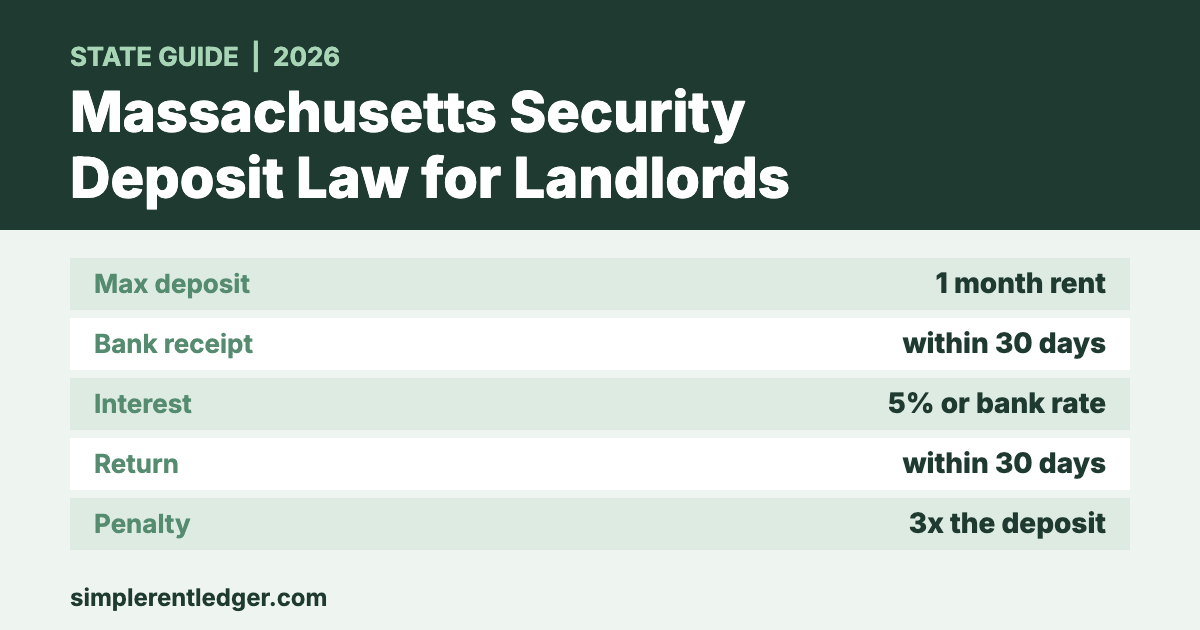
Massachusetts deposit rules at a glance
| Rule | Massachusetts requirement |
|---|---|
| Maximum deposit | 1 month’s rent |
| Other move in payments allowed | First month’s rent, last month’s rent, and the cost to buy and install a lock and key. Nothing else. |
| Receipt for the deposit | At the time you receive it, signed by the person who receives it |
| Statement of condition | When you receive the deposit, or within 10 days after the tenancy starts, whichever is later |
| Where to keep it | A separate, interest bearing account in a bank located in Massachusetts |
| Bank receipt to tenant | Within 30 days of receiving the deposit: bank name and location, amount and account number |
| Interest | 5% a year, or the lower rate the bank actually pays, at the end of each year of the tenancy |
| Return deadline | Within 30 days after the tenancy ends, with interest |
| Penalty for key violations | 3 times the deposit, plus 5% interest, court costs and attorney’s fees |
Source: MGL c. 186, section 15B. Vacation rentals of 100 days or less are not covered.
What can a Massachusetts landlord collect at move in?
Only 4 things, and each is optional:
- The first full month’s rent.
- The last full month’s rent, at the same rate as the first month.
- A security deposit of no more than the first month’s rent.
- The cost to buy and install a new lock and key.
Example: Kevin rents one side of his duplex in Worcester for $1,800 a month. At move in he can collect at most $1,800 first month, $1,800 last month, a $1,800 deposit and the actual lock cost, say $150. He cannot add a pet deposit, cleaning fee or application fee on top. After the tenancy starts, he cannot ask for rent in advance beyond the current month.
Using a broker? Since August 1, 2025, the law says no landlord or agent of the landlord may require the tenant to pay more than these 4 amounts, to the landlord or to the agent. If you hire a broker to find a tenant, plan to pay the broker’s fee yourself.
Landlord timeline: from move in to move out
| When | What you must do |
|---|---|
| The day you receive the deposit | Give a written receipt signed by the person who received it. For last month’s rent, give a receipt with the amount and the date received. |
| When you receive the deposit, or within 10 days after move in (whichever is later) | Give a signed statement of condition listing all existing damage, with the warning notice required by the law in 12 point bold type. |
| Within 30 days of receiving the deposit | Put it in a separate interest bearing account at a Massachusetts bank and give the tenant a receipt with the bank’s name and location, the amount and the account number. |
| If the tenant returns their own damage list (they have 15 days) | Within 15 days, return a copy with your signature agreeing, or attach a clear statement of what you disagree with. |
| Each year of the tenancy | Pay the interest owed on the deposit and on last month’s rent, or let the tenant deduct it from rent. |
| If you sell the building | Transfer the deposit and interest to the buyer. The new owner must notify the tenant in writing within 45 days. |
| Within 30 days after the tenancy ends | Return the deposit with interest, minus only allowed deductions, with a sworn itemized list and proof of costs. |
Track every date and payment in one place. Our free security deposit record and rent ledger template make it easy to prove what you received and when.
How much interest do you owe?
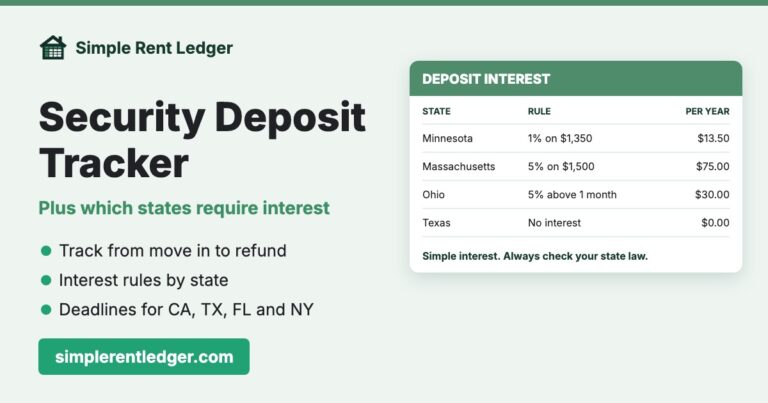
On the security deposit: 5% a year, or the lower amount the bank actually paid, once you have held the deposit for 1 year. It is due at the end of each year of the tenancy. If the tenancy ends earlier, you owe the interest that built up, within 30 days.
On last month’s rent: interest builds from the first day of the tenancy at 5% a year, or the lower rate the bank pays where you hold it. No interest builds for the final month itself.
Example: Kevin keeps the $1,800 deposit in an account that pays 0.5% a year. After the first year he owes the tenant $9.00 in deposit interest ($1,800 × 0.5%), because that is lower than 5%. If he does not pay it within 30 days of the anniversary, the tenant may deduct it from the next rent payment.
Returning the deposit and allowed deductions
Within 30 days after the tenancy ends, return the deposit with interest. You may only deduct:
- Unpaid rent or unpaid water charges.
- Unpaid property tax increases, if the lease has a valid tax escalation clause.
- A reasonable amount to repair damage caused by the tenant. Normal wear and tear is never deductible.
For damage, you must send an itemized list of damages sworn to under the pains and penalties of perjury, with written proof such as estimates, bills, invoices or receipts. No other deductions are allowed. Our security deposit return letter gives you a clear format, but in Massachusetts you also need the sworn statement.
What happens if you break the rules?
- 3 times the deposit, plus 5% interest, court costs and attorney’s fees, if you fail to keep the deposit in a separate Massachusetts account, fail to transfer it when you sell, or fail to return it within 30 days.
- You lose the right to keep any of the deposit for damage if you skip the sworn itemized list, and in the other cases above.
- Immediate return of the deposit if you don’t give the bank receipt within 30 days.
- Lease terms that conflict with section 15B are void, even if the tenant signed them.
Because the penalties are so heavy, some Massachusetts landlords collect only first month’s rent and skip the deposit altogether. That is a choice to weigh with your risk.
Bonus: Massachusetts late fee rule
The same law says a lease may not charge any interest or penalty for late rent until 30 days after the rent was due. That is a much longer wait than many states allow. To compare with other states, see our late fee laws in all 50 states. For more on setting and charging late fees, see our late rent fee guide.
This summary is based on MGL c. 186, section 15B and Massachusetts state guidance as of 2026. The law includes exact wording you must use, for example in the statement of condition, so read the statute or ask a Massachusetts attorney before you take a deposit.
Need the Massachusetts receipts? Our free security deposit receipt template (fillable PDF) has fields for the bank name, location and account number.
Need to figure the interest owed? Try our security deposit interest calculator.
Frequently asked questions
How much can a landlord charge for a security deposit in Massachusetts?
No more than 1 month’s rent. Besides the deposit, a landlord may only collect first month’s rent, last month’s rent and the cost of a new lock and key.
How long does a landlord have to return a security deposit in Massachusetts?
30 days after the tenancy ends, with any interest owed, minus only allowed deductions backed by a sworn itemized list and proof of costs.
Do Massachusetts landlords have to pay interest on security deposits?
Yes. The deposit earns 5% a year, or the lower rate the bank actually pays, paid at the end of each year of the tenancy. Last month’s rent also earns interest.
Where must a landlord keep the security deposit in Massachusetts?
In a separate, interest bearing account at a bank located in Massachusetts, not mixed with the landlord’s own money. The tenant must get a receipt with the bank name, location, amount and account number within 30 days.
What is the penalty for not returning a security deposit in Massachusetts?
The tenant can recover 3 times the deposit, plus 5% interest, court costs and reasonable attorney’s fees.