Tenant Screening Checklist for Landlords (Free Fillable PDF)
A tenant screening checklist is a short list of steps you follow for every applicant: set written criteria, collect a complete application, get consent, verify income and rental history, review credit and background reports as the law allows, then decide and document why. Below is a free fillable tenant screening checklist (PDF), the fair housing and credit report rules that apply, application fee limits in a few states, and a worked example.
Free fillable tenant screening checklist (PDF). One page: your written criteria, 10 screening steps with a done box and notes, the decision (approved, approved with conditions or denied with the reason), the adverse action notice reminder and a records section.
Fill it in on your computer or print one for each applicant.
Want more forms? Join our email list and get the free Landlord Starter Kit: the filled in example ledger, the Quick Start guide and 5 printable forms.
The tenant screening checklist: 10 steps
- Write your criteria first (income, credit, rental history, occupancy, pets) and use the same ones for every applicant.
- Give every applicant the same application. Our free rental application form is a fillable PDF.
- Make sure it is complete and signed by every adult who will live there.
- Check photo ID so you know who you are screening.
- Get written consent before you order a credit or background check.
- Charge only what your state allows for the application or screening fee, and give a receipt.
- Verify income with pay stubs, an offer letter or bank statements, and verify employment.
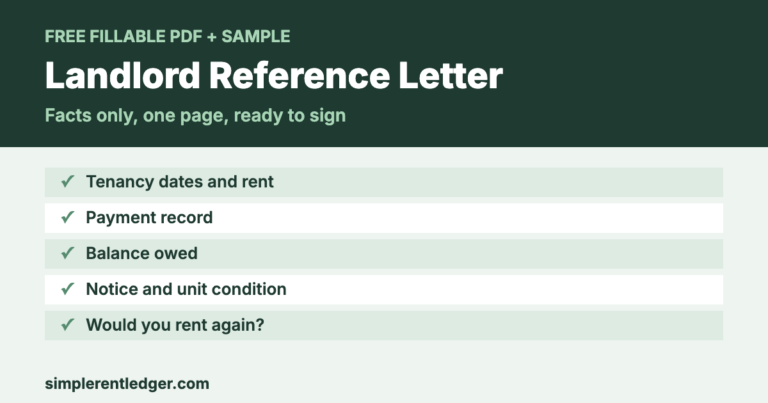
- Call a previous landlord, not just the current one, and ask the same questions for every applicant. Our landlord reference letter page shows what landlords usually share.
- Review the credit and background reports against your written criteria, as your state and city allow.
- Decide and write down why, and send an adverse action notice if a report played any part in a denial or in extra conditions.
Set written criteria before you advertise
Written criteria protect you. They make your decisions consistent and easy to explain, and some states require them. Decide each one before you list the unit:
| Criterion | What to decide | Example |
|---|---|---|
| Income | How much monthly income an applicant needs | 3 times the monthly rent (a common rule of thumb, not a law) |
| Credit | What you will and won’t accept | No unpaid debt owed to a past landlord |
| Rental history | How far back you check and what disqualifies | 2 years of history, no evictions |
| Occupancy | How many people may live in the unit | Follow your local occupancy code |
| Criminal history | Whether and how you consider it | Only as your state and city allow, written as a policy |
| Other | Pets, smoking, move in date | Pets allowed with a pet addendum |
In Texas, the law requires you to make a printed notice of your tenant selection criteria available when you give out an application. If you don’t and you reject the applicant, you must return the application fee and any application deposit (Texas Property Code 92.3515).
Fair housing rules that apply to screening
The federal Fair Housing Act prohibits housing discrimination because of race, color, national origin, religion, sex, familial status or disability. Screening is where most mistakes happen: different criteria for different people, steering, or questions you should not ask.
- Small owner occupied buildings: federal law has narrow exemptions, for example an owner who lives in a building of up to 4 units, or some owners of 3 or fewer single family homes who rent without an agent. They never cover discriminatory advertising, and state and city fair housing laws often still apply. The safe habit is to follow fair housing rules for every unit.
- More protected groups in many places. Many states and cities add protections. For example, California bars discrimination because a tenant uses federal, state or local housing assistance such as a voucher, and New York protects lawful source of income.
- Disability: a tenant can ask for a reasonable accommodation, for example an assistance animal in a building with a no pets rule. Treat it as a fair housing request, not a pet request.
- Ask the same questions of every applicant and keep the answers with the file.
Credit and background checks: the FCRA basics
The Federal Trade Commission explains how the Fair Credit Reporting Act (FCRA) applies to landlords who use consumer reports:
- Use it only for housing. Landlords may get reports on applicants and tenants for renting or renewing, or with written permission, and must certify to the reporting agency that the report is used only for that purpose.
- Adverse action notice. If you deny an application, require a cosigner or ask for a larger deposit based even partly on a report, you must give a notice. It includes the reporting agency’s name, address and phone number, a statement that the agency did not make the decision, and the applicant’s right to a free copy of the report if they ask within 60 days and to dispute anything inaccurate. If you used a credit score, the notice must also include the score and the key factors that hurt it.
- Dispose of reports securely when you are done: shred paper and make electronic copies unreadable.
Application fee rules in California, New York and Texas
| State | The rule | Law |
|---|---|---|
| California | The screening fee is capped (a base of $30, adjusted each year for inflation), may not be more than your actual out of pocket costs plus the reasonable value of your time, needs an itemized receipt, and the applicant gets a copy of their credit report. You may not charge it when you know no unit is or will soon be available. | Civil Code 1950.6 |
| New York | No fee for processing an application. A background and credit check fee is limited to the actual cost or $20, whichever is less, and must be waived if the applicant gives you a check done in the past 30 days. You must give them a copy of the results and the receipt. | Real Property Law 238-a |
| Texas | This law sets no fee cap, but you must make your printed selection criteria available with the application or refund the fee if you reject the applicant. | Property Code 92.3515 |
Other states and many cities have their own fee limits and screening rules. Check yours before you charge anything.
Example: screening one applicant
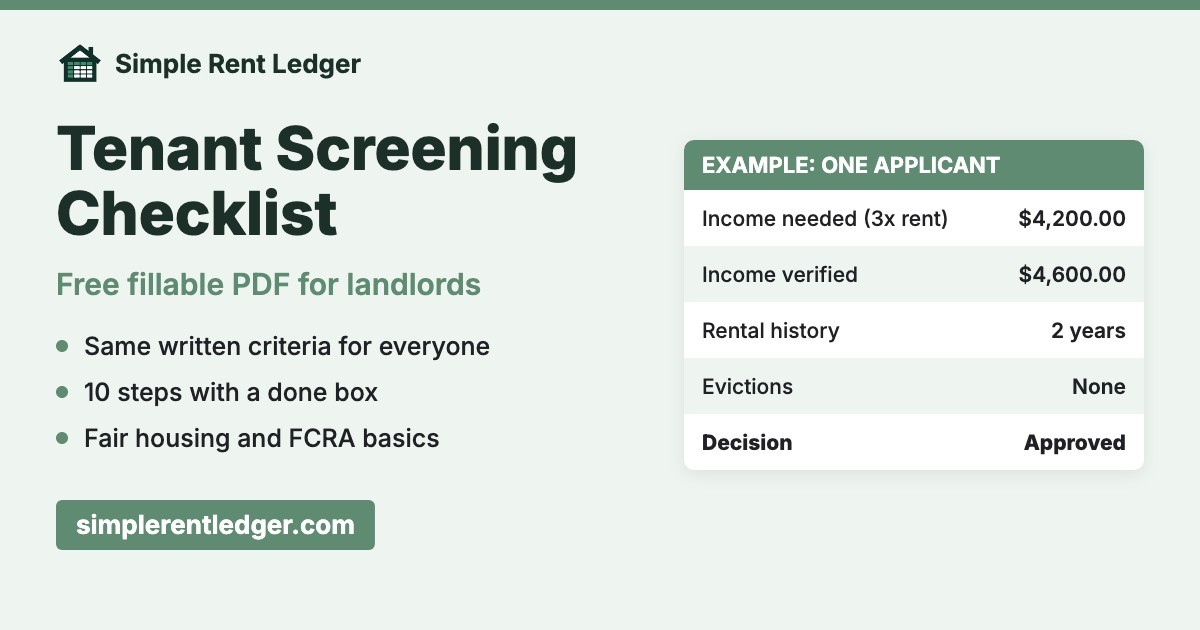
Kevin Brooks applies for 3107 Elm Creek Dr, Unit 2, Austin, TX 78745 at $1,400.00 a month. The owner’s written criteria say: income of 3 times the rent ($4,200.00 a month), no unpaid debt to a past landlord and 2 years of rental history with no evictions. Because the rental is in Texas, the owner gave Kevin the printed selection criteria with the application.
| Step | What the owner found | Meets the criteria? |
|---|---|---|
| Income | Pay stubs show $4,600.00 a month | Yes |
| Rental history | Previous landlord: 2 years, paid on time, no eviction | Yes |
| Credit | No unpaid debt to a landlord | Yes |
| Decision | Approved on 04/09/2027 | Checklist filed with the application |
Names, addresses and numbers in this example are made up.
After the decision
- Approved: sign the lease, collect the deposit, do a move in inspection with photos and start a tenant ledger on day one.
- Approved with conditions or denied because of a report: send the adverse action notice described above.
- Housing voucher holder: track the tenant portion and the housing authority payment separately with our Section 8 rent ledger.
- Keep records: the application, your criteria and the checklist in the tenant file. See how long to keep them.
Fair housing, screening and fee rules differ by state and city and change over time. Check your local law, or ask a local attorney, before you set criteria or deny an applicant.
Calling previous landlords? Use our free rental verification form (fillable PDF) so you ask every landlord the same questions.
New to renting out a property? Our guide on how to be a landlord walks through each step, with a free first time landlord checklist.
Frequently asked questions
What should be on a tenant screening checklist?
Your written criteria, a complete signed application, ID, written consent for checks, a fee within your state limit, income and employment verification, a previous landlord reference, credit and background review as the law allows, and a written decision with the reason.
How do landlords screen tenants fairly?
Write the criteria before you advertise, apply the same steps to every applicant, ask the same questions, and never base a decision on race, color, national origin, religion, sex, familial status or disability, or on any group your state or city also protects.
Do I have to tell an applicant why they were denied?
If a credit or background report played any part in the decision, the FCRA requires an adverse action notice with the reporting agency’s contact details and the applicant’s rights. Some states and cities have more rules.
How much can a landlord charge for an application fee?
It depends on the state. New York limits the background and credit check fee to the actual cost or $20, whichever is less. California caps the screening fee and adjusts it each year. Texas Property Code 92.3515 sets no cap but requires a criteria notice.
Is 3 times the rent a legal requirement?
No. It is a common rule of thumb. Whatever income standard you choose, write it down and apply it to every applicant, and follow any local rules on vouchers and other income sources.
Next step after you approve a tenant: track rent from day one with our free rent ledger template.