Florida Landlord Guide: Deposits, Late Fees, Notices and Rent Rules (2026)
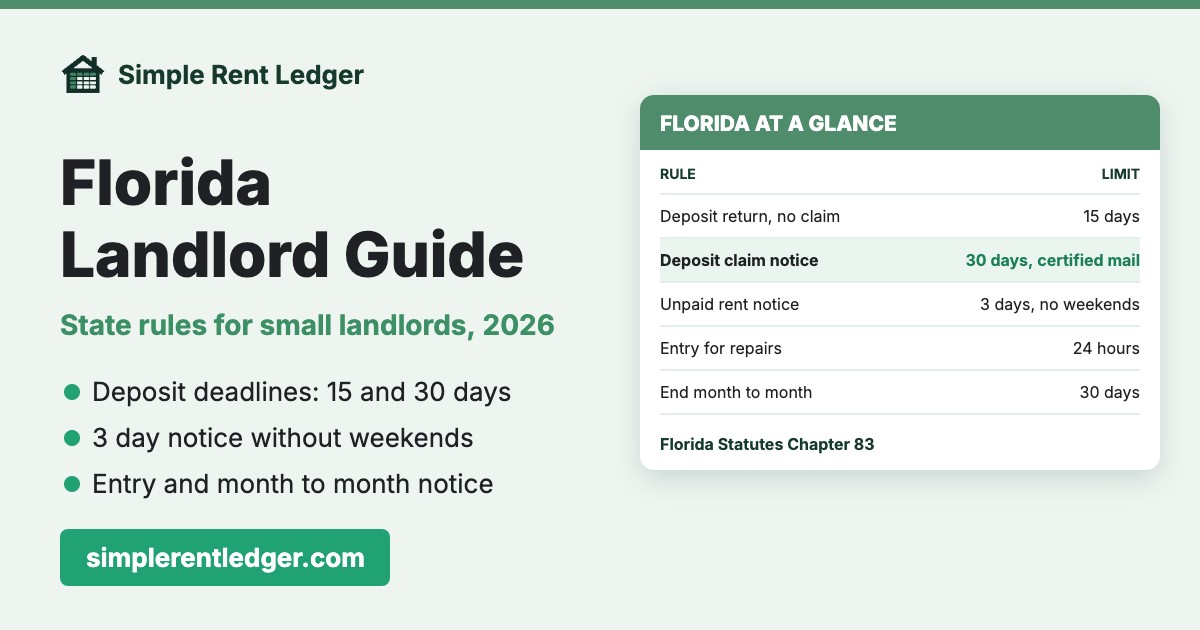
Florida landlords must return a security deposit within 15 days if they keep nothing, or send a written notice of their claim by certified mail within 30 days. Unpaid rent requires a 3 day notice that does not count weekends or legal holidays. You must give 24 hours notice before entering for repairs, and 30 days notice to end a month to month tenancy. Florida sets no cap on late fees or deposits, and state law now overrides most local landlord rules. Here is each rule for a small landlord, with the Florida Statutes behind it.
Florida rules at a glance
| Topic | Florida rule | Law |
|---|---|---|
| Security deposit limit | No state limit | Fla. Stat. 83.49 |
| Deposit disclosure | Tell the tenant in writing how the deposit is held, within 30 days of receiving it | Fla. Stat. 83.49(2) |
| Deposit return, no claim | Within 15 days after the tenant moves out | Fla. Stat. 83.49(3) |
| Deposit claim | Written notice by certified mail within 30 days; tenant has 15 days to object | Fla. Stat. 83.49(3) |
| Notice for unpaid rent | 3 days, not counting Saturdays, Sundays and legal holidays | Fla. Stat. 83.56(3) |
| Entry for repairs | 24 hours notice, between 7:30 a.m. and 8:00 p.m. | Fla. Stat. 83.53 |
| Ending month to month | 30 days written notice before the end of the monthly period | Fla. Stat. 83.57 |
| Local rules | State law preempts local landlord tenant ordinances | Fla. Stat. 83.425 |
Security deposits
Holding the deposit
Florida does not cap deposits, but it is strict about how you hold them. You can keep the money in a separate non interest bearing account, a separate interest bearing account (paying the tenant interest), or post a surety bond. Within 30 days of receiving the deposit, you must give the tenant written notice of how and where you hold it, using the wording in the statute.
Returning the deposit
After the tenant moves out you have two paths:
- Keeping nothing: return the full deposit within 15 days.
- Making a claim: within 30 days, send a written notice of your intent to impose a claim by certified mail to the tenant’s last known address, using the statutory wording. The tenant then has 15 days to object. If you miss the 30 day notice, you lose the right to make a claim on the deposit.
Florida also allows a monthly fee in lieu of a security deposit if the tenant agrees in writing, under rules added in 2023. Track every deadline with our security deposit tracker.
Late fees
Florida law does not set a cap on late fees. The fee must be written in the lease and should be reasonable; courts can refuse to enforce a fee that works like a penalty. Many Florida leases use a flat fee after a short grace period. Note that when you serve a 3 day notice, it should demand rent only, not late fees, unless your lease defines the fee as rent. See the late rent fee guide and late fee calculator.
Notices for unpaid rent
Before filing an eviction for unpaid rent, a Florida landlord must deliver a written 3 day notice demanding payment or possession. Saturdays, Sundays and legal holidays do not count in the 3 days. Before accepting a partial payment after the notice, read our partial rent payment guide, because accepting rent can waive the notice. A friendly reminder first, like the sample in our late rent notice guide, often solves the problem.
Entry and month to month notice
- Entry for repairs: 24 hours notice, and only between 7:30 a.m. and 8:00 p.m. Emergencies are the exception.
- Ending a month to month tenancy: 30 days written notice before the end of the monthly period, under the 2023 change to Fla. Stat. 83.57.
Rent increases and local rules
Florida has no statewide rent cap, and cities and counties generally cannot adopt rent control. In 2023 the state also took over the regulation of residential tenancies, which overrides most local landlord tenant ordinances. You can raise rent at the end of a lease term, or on a month to month tenancy with proper notice.
Records and receipts
Keep a rent ledger and give a rent receipt for cash payments. In a Florida eviction, a clear ledger that shows each charge, payment and balance makes your case much easier to prove.
Is air conditioning required?
No Florida statute requires a landlord to provide air conditioning. Section 83.51 lists heat during winter, running water and hot water for units other than a single-family home or duplex (unless otherwise agreed in writing), but it does not mention air conditioning. A 2026 bill that would have required cooling equipment in many rentals, SB 322, died in committee on March 13, 2026.
Two things still matter. Section 83.51 also requires you to follow the applicable building, housing and health codes, so check your city or county code. And if your lease says you provide or maintain air conditioning, your lease binds you, so repair it promptly and keep records of the repair.
Florida Chapter 83 requires specific wording in several notices. Use the statutory text or official forms, and ask a Florida landlord attorney before you file an eviction.
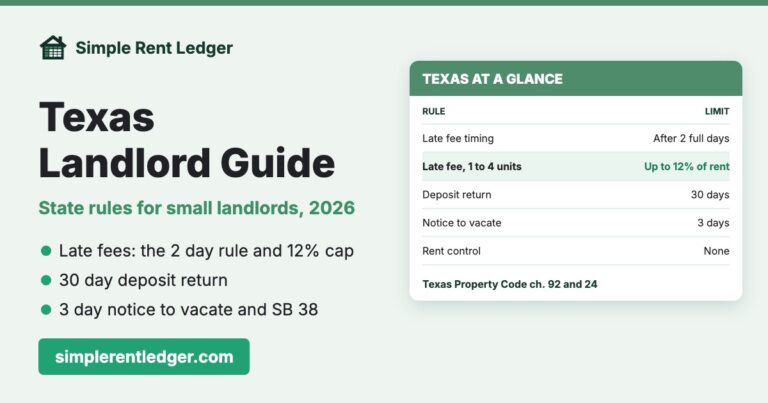
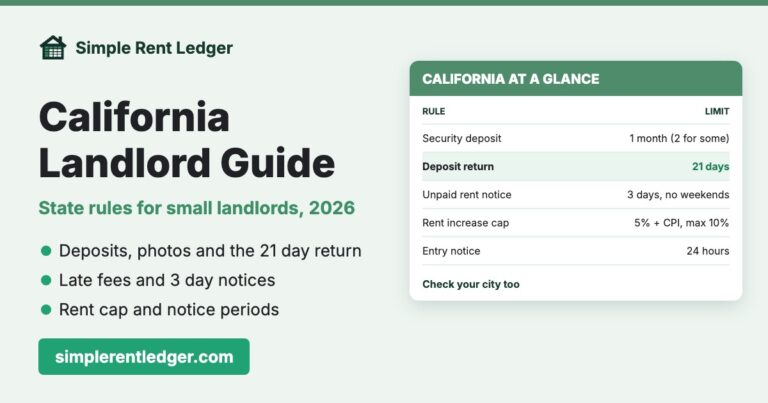
Have rentals in another state? See our California, Texas and New York landlord guides.
Raising the rent? Use our free rent increase letter template with notice rules by state.
Ending a month to month tenancy? Use our free 30 day notice to vacate.
Frequently asked questions
How long does a Florida landlord have to return a security deposit?
15 days if the landlord keeps nothing. To keep any part, the landlord must send a written notice of claim by certified mail within 30 days.
Is there a limit on security deposits in Florida?
No. Florida law does not cap the amount, but it sets strict rules on how the deposit is held and returned.
Do weekends count in a Florida 3 day notice?
No. Saturdays, Sundays and legal holidays are not counted.
How much notice does a Florida landlord need to enter?
24 hours notice for repairs, with entry between 7:30 a.m. and 8:00 p.m., except in emergencies.
How much notice ends a month to month lease in Florida?
30 days written notice before the end of the monthly period.
Do Florida landlords have to provide air conditioning?
No Florida statute requires it. Section 83.51 lists heat, running water and hot water but not air conditioning, and a 2026 bill to require cooling (SB 322) died in committee. Local codes and your lease can still require it.