Landlord Record Keeping: What to Keep and for How Long
Landlords should keep every lease, rent record, expense receipt, bank statement and tax return, plus the purchase and improvement records for each property. Under IRS guidance, most tax records should be kept at least 3 years after you file, but the records that set your property’s basis (purchase price, closing costs and improvements) must be kept until at least 3 years after you file the return for the year you sell. A simple folder system and a rent ledger make this a 10 minute monthly job.
What records should a landlord keep?
| Category | Examples |
|---|---|
| Property records | Closing statement, deed, purchase contract, appraisal, land and building split |
| Improvements | Invoices for a new roof, HVAC, windows, remodels, with dates placed in service |
| Rent records | Rent ledger, tenant ledgers, receipts given, bank deposits |
| Expenses | Receipts, invoices, credit card and bank statements, mileage log |
| Tenant files | Applications, screening reports, leases, renewals, notices, move in and out checklists and photos |
| Security deposits | Amount, date received, where held, interest paid, itemized deductions at move out |
| Taxes | Each year’s return with Schedule E, Form 4562 for depreciation, Forms 1098 and 1099 |
| Insurance and legal | Policies, claims, any court filings |
How long should you keep each type of record?
These periods follow the IRS guidance on keeping records. Your state, your lender or a court case can require longer.
| Record | Keep at least | Why |
|---|---|---|
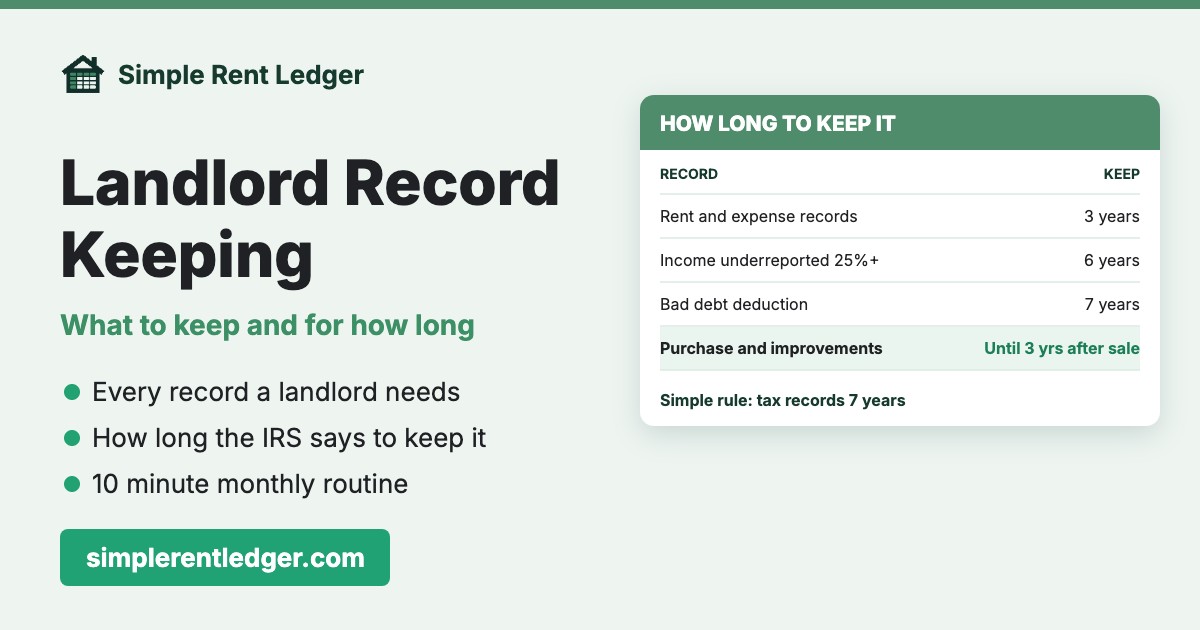
| Rent, expense and mileage records for a tax year | 3 years after you file that return | The normal period the IRS has to examine a return |
| Records if income was underreported by more than 25% | 6 years | The longer period that applies in that case |
| Records for a bad debt deduction (for example, unpaid rent you deducted) | 7 years | The special period for bad debts and worthless securities |
| Purchase, closing and improvement records | Until 3 years after you file the return for the year you sell | They set your basis, depreciation and gain on sale |
| Depreciation records (Form 4562) | Same as purchase records | Needed to figure gain and depreciation recapture when you sell |
| Leases, tenant files and deposit records | Check your state; many landlords keep them 5 to 7 years after the tenant leaves | Disputes and deposit claims can come up after move out |
Simple rule: keep yearly tax records for 7 years, and keep everything about buying and improving a property until 7 years after you sell it. It costs nothing to store files digitally, and it covers almost every case.
Free rental property record keeping template (Excel)
The easiest way to keep rental property records is one spreadsheet for the numbers plus one folder for the papers. Our free rent ledger template works as a rental property record keeping template in Excel (it also opens in Google Sheets). It has tabs for:
- Properties and Tenants: each unit, each lease and the security deposit.
- Rent Log and Tenant Ledger: every charge and payment with a running balance.
- Expenses: each receipt with its date, vendor, amount and Schedule E category.
- Mileage: trips for repairs, showings and supplies.
- Schedule E: year totals that match the lines on your tax form.
Use the spreadsheet for the numbers and the folder system below for the papers behind them, and keep both for as long as the table above says.
A simple folder system for small landlords
Rentals/
  418 Oak St/
    00 Purchase and closing/
    01 Improvements/
    02 Insurance/
    03 Tenants/
      Unit 1 Lopez/
      Unit 2 Carter/
  2026/
    Receipts/
    Bank statements/
    Rent ledger 2026.xlsx
    Tax return 2026/
  2027/
Keep property folders forever, and keep one folder per tax year for everything else. Scan paper receipts with your phone the day you get them and drop them in that year’s Receipts folder.
Rental property bookkeeping in 6 steps
Rental property bookkeeping means recording every dollar that comes in and goes out of your rental, so your records match the bank and your tax return. For a small landlord, you don’t need accounting software. IRS Publication 583 says you can choose any recordkeeping system that clearly shows your income and expenses.
- Open a separate bank account for the rental. Put all rent in it and pay all rental bills from it. The IRS tells business owners to keep business and personal accounts separate, and the same idea keeps rental records clean.
- Keep one ledger per tenant with each charge, payment and the running balance. Our free rent ledger template does this.
- Record every expense with its Schedule E category when you pay it, using the rental expense spreadsheet.
- Keep the proof. IRS Publication 583 lists supporting documents such as paid bills, invoices, receipts, deposit slips and canceled checks. Scan or photograph them into the year’s folder.
- Reconcile every month. Match the rent and expense totals to the bank statement and fix any difference right away.
- Total the year. Add up rent received and each expense category for Schedule E. See our Schedule E guide.
If you use the cash method, IRS Publication 527 says you report rent in the year you actually or constructively receive it, so record each payment on the date you receive it.
The 10 minute monthly routine
- Enter rent payments and expenses in your ledger, each expense with its Schedule E category.
- Save every receipt in the year’s folder.
- Match the ledger to the bank statement for the rental account.
- Add any notices, repairs or tenant messages to the tenant’s folder.
- Back up the folders to cloud storage.
See our rent tracking routine and the expense spreadsheet for the details.
Which records matter most at tax time?
- Total rent received, including late fees, for Schedule E line 3.
- Expense totals by category for lines 5 to 19. See the Schedule E guide.
- Mileage log with 2026’s two rates. See the mileage deduction guide.
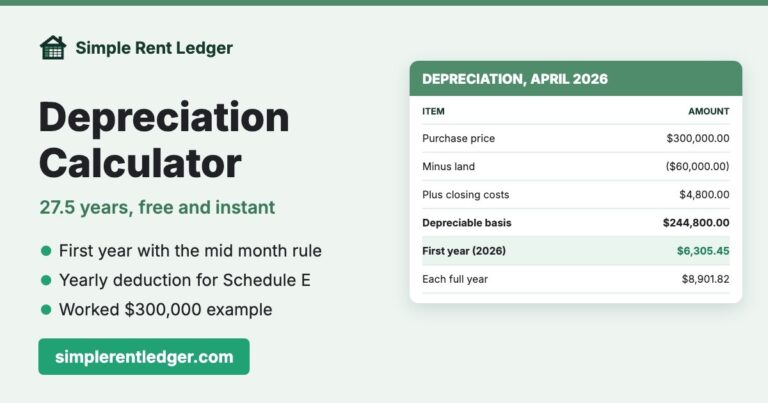
- Depreciation from your purchase and improvement records. Use the depreciation calculator.
- Forms 1098 from your lender for mortgage interest.
Record keeping periods can be longer under state law or in special situations. Ask a tax professional about your case.
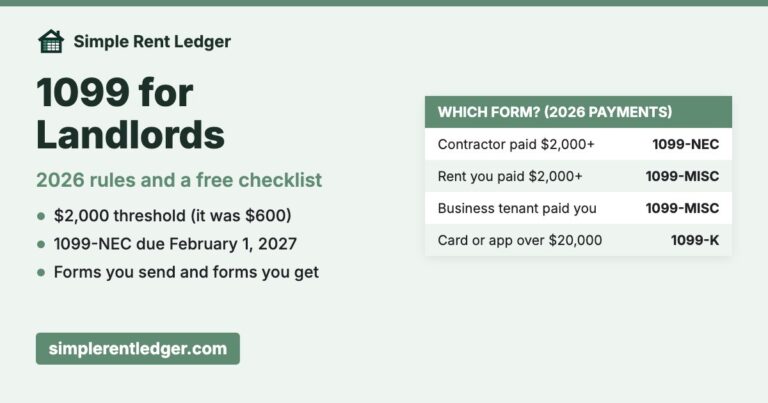
Keep the Forms W-9 and 1099 you send with each year’s records. See 1099 for landlords for which payments need one.
At year end, summarize your records with our free rental property balance sheet and income statement template (Excel).
Raising the rent? Use our free rent increase letter template with notice rules by state.
Inspecting a rental? Keep a dated record with our free rental property inspection checklist (fillable PDF).
New to renting out a property? Our guide on how to be a landlord walks through each step, with a free first time landlord checklist.
Frequently asked questions
How long should landlords keep rental records?
Generally at least 3 years after you file the tax return they support, and longer in some cases. Keep purchase and improvement records until at least 3 years after you file the return for the year you sell.
Do I need to keep paper receipts?
No. The IRS accepts clear electronic copies. Scan or photograph receipts and store them in an organized folder.
How long should I keep a tenant’s file after they move out?
It depends on your state. Many landlords keep tenant files 5 to 7 years after move out, because deposit and other disputes can come up later.
Is a spreadsheet good enough for landlord records?
Yes, for small landlords. A rent ledger plus an expense list with receipts gives the IRS what it needs: the amount, date and purpose of each item.
What is the most important record to keep?
The purchase and improvement records. They set your basis and depreciation, and you need them years later when you sell.