California Landlord Guide: Deposits, Late Fees, Notices and Rent Rules (2026)
California landlords can usually collect a security deposit of up to one month’s rent, must return it within 21 days of move out, and must take photos at move in and move out. There is no fixed cap on late fees, but they must be reasonable. Unpaid rent requires a 3 day notice that does not count weekends or court holidays, and many rentals are covered by a statewide rent cap. Here is each rule for a small landlord, with the law behind it.
Check your city too. Los Angeles, San Francisco, Oakland, San Jose, Santa Ana and many other cities add their own rent control, just cause and registration rules on top of state law. This guide covers state law only.
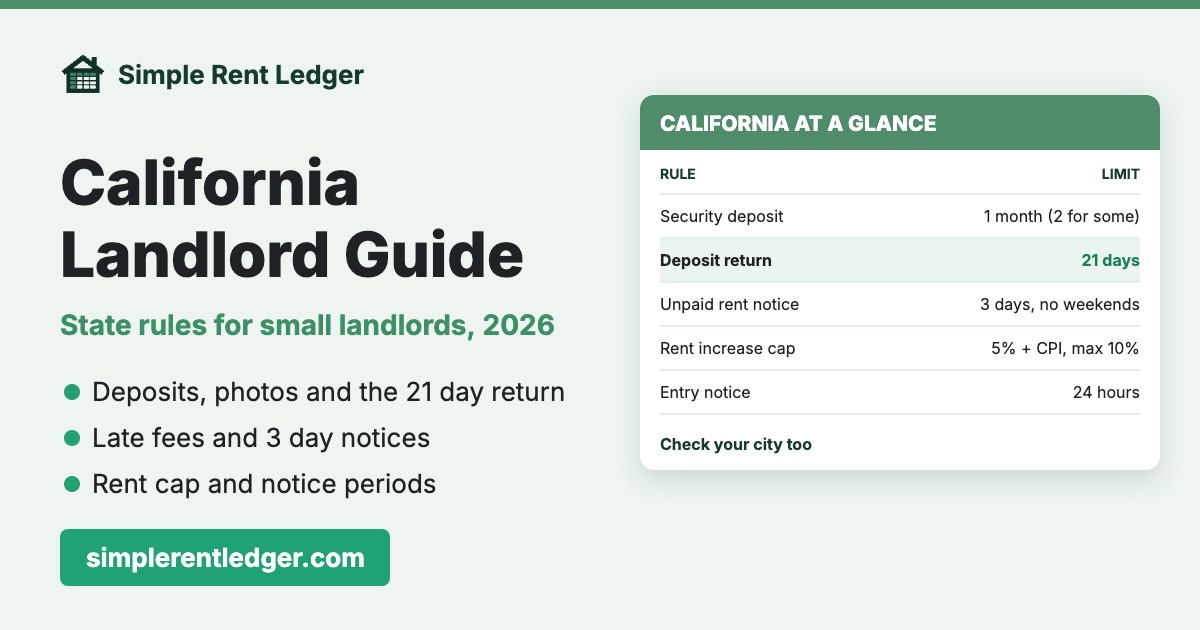
California rules at a glance
| Topic | California rule | Law |
|---|---|---|
| Security deposit limit | 1 month’s rent (2 months for some small landlords) | Civ. Code 1950.5 |
| Deposit return | Within 21 days of move out, with an itemized statement | Civ. Code 1950.5 |
| Deposit photos | At move in (tenancies from 07/01/2025), at move out, and after repairs | Civ. Code 1950.5 (AB 2801) |
| Late fees | No set cap; must be a reasonable estimate of the landlord’s costs | Civ. Code 1671 |
| Notice for unpaid rent | 3 days, not counting Saturdays, Sundays and court holidays | Code Civ. Proc. 1161 |
| Rent increase limit | 5% plus regional CPI, never more than 10% a year, unless exempt | Civ. Code 1947.12 (AB 1482) |
| Rent increase notice | 30 days (10% or less), 90 days (more than 10%) | Civ. Code 827 |
| Entry notice | 24 hours written notice is presumed reasonable | Civ. Code 1954 |
Security deposits
How much can you charge?
For deposits collected on or after 07/01/2024, the limit is one month’s rent, furnished or not. A small landlord exception allows up to two months’ rent if the owner is a natural person (or an LLC made up of natural persons) who owns no more than 2 residential rental properties with no more than 4 units offered for rent in total. A settlor or beneficiary of a family trust counts as a natural person. The 2 month exception does not apply if the tenant is a service member.
Photos are now required
Under AB 2801, landlords must photograph the unit within a reasonable time after the tenant moves out and before repairs or cleaning that will be deducted, and again after that work is done. For tenancies starting on or after 07/01/2025, landlords must also take photos immediately before or at the start of the tenancy. Keep the photos with the tenant’s file.
Returning the deposit
Return the deposit, or send an itemized statement of deductions with the balance, within 21 days after the tenant moves out. Deductions over $125 need copies of receipts or invoices. A tenant can ask for a pre move out inspection, which gives them a chance to fix problems first. Keeping a deposit in bad faith can cost up to twice the deposit in penalties. Track every step in a security deposit tracker.
Late fees
California law does not set a dollar or percentage cap on late fees. Instead, a late fee is a form of liquidated damages and must be a reasonable estimate of what late payment actually costs you. Courts have struck down fees that look like a penalty. Many small landlords stay around 5% of the rent or less and include a grace period in the lease. See our late rent fee guide and late fee calculator.
Notices for unpaid rent
Before filing an eviction for unpaid rent, a California landlord must serve a 3 day notice to pay rent or quit. Saturdays, Sundays and judicial holidays do not count toward the 3 days. The notice must state the exact rent owed (not late fees) and how and where to pay. A friendly reminder first often solves the problem. Our late rent notice guide has a sample letter.
Rent increases and the statewide cap
The Tenant Protection Act (AB 1482) limits yearly increases to 5% plus the regional change in the cost of living, and never more than 10%. Some rentals are exempt, including:
- Single family homes and condos owned by individuals (not a REIT, corporation, or LLC with a corporate member), but only if the lease includes the required written exemption notice
- Housing built in the last 15 years (a rolling window)
- Certain deed restricted affordable housing
Notice still matters even for exempt units: 30 days for an increase of 10% or less over 12 months, and 90 days for more than 10%. Add 5 days if you mail the notice.
Entering the unit
Give written notice before entering for repairs, inspections or showings. 24 hours is presumed reasonable (6 days if mailed). Entry should be during normal business hours unless the tenant agrees otherwise. Emergencies are the exception.
Rent receipts and records
If a tenant pays in cash, give a receipt. Under California law a person who receives a payment must give a receipt when asked. Keeping a rent ledger and a rent receipt for every cash payment protects you if there is ever a dispute.
What a landlord cannot do in California
California law lists many things a landlord cannot do. These are the main ones for small landlords:
| A California landlord cannot | Law |
|---|---|
| Charge more deposit than the legal limit, or keep a deposit more than 21 days after move out without an itemized statement (details) | Civ. Code 1950.5 |
| Enter without proper written notice, except in an emergency (details) | Civ. Code 1954 |
| Shut off utilities, change the locks, remove doors or windows, or remove the tenant’s belongings to force them out. The tenant can recover actual damages plus up to $100 a day, and at least $250 per violation | Civ. Code 789.3 |
| Use force, threats or menacing conduct, or threaten to report a tenant’s immigration status, to make them leave. Penalty up to $2,000 per violation | Civ. Code 1940.2 |
| Retaliate within 180 days after a tenant’s good faith repair complaint, for example by raising the rent, cutting services or evicting, when the tenant is not behind on rent | Civ. Code 1942.5 |
| End a tenancy without “just cause” after the tenant has lived there 12 months, unless the property is exempt | Civ. Code 1946.2 |
| Raise rent above the statewide cap on covered units (details) | Civ. Code 1947.12 |
| Discriminate or harass, including turning down a tenant because the rent is paid with a Section 8 voucher or other lawful source of income | Gov. Code 12955 |
Some cities, such as Los Angeles and San Francisco, add their own rent and eviction rules. Check your city too.
Mold
Since 2016 (SB 655), California law lists visible mold growth, as determined by a health officer or a code enforcement officer, as a condition that can make a rental substandard (Health and Safety Code 17920.3(a)(13)). Minor mold on surfaces that collect moisture as part of their normal use, like a shower, is excluded.
Your duty to repair mold starts once you have notice of it, and does not arise if the tenant is in violation of their own duties under Civil Code 1941.2 (Civil Code 1941.7). You may enter to fix it if you follow the entry notice rules in Civil Code 1954. In practice: answer a mold report in writing quickly, fix the moisture source, not only the stain, and keep photos and receipts.
California law changes often, and local ordinances can be stricter. Check the current statutes and your city’s rules, or ask a California landlord attorney.
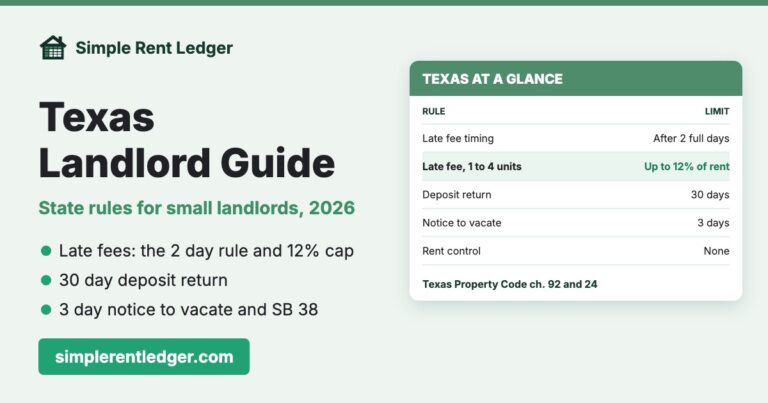
Have rentals in another state? See our Texas landlord guide.
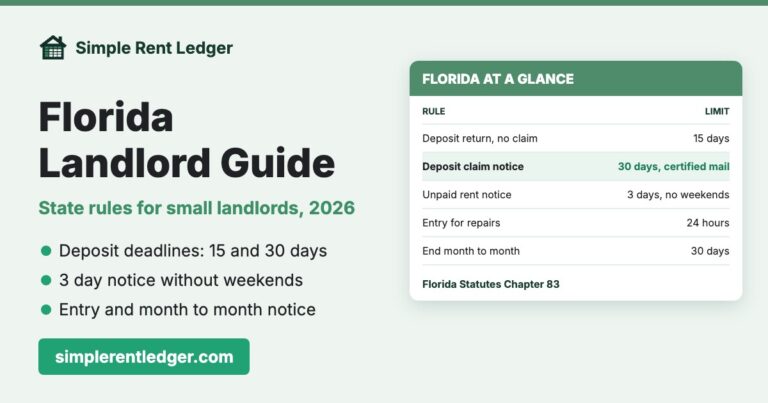
Also see our Florida landlord guide.
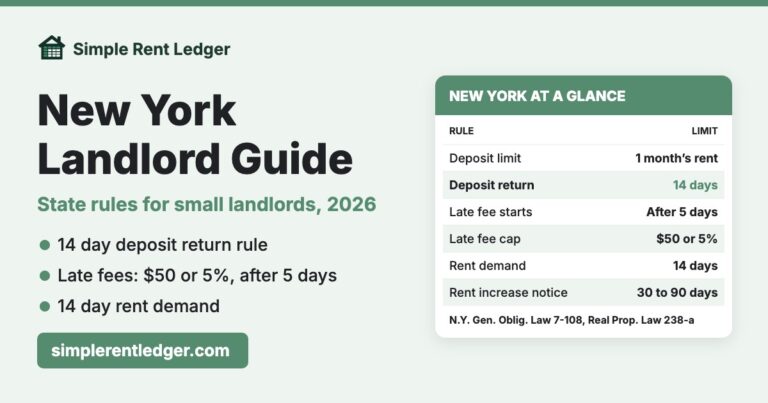
Also see our New York landlord guide.
Raising the rent? Use our free rent increase letter template with notice rules by state.
Ending a month to month tenancy? Use our free 30 day notice to vacate.
Frequently asked questions
How much security deposit can a landlord charge in California?
One month’s rent for most landlords, for deposits collected on or after 07/01/2024. Some small landlords who own no more than 2 rental properties with no more than 4 units can charge up to two months.
How long does a California landlord have to return a deposit?
21 days after the tenant moves out, with an itemized statement of any deductions.
Is there a cap on late fees in California?
No fixed cap, but the fee must be a reasonable estimate of the landlord’s costs from late payment. A fee that works like a penalty can be unenforceable.
Do weekends count in a California 3 day notice?
No. Saturdays, Sundays and judicial holidays are not counted in the 3 days.
How much can I raise rent in California in 2026?
If AB 1482 applies, 5% plus the regional cost of living change, up to 10% a year. Exempt units have no state cap, but notice rules still apply and local rent control may be stricter.
Is mold the landlord’s responsibility in California?
Visible mold growth, as determined by a health officer or code enforcement officer, can make a rental substandard, and the landlord’s duty to repair it starts once the landlord has notice of it. Minor mold on surfaces that normally get wet, like a shower, is excluded.
Sources
- California Civil Code 1950.5 (security deposits)
- California Civil Code 1947.12 (AB 1482 rent cap)
- California Civil Code 827 (rent increase notice)
- California Civil Code 1954 (entry)
- California Code of Civil Procedure 1161
- San Francisco Rent Board: security deposits (state law summary)
- California SB 655 (Health and Safety Code 17920.3, Civil Code 1941.7)
- California Civil Code 789.3 (utility shutoffs and lockouts)
- California Civil Code 1940.2 (harassment to make a tenant leave)
- California Civil Code 1942.5 (retaliation)
- California Civil Code 1946.2 (just cause)
- California Government Code 12955 (housing discrimination, source of income)