Texas Landlord Guide: Deposits, Late Fees, Notices and Rent Rules (2026)
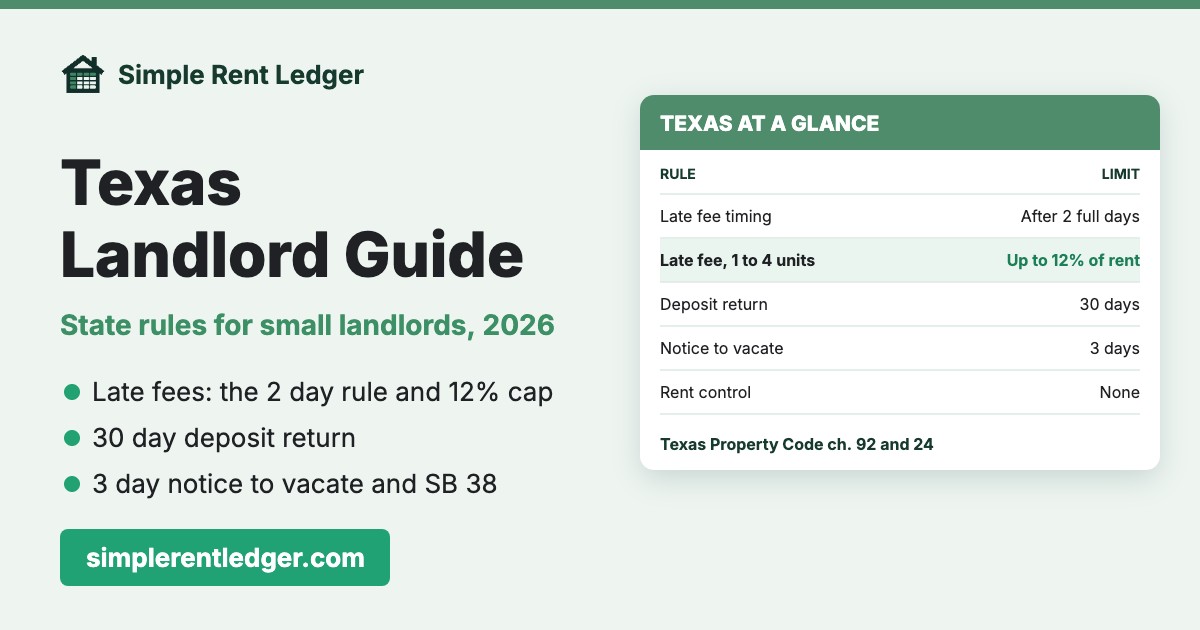
Texas landlords can charge a late fee only after rent is two full days late, and a fee up to 12% of the monthly rent is considered reasonable for a building with 4 units or fewer. There is no limit on security deposits, but you must refund the deposit within 30 days after the tenant moves out. Before filing an eviction, you generally give a 3 day written notice to vacate, and the SB 38 eviction changes apply to cases filed on or after 01/01/2026. Here is each rule for a small landlord, with the Texas Property Code section behind it.
Texas rules at a glance
| Topic | Texas rule | Law |
|---|---|---|
| Security deposit limit | No state limit | Prop. Code ch. 92, subch. C |
| Deposit return | Within 30 days after the tenant surrenders the unit | Prop. Code 92.103 |
| Late fee timing | Only if rent is still unpaid two full days after the due date | Prop. Code 92.019 |
| Late fee amount | Must be reasonable; up to 12% of monthly rent is considered reasonable for 4 units or fewer (10% for more than 4) | Prop. Code 92.019 |
| Notice for unpaid rent | 3 day written notice to vacate, unless the lease sets a different period | Prop. Code 24.005 |
| Cash rent | Give a written receipt and keep a record of cash payments | Prop. Code 92.011 |
| Rent control | None; cities cannot adopt it | Local Gov. Code 214.902 |
| Locks | Rekey within 7 days after a tenant moves out | Prop. Code 92.156 |
Late fees
Texas has one of the clearest late fee laws in the country. You can charge a late fee only if all of these are true:
- The fee is written in the lease.
- Some rent is still unpaid two full days after the date it was originally due.
- The fee is reasonable.
For a building with 4 or fewer units, a total late fee of up to 12% of the monthly rent is considered reasonable. On $1,400 rent, that is up to $168. For larger buildings the safe harbor is 10%. If rent is due on the 1st, the earliest you can charge the fee is the 4th. Use our late fee calculator and read the late rent fee guide.
Security deposits
Texas does not cap how much deposit you can charge. What matters is the return:
- Refund the deposit, minus lawful deductions, within 30 days after the tenant surrenders the unit.
- Give a written, itemized list of deductions, unless the tenant owes rent and there is no dispute about the amount.
- You do not owe a refund or the list until the tenant gives you a forwarding address in writing.
- You cannot deduct for normal wear and tear.
- Keeping a deposit in bad faith can cost $100, three times the amount wrongfully kept, and attorney fees.
Track the deposit from move in to refund with our security deposit tracker.
Notices for unpaid rent and SB 38
Before filing an eviction, a Texas landlord must give a written notice to vacate at least 3 days before filing, unless the lease sets a different period. The notice can be delivered by mail, in person to a tenant 16 or older, inside the unit in certain cases, or electronically if you both agreed to that in writing. If the tenant was not late before, the notice generally must give the option to pay the rent or leave.
SB 38, passed in 2025, changes the eviction court process for cases filed on or after 01/01/2026. It does not shorten the 3 day notice. If you get to the point of filing, use the official justice court forms and consider talking to a Texas landlord attorney. A friendly reminder first, like the sample in our late rent notice guide, often solves the problem.
Cash payments and receipts
If you accept rent in cash, Texas law requires you to give the tenant a written receipt and keep a record of the payment. A rent receipt template and a rent ledger make this easy.
Rent increases
Texas has no rent control, and state law stops cities from adopting it. You can raise the rent by any amount at the end of the lease term. During a fixed term lease, you can only raise it if the lease allows it. For a month to month tenancy, give notice at least one full rental period before the increase takes effect, unless your lease says otherwise.
Locks and safety
Texas has detailed security device rules. Among them, you must rekey the locks within 7 days after each tenant moves out, and provide working smoke alarms. These rules are in Property Code chapter 92, subchapters D and F.
What a landlord cannot do in Texas
Texas gives landlords more freedom than many states, but the Property Code still sets clear limits:
| A Texas landlord cannot | Law |
|---|---|
| Charge a late fee that is not in the written lease, is not reasonable, or comes before rent is two full days late (details) | Prop. Code 92.019 |
| Keep any of the deposit for normal wear and tear, or hold it past 30 days after the tenant leaves and gives a forwarding address. Bad faith can cost $100, three times the amount kept, and attorney fees (details) | Prop. Code 92.103, 92.104, 92.109 |
| Cut off utilities, except for bona fide repairs, construction or an emergency, or the narrow cases the law allows | Prop. Code 92.008 |
| Lock a tenant out, or remove doors, windows, locks or furnished appliances, except for repairs or under the strict lockout rules for unpaid rent. Those rules require a lease clause and advance notice, and the tenant must be able to get a new key at any hour, even without paying | Prop. Code 92.0081 |
| Retaliate within 6 months after a tenant asks for repairs, uses a legal right or complains to a code agency, for example by filing an eviction, raising the rent or cutting services | Prop. Code 92.331 |
| Ignore a repair notice for a condition that materially affects health or safety, when the tenant is current on rent | Prop. Code 92.052 |
| Refuse to rent or set different terms because of race, color, religion, sex, familial status, national origin or disability | Prop. Code ch. 301 (Texas Fair Housing Act), federal Fair Housing Act |
Texas has no statute that sets a notice period for entering the unit, so follow your lease (see Entering the unit).
Entering the unit
Texas has no state law that sets how much notice a landlord must give before entering. As the Texas State Law Library puts it, “There are no state laws that regulate landlord’s entry in Texas.” Your lease decides, so write it in: when you may enter, how much notice you will give for repairs and showings, and that you may enter right away in an emergency.
If the lease is silent, ask the tenant first except in an emergency. Entering more often than needed, at unreasonable times or against the lease can breach the tenant’s right to quiet enjoyment. Some cities add their own rules.
Texas law changes, and the SB 38 court rules are new. Check the current Property Code and your justice court’s forms, or ask a Texas landlord attorney.
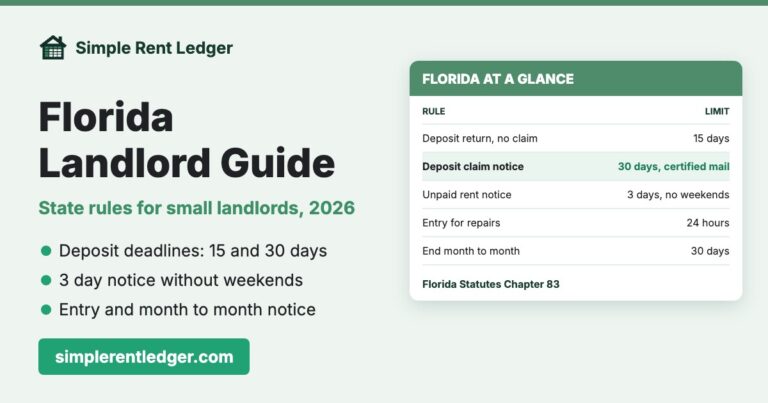
Also see our Florida landlord guide.
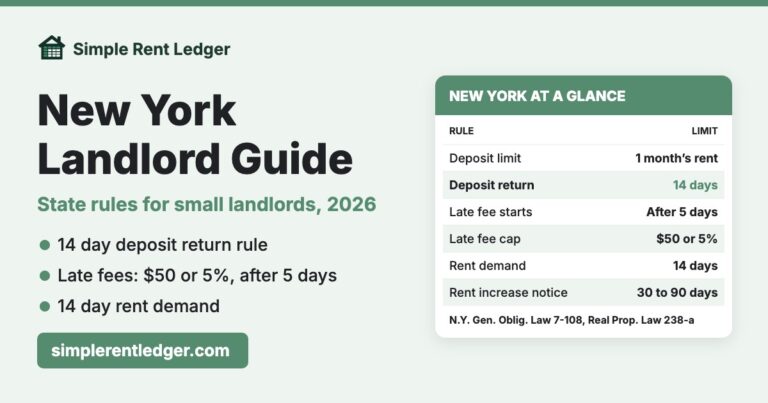
Also see our New York landlord guide.
Raising the rent? Use our free rent increase letter template with notice rules by state.
Ending a month to month tenancy? Use our free 30 day notice to vacate.
Frequently asked questions
How much can a Texas landlord charge for a late fee?
A reasonable fee, and only after rent is two full days late. For 4 units or fewer, up to 12% of the monthly rent is considered reasonable.
How long does a Texas landlord have to return a security deposit?
30 days after the tenant surrenders the unit, but the clock depends on the tenant giving a forwarding address in writing.
Is there a limit on security deposits in Texas?
No. Texas law does not cap the amount, but the lease and fair housing rules still apply.
How many days notice does a Texas landlord give before eviction?
Generally a 3 day written notice to vacate before filing, unless the lease sets a different period.
What is Texas SB 38?
A 2025 law that changes the eviction court process for cases filed on or after 01/01/2026. It does not shorten the 3 day notice to vacate.
Does a Texas landlord have to give notice before entering?
No state law sets a notice period. The lease decides when and how the landlord may enter. If the lease is silent, ask the tenant first except in an emergency.
Sources
- Texas Property Code Chapter 92 (residential tenancies)
- Texas Property Code Chapter 24 (24.005 notice to vacate)
- Texas Local Government Code 214.902 (rent control)
- Texas Property Code 92.019 (late fees), Justia
- Texas State Law Library: Landlord entry
- Texas Property Code Chapter 301 (Texas Fair Housing Act)
- HUD: Fair Housing Act overview